

History seemed to step out of text and storybooks as I travelled through a land that boasts of one of the
ancient civilisations of the world, dating back to about 7,000 years.
The Great Pyramid of Giza — the only surviving wonder of the ancient world, the tomb and treasures of
Tutankhamun, a 250km drive through a desert, ancient temples, a cruise on the Nile and a hot-air
balloon ride over the Valley of the Kings — everything seemed surreal as I soaked in the charms of Egypt.
From Cairo airport we drove straight to our hotel in Giza. In the evening, we went for a sound-and- light show. It was cold and the breeze blowing in the open area was biting but the audience was enthralled as the Sphinx narrated the history of the pyramids of Khufu (or Cheops), his son Khafre and grandson Menkaure and revealed the secrets of the ancient world.

The next day we took a daylong trip to Alexandria. One of the first things that struck me in Egypt was that the houses seemed very earthy, as if rising straight from the land.
No plaster, no paint. And the cities were no better than Indian cities. Alexandria was no different.
I was, however, quite excited to see the site of the famous lighthouse, another of the seven wonders of the ancient world, where now stands a fortress. But what really impressed me was the library. Built close to the site of the ancient bibliotheca, which was built 2,300 years ago and boasted of a grand treasure of papyrus scrolls, stands the modern one. It impresses with its architecture, vast collection of books, museums and planetarium.

(far right)
I found myself actually standing before the pyramids on Day 3 of my trip. Our first visit was to the Great Pyramid of Khufu, believed to have been constructed over 20 years from 2,580 BC. Filled with wonder, I craned my neck to see the top of the man-made mountain, which stands 139 metres high, 7.5 metres shorter that its original height! It has lost its pyramidion (capstone, which legend says was made of gold) and outer casing but is still impressive by its sheer size and by the very fact that it has stood there for more than 4,500 years, attracting visitors down the ages and from all over the world. Its feat also lies in the perfect angle at which it was built.
A short drive took us to a panoramic point from where we could see most of the nine pyramids of Giza. Another drive took us to the Sphinx, which is said to bear the face of Khafre. In front of the Sphinx is a mummification chamber. Standing there, we learnt a little about how the royals were mummified.
Next we visited perfume and papyrus shops and the Egyptian Museum, which gave us a very good insight into the old, middle and new kingdoms of Egypt. What I found amazing was the life-like eyes of statues Egyptians had made thousands of years ago. Those of Rahotep and Nofret, inlaid with crystal 4,600 years ago, are said to have scared the life out of workmen who opened their mastaba (tomb).

The museum also houses a chamber for royal mummies, including that of Ramesses II, regarded as the most powerful Pharaoh of the Egyptian empire, and the treasures found in the tomb of King Tutankhamun.
From Cairo we took an overnight train to Aswan, where we boarded a ship for a cruise on the Nile and were welcomed with Egypt’s traditional hibiscus drink. That afternoon we took a boat to Philae, a 2,400-year-old temple built on an island and dedicated to Goddess Isis. Over the next three days, we visited several other temples — Abu Simbel, Kom Ombo, Edfu, Karnak and Luxor.
We left for Abu Simbel, a 3,200-year-old temple on Egypt’s border with Sudan, at 3.35am. As we drove 260km through the Sahara, all one could see was sand and sand dunes. The sun rising on the horizon and gradually turning the sand to gold and at noon turning it into a mirage remains etched in my memory.


There are two huge rock temples at Abu Simbel built by Ramesses II to commemorate his victory over the Hittites in the battle of Kadesh. The ensuing peace treaty is said to be the world’s first. The main temple is dedicated to sun god Amun-Ra but the Pharaoh seats himself with the gods here. The second is a monument to his queen Nefertari
and is dedicated to Goddess Hator.
On our return from Abu Simbel, our ship set sail. We sat on the sun deck, watching the lush green fields on the banks of the Nile pass by. I observed farmers working in the fields, the trees, including date palms with luscious fruit hanging in exotic bunches, the movement of horse-drawn carts, fishermen rowing on the Nile, seagulls flying past and the sand dunes just beyond the green belt. As the breeze cooled my sun-soaked skin, my city-strung nerves began to relax.
As the afternoon sun cast a benign glance on the Nile, we visited Kom Ombo, a 2,000-year-old temple dedicated to Sobek, the crocodile god, and Horus, the falcon god. Besides staring wide-eyed at the decorations, as in all temples, here we learnt that Egyptians used to keep calendars and how advanced their medical knowledge was. One of the walls has engravings of surgical instruments! Here, as in other places in Egypt, is a Nilometer which was used in ancient times to measure the level of water of the Nile and, thereby, determine crops and taxes.

Next day, we crossed the Esna lock gate. Besides seeing the ship manoeuvre different water levels, I witnessed vendors in boats bargaining with guests at various levels of the ship and in the process throwing their goods with perfect aim on the top deck (fourth level) for buyers to inspect.
I shopped in Egypt for souvenirs, papyrus, Egyptian cotton and cartouche (an oval figure containing characters representing names of royals and the divine) with my name written in hieroglyph.
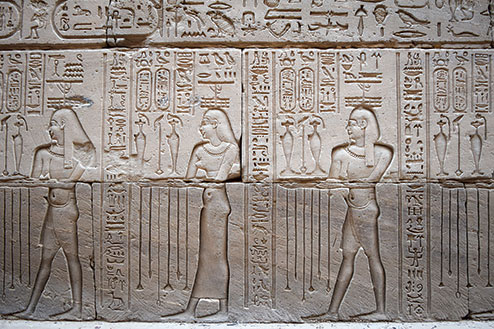
The sixth evening, our ship anchored at Luxor. Next morning, we took a hot-air balloon ride. The balloon gently lifted off the ground and as we rose to a height of 3,000 feet, we saw the sunrise — an incredible experience. Later, we visited the Valley of the Kings, built on the west bank of the Nile, where the sun sets. Besides the three tombs allowed on a ticket, I visited King Tut. The Pharaoh’s mummy, now more than 3,300 years old, and a sarcophagus lie here. His mask, the four gilded chambers and two other sarcophaguses that protected his mummy and the jewellery that covered him are kept in the Egyptian Museum. The relief and paintings in the tombs give us a good idea about ancient Egyptians’ beliefs about afterlife.

Lastly, we visited the Karnak and Luxor temples built on the east bank of the Nile at Thebes (modern Luxor). The temples impress with their colossal pillars and obelisks, especially Karnak, which is the most magnificent of Egypt’s temples. Construction had started at Karnak, said to be the largest temple complex ever built by man, about 4,000 years ago and was continued by several dynasties over 2,000 years. Luxor, also built by several dynasties, showcases Greek, Roman, Islamic and Christian influences.

All these temples and tombs, many of which were lost in the sands of time and then found again, give us a glimpse into the ancient world and yet tantalize with what they keep hidden in their heart.
How to go: There are several flights to Cairo (via Dubai, Doha, Abu Dhabi) from Calcutta and other cities in India
Where to stay: There are hotels of all budgets in Cairo, Giza and Luxor.
Pictures by Nityagopal Basu and Aditya Basu