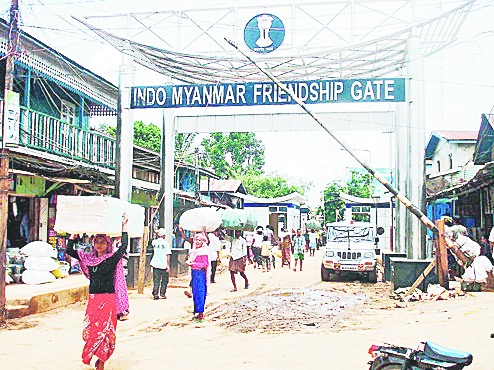

Sonahat-Biskhowa (Dhu-bri) border, Nov. 12: Border villagers, who have their lands outside the barbed wire fencing in Dhubri district, have appealed to the BSF for deploying more jawans at border gates from dawn to dusk so that they can move freely to work on their land.
At present, border gates are opened three times a day - 7am to 8am, 11am to 12am and 4pm to 5pm - which hinders farming, the villagers said.
These villagers have to show their identity cards issued by the BSF and get their names registered to work on the field outside the border fence. However, in order to come back they have to wait for the gates to open at scheduled time.
"These timings create problems for us as we have to move out to bring something or take produce back home. We cannot do so because of restriction at the gates," said Pradip Momin of Bishkhowa-Part III (Sonahat) border village, who was waiting outside the fence on his 6- bigha land for the gate to open.
Nagen Barman of Sonahat village near the BSF border outpost, who has a 3- bigha land, said they have requested the BSF officials to deploy jawans at the gate and allow them to move in and out freely but their plea was turned down.
"We have to stay outside the fence for hours even if our work is over within an hour or so," Barman added.
Like Momin and Barman, hundreds of other border villagers with land outside the fence have been facing similar problems.
Some alleged that sometimes taking advantage of poor patrolling by the BSF jawans at night Bangladeshi villagers reap their crops.
Former Golokganj legislator Dinesh Chandra Sarkar, who has land outside the fence in Bishkhowa-Lakhimari and Sonahat border areas in Dhubri district, launched an organisation - Nagarik Unnayan Manchato - to highlight the matter.
The villagers are demanding that the government, either the Centre or state, purchase these lands outside the fence to solve the problem of Bangladeshi villagers reaping the crops.
Several memorandums were submitted to the state and Union governments but till now no tangible action has been taken.
A septuagenarian villager, Satish Chandra Barman, who was one of the leaders of that movement, said it was useless to keep such land where landowners could not go and work freely.