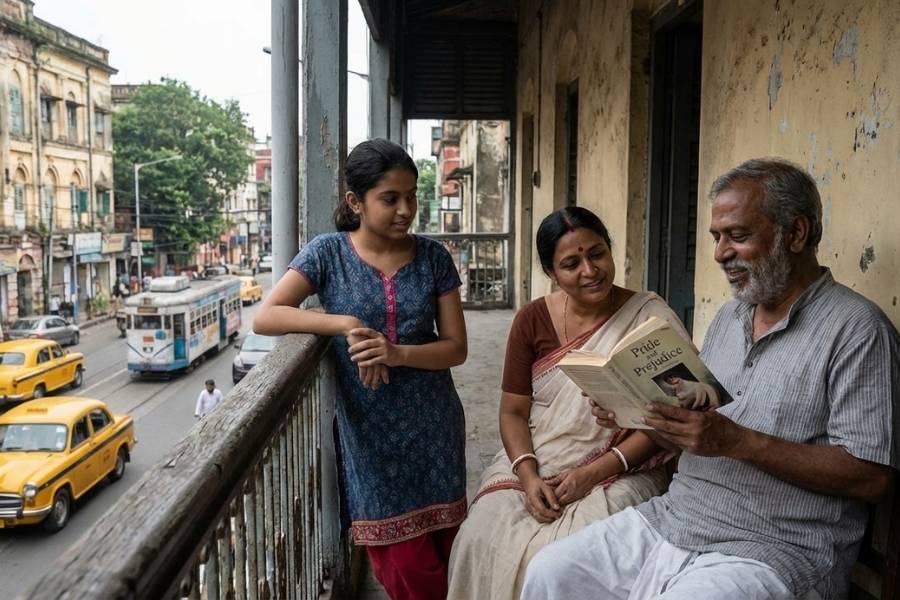
It is almost a truth acknowledged that once a reader discovers Jane Austen, it becomes almost impossible to stop them from searching every book she has ever written. Two and a half centuries have passed since the birth of one of the legendary authors in English literature, her enduring pull remains as strong as ever — even here in Kolkata.
With its culture of reading, re-reading and literary debates, Bengalis have long embraced Austen’s world of wit, quiet rebellion and restraint.
From dog-eared paperbacks passed around in families to thought-provoking discussions in college canteens and libraries, Austen’s stories continue to find resonance among Bengali readers, even today. The social codes and barriers she observed, the emotional undercurrents she explored, masked in wits and sarcasm, can be related in a culture equally attuned with the similar irony, humour and outspokenness.
As the woman from Steventon turns 250 on 16 December, My Kolkata spoke with Austen enthusiasts around the city, who reflected on why her novels still feel personal, relevant and relatable.
Relatability: The hallmark of Austen’s appeal
Her themes of money, marriage, and social expectations mirror the realities we inhabit even today. The characters resemble people we encounter in everyday life — their small joys, anxieties, and emotional negotiations feel recognisable and grounded. At the heart of Austen’s work is her exploration of human relationships — between parents and children, lovers, families, and society at large. These dynamics transcend time and geography, which is why readers in Kolkata and across India continue to resonate with her novels.
— Nishi Pulugurtha, professor of English Literature
There’s a commonality between Bengali society and the Austen’s world
The fashionable society in Austen’s novels is not very different from the society in Bengal (fashionable or not). While balls were the place to get hold of a worthy bachelor in Austen's novels, in Bengal, family gatherings and weddings are considered the most suitable places to find a match. And the all-consuming question for women over 25 is when they will get married. Of course, there are some who love to play Emma and not Jane Benett. Nevertheless, the parallels are too many to list.
— Hoimonti Banerjee, media professional and teacher
When Elizabeth Bennet meets Bijoya and Bimala
Elizabeth Bennet of Pride and Prejudice and Bijoya of Sarat Chandra’s Datta share a strong moral centre, sharp intelligence, and a refusal to submit to societal expectations. In Tagore’s Ghare Baire, Bimala also undergoes a journey of self-awareness within a strict social order. Bimala’s journey is not merely about external events but about seeing herself clearly within the pressures of a structured household and nationalist expectations. In that sense, Elizabeth stands very close to figures like Bimala or Bijoya in Bengali literature — female protagonists who learn to understand themselves before they can make meaningful choices.
— Animesh Dhara, PhD aspirant
Love, marriage, and the urge to be heard beyond social status
Jane Austen writes about love within rigid social systems, but what makes her appeal enduring is her focus on emotional understanding over material gain. Her heroines seek partners who truly understand them, not just attain social status. This closely mirrors Bengali society, where marriage often becomes a social obligation rather than an emotional choice. Across British and Bengali worlds alike, Austen shows that love, marriage, and the desire to be understood remain universal.
— Susovan Samanta, student
To read Austen tells us more about us than it does about her
My students respond to the superficialities first — the romance, the parties etc. Then they slowly begin to understand the keen ironic humour and sharp wit that is comic in every sense of the term. An author's popularity in a given cultural moment says more about the moment than it does about the author. To read and enjoy Austen tells us more about us than it does about her.
— Arjun Sengupta, professor of English Literature
Do Austen’s characters remind us of our family?
Something about the way that Austen writes, her depth of observation that captures the essence of her characters feel so real. Mrs. Norris, with her obnoxious air of self-interest, reminds me of the nosy pishis and mashis who meddle their way into their relatives’ business. Mr and Mrs. Bennet? They are the perfect examples of bickering ghoti-bangal parental duo who are constantly disagreeing with each other. Anne Elliot being unmarried at 27, becomes a let-down in her own family where her spinsterhood is considered as a major flaw to her family's societal reputation.
— Tamoha Majumdar, independent scholar
Everyday interactions in Bengali society and Austen’s world
In both Bengali households and families in Austen’s world, everyday interactions are governed by politeness, restraint, and a keen awareness of how one, especially a woman, is perceived by others. Conversations, visits, and relationships often carry meanings beyond what is openly said.
— Manisha Manna, civil service aspirant