
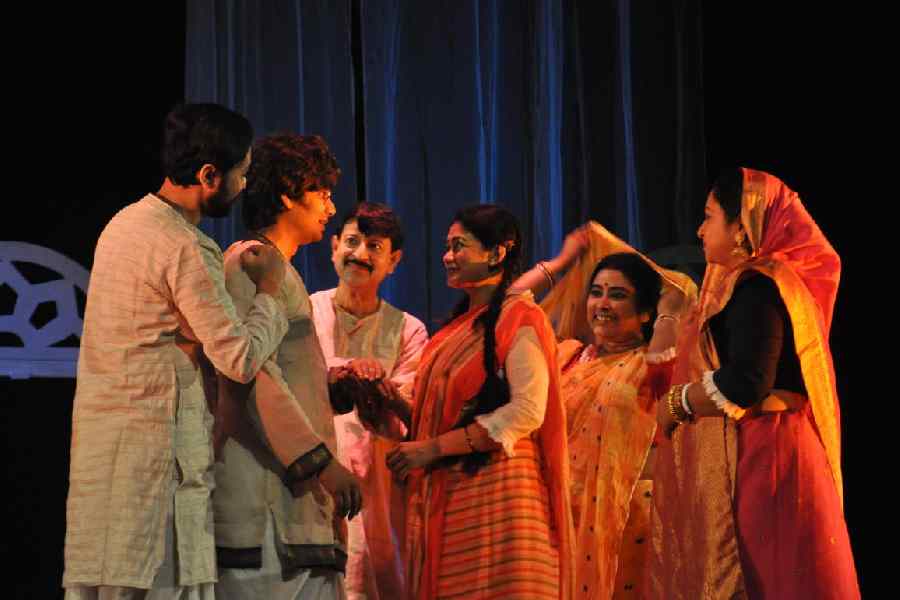
Rabindranath Tagore seems to have vanished from the Calcutta theatre scene. Barring a few attempts at staging Raktakarabi and occasional adaptations of his short stories, hardly any notable production has come up in recent years. Theatre in G Minor, a new outfit with a penchant for experimental work, deserves a pat on the back for adapting Shesh Raksha (1928) in earnest.
A light-hearted comedy with plenty of music thrown in, Shesh Raksha (picture) demands a lot of ready wit from the cast. Nibedita Bhattacharjee retains the comic flair of the original as she edits Tagore’s text to suit the ensemble. Partha Pratim Roy designs and directs a minimalist production with an eye for intimate details that highlight the otherwise relaxed tone of the drama. As the comedy of errors reaches the climax, seasoned actors like Pallab Roy and Siddhartha Chakraborty put their best foot forward to manipulate situations. Among the youngsters, Roy and Bhattacharjee, playing the romantic lead, along with four others, look promising.
Yorkshire-based Aaloran presented Prosongo: Prem on Valentine’s Day at the ICCR auditorium. Primarily a selection of scenes from Tagore’s plays and a dramatisation of his short stories, the production starts with a rather-too-tight version of Shesh Raksha that fails to create much impact. The video projections on the cyclorama look perfunctory. The production gains momentum with Dibyendu Bandyopadhyay, the director, capturing the essence of Nashta Neer and Samapti. The textual editing helps, and the actors, wearing period costumes that underline their characters’ social status, display a certain degree of maturity that is reminiscent of Satyajit Ray’s celluloid adaptations of the works.
The last — a judiciously curtailed version of Shesher Ratri — turned out to be the most satisfactory of the quartet. The rifts caused by generation gap and empathy rooted in seasoned relationships provide the ideal platform for a meditation on death. Bandyopadhyay startles with a nuanced portrayal of a patient whose health keeps failing. The embroidered quilt that covers the sick-bed becomes a character in itself. The group’s passion for asserting a cultural identity through Tagore adaptations looks poised for greater heights.