The exhibition, The Babu and the Bazaar: Art from 19th and Early 20th Century Bengal (on view at The Alipore Museum), organised by DAG and curated by Aditi Nath Sarkar and Shatadeep Maitra, reconstructs an urban milieu in which class aspiration, gender politics and the contradictions of modernity collided with theatrical force. Kalighat painting, often dismissed in its time as bazaar art, emerges here not as a minor tradition but as an incisive visual commentary on a society in rapid transition.
The show traces the medium’s evolution from scroll traditions of rural Bengal to the portable mill-paper paintings sold to pilgrims at the Kalighat temple. These works reveal a shift in economy and audience: pigments drawn from turmeric, hibiscus, conch shell and betel juice meet imported papers and, later, synthetic paints. The exhibition deftly situates these changes within Calcutta’s broader transformation into the East India Company’s “second city”, a mercantile hub where European naturalism, Indian iconography, and global trade routes converged.
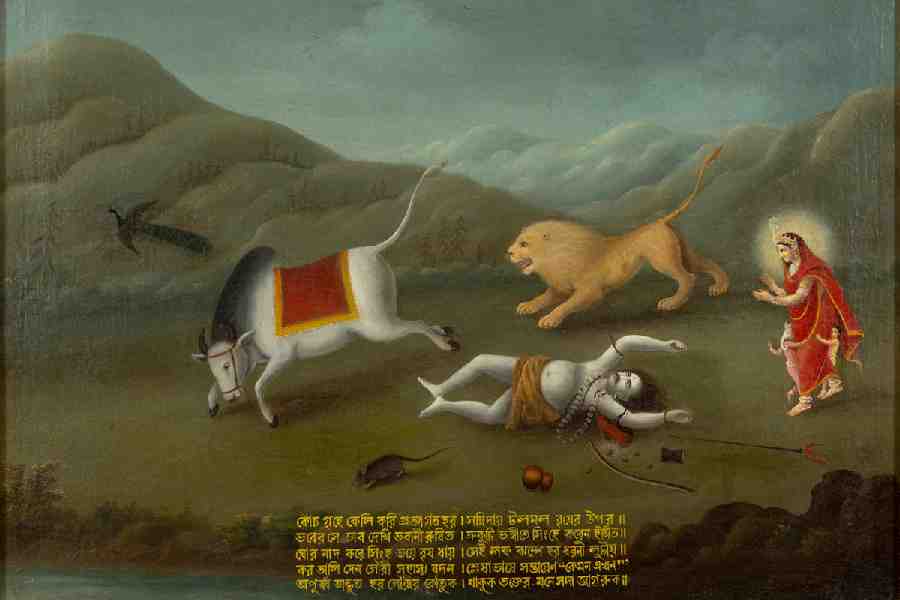
Religious imagery anchors the show; yet even these works bear the imprint of an increasingly hybrid world. Gajalakshmi, Saraswati and Dakshina Kali appear in forms that fuse Indian mythic vocabulary with new techniques of shading, foreshortening and volume inspired by British models. There is another aspect to the religious imagery that is a refreshing reminder of a culture where gods were not muscular, statuesque beings who were only to be feared — a portly Shiva and a lanky Hanuman resembling the common langur were a sight for sore eyes; Durga’s departure saw her eyes being wiped by women of the house while Shiva stood to one side with Ganesha on his hips; in a hilarious oil painting, Shiva lies sprawled on the ground after Bhabani, angry with his inebriated state, sets her lion on Nandi the bull who throws Mahadev off his back, while his wife and children stand clapping and laughing at him (picture, right). Such a loving mockery of the gods is inconceivable in New India.
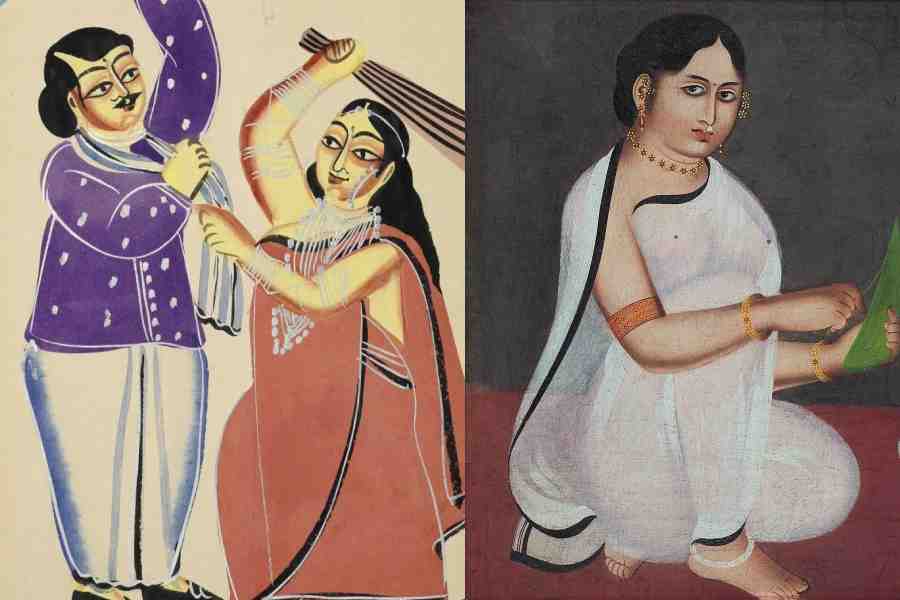
But it is the social paintings that lend the exhibition its edge. The deracinated Babu, foppish and eager to mimic European manners, receives little mercy from the patuas. Rendered in black coats, Prince Albert-style curls, and crisply pleated dhotis, he is routinely shown in postures of buffoonery or humiliation. In some works, the Bibi seizes the broom (picture, left); in others, the Sundari dominates scenes of clandestine pleasure. These images speak to a city grappling with shifting gender roles and anxieties about Westernisation.
The portrayals of the Sundari figures mirror the brutal realities for women. Many widowed women, socially abandoned after the abolition of sati, were forced into prostitution, a history subtly reiterated through the black-bordered, translucent white sari (picture, middle). The exhibition does not sensationalise this material; instead, it sets these images within a wider frame of gendered hierarchies and the voyeuristic gaze that shaped popular visual culture.
The Babu and The Bazaar succeeds not only as an archival feat but as a pointed reflection of contemporary India. The tensions that it highlights — between elite pretence and popular culture, between the gaze that objectifies and the body that resists, between imported aesthetics and indigenous expression — continue to animate debates about art, class and identity.