 |
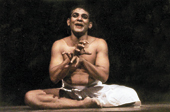
| Naturalised work: A scene from Barasat Anushilani?s Ek Rasik Daubarik |
Bengali troupes flourish in the districts like never before. Coincidentally, several of their productions seen in the metropolis of late have theatre itself as subject, almost self-referentially dealing with the actual conditions of their own activities. It hardly matters that the dramatists all happen to be from Calcutta, for the groups have naturalised the work to reflect their genuine concerns.
Barasat Anushilani?s Ek Rasik Daubarik, written and directed by Ramaprasad Banik, describes a play staged at a function in the suburbs, where things go horribly wrong as the drunken mastans take over and an innocent theatrelover-cum-gatekeeper falls martyr to the cause. We can see such incidents happening in present times. It marks a coming of age for the group, whose efforts no longer appear amateurish as they used to be. Banik?s considerable experience has honed the large cast of nearly 30 into shape.
Apparently for the first time ever, a group from Nabadwip came to town ? Tarun Natya Goshthi, with Shekhar Samaddar?s Ramani Mohan. The eponymous character is a retired female impersonator persuaded by the local club to act in a show which turns so successful that it pushes him on the road to stardom again, much to the disgust of his son who hates his father?s effeminate acting. The resulting domestic tension forms the crux of the drama, with theatre, as always, getting the raw deal. The performance of Bapi Chakrabartti (also the director) in the title role stands head and shoulders over everyone else; his falsetto voice and singing make the play an obvious vehicle for his talents.
In another tale of the vicissitudes faced by theatre workers, Gobardanga Naksa presents Lebedeff, authored by Chittaranjan Ghosh, famous for his version of Antigone. This is a biodrama about the fascinating but neglected Russian founder of Bengali proscenium theatre in 1795. Ghosh simplified Lebedeff?s highly mysterious life into a eulogy of his selfless dedication to Bengali drama, as opposed to the malicious conspiring of the British who Ghosh accuses of burning down Lebedeff?s playhouse.
Ashis Das directs another large cast ably ? despite the Europeans in their typecast red wigs ? and Ajit Saha gives Lebedeff an unimpeachably heroic personality. Besides the welcome history lesson, Das suggests a parallel with contemporary society ? that it still raises similar obstacles in theatre?s path.
The established Berhampore Repertory Theatre has chosen, quite unusually, a jatra script by the well-known Brajen De, Dharmer Bali, to commemorate the tercentenary of the naming of Murshidabad. The director, Asit Basu, has achieved something remarkable, editing the text down to a much more compact rendering that heightens the original message of Hindu-Muslim harmony in Murshid Quli Khan?s time. Urban theatre is not the only torchbearer of such sentiments, and this production should go down well in BRT?s constituency.
Basu also retains touches of jatra-esque acting to lend the style authenticity, while Pradip Bhattacharya puts in an unforgettable cameo as a no-nonsense Muslim peasant guard.