 |
 |
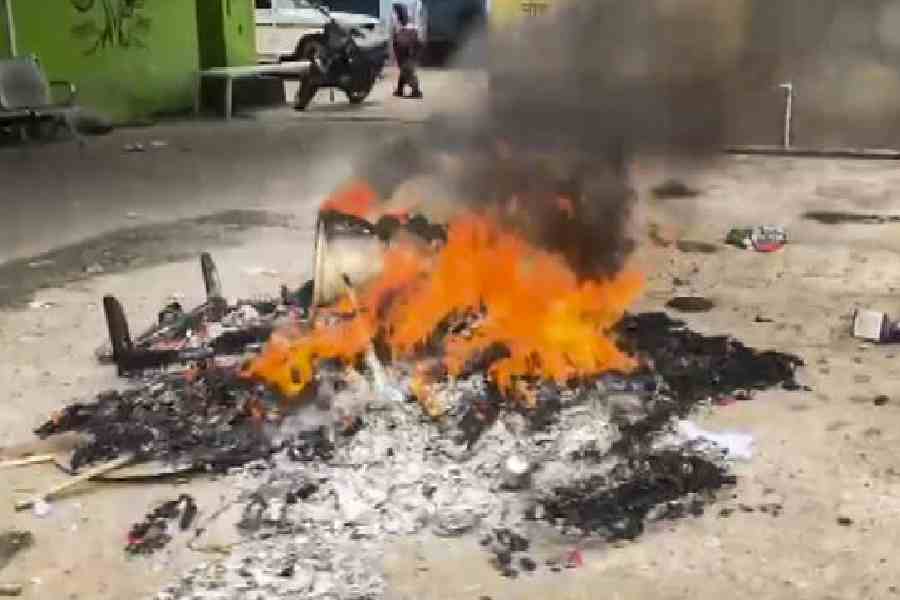
| FIRESTORM: The Godhra incident (above) and the Ghatkopar blast (top) accused were charged under POTA |
POTA is dead, but long live POTA. Nine months after the Prevention of Terrorism Act, 2002 (POTA) ? its critics call it the Production of Terrorists Act ? was repealed, there is still uncertainty about the status of scores of POTA cases lodged all over the country.
When the UPA government, on September 24, 2004, repealed the controversial POTA, it gave one year to the three Central POTA Review Committees to wind up all cases registered under the law. The committees, instituted in 2003, have to ascertain which of the cases can only be tried under POTA.
But now it seems that it will be a while before people languishing in jails under POTA know their fate. “The possibility of our committee finishing the cases on time is remote,” admits a member of the Justice Nag Review Committee.
POTA was endorsed by 10 states ? Jammu and Kashmir (J&K), Himachal Pradesh, Uttar Pradesh, Delhi, Gujarat, Andhra Pradesh, Jharkhand, Maharashtra, Sikkim and Tamil Nadu. Cases in Jharkhand are being reviewed by the Justice Nag Committee, and those in Gujarat and J&K by the Justice Jain Committee. The Justice Mehra Committee deals with the remaining seven states. The review committees are supposed to consider only the prima facie evidence provided to them by investigative agencies, though they also hear the prosecution and the counsel for the defence.
“Our purpose is to sieve out those cases where POTA may have been applied by an over-enthusiastic police force,” says the member. “Punishment under POTA is rigorous, and we have to ensure that only those who cannot be charged under the IPC or CrPC are charged with POTA,” he explains.
Jharkhand, with 147, has the maximum number of cases in the country and the largest number of accused ? 1127. On an average, a case is heard over two days but it depends on the number of accused in a particular case. After Jharkhand, the most cases are in J&K (91), followed by Andhra Pradesh (43). The 23 cases under POTA in Delhi include the high-profile Parliament attack case.
While Gujarat and Maharashtra have fewer cases registered under POTA, the number of accused in these states is surprisingly high. There are 456 accused in just 14 POTA cases in Gujarat, while, in Maharashtra, 131 people are accused in 13 cases.
This, committee members elaborate, is because the police in Maharashtra and Gujarat ? states keen to be seen at the forefront of the fight against terror ? often failed to distinguish between conspirators and normal criminals.
In the Godhra case, for instance, the Jain Committee found that a mob had been booked under POTA along with the alleged conspirators. The committee eventually concluded on June 3 this year that though the 131 accused in that case could have been charged under the IPC or CrPC, POTA was not applicable to any of them.
The indiscriminate use of POTA again came to the fore a week later, when a POTA trial court in Mumbai acquitted all the 13 accused in the Ghatkopar blasts case. The Mehra Committee had earlier considered the case and deemed the application of POTA unfit.
“These cases highlight the need for the review committees. On the other hand, if we find POTA applicable against an accused, the case against him gets strengthened,” says a member of the Mehra Committee. Another pointer to the gross overuse of POTA is the number of cases withdrawn by state governments for lack of evidence. In J&K, 41 of 416 cases initially registered were later withdrawn.
In the Godhra case, too, the government withdrew cases against eight of those initially accused, as they realised they would make a mockery of themselves before the review committee,” says Nitya Ramakrishnan, chief counsel for the defence in the Godhra case.
Of the 350 cases under POTA nationally, more than one-third are under trial and the rest under investigation. Only 22 out of the 147 POTA cases in Jharkhand are so far under trial, with more than two-thirds of the accused still absconding. In Andhra Pradesh, less than 10 per cent of the cases have reached the POTA court. The scenario isn’t different elsewhere.
“A large number of absconding accused inevitably means that several of these cases will be dropped by the investigative agencies,” says a member of the Nag Committee.
As things stand now, families of victims of terrorist attacks won’t get justice ? going by the number of cases where the police focussed more on confessions, which the POTA allows, and less on gathering evidence. Till the committees finish their work, many fear the POTA saga may be far from over.