 |
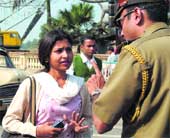
| Women friendly: The manual may teach the police to be more aware of crimes against women |
A smile breaks out on the face of 17-year-old Taruni (name changed) as she reads the section on domestic violence and sexual harassment incorporated in a new, soon-to-be-used police training manual. “Victims now may have an easier time with the police than I did,” she says.
Taruni, who was sexually assaulted by an uncle, had been turned away by the police when she approached them for help. The police refused to lodge an FIR, and instead, told her: “This happens regularly and in almost every family. Be thankful it was only someone in the family.”
However, female victims of violence expecting policemen they approach to be indifferent, unsympathetic or even hostile may soon be in for a pleasant surprise. A new manual aimed at sensitising India’s police force to gender issues has impressed women’s activists, victims, and even policemen. “This manual comprehensively sensitises police officers to gender issues and the relevant legal provisions,” says M. Ratan, director of the Andhra Pradesh Police Academy. Copies of the manual have been circulated in police academies throughout the country, and are going to be used in police training workshops before the end of the year.
The manual, developed after a year-long intensive research by the Gender Training Institute (GTI) of the Delhi-based Centre for Social Research, deals with crimes related to dowry, illegal trafficking and domestic violence. The manual, senior police officers hope, will finally help break several social stereotypes relating to crimes against women transfixed in the minds of policemen ? a demand that has been raised in the past without much success. Women activists say in the absence of police sensitisation towards women-specific crimes, the fundamental right to equality as enshrined in the Constitution remains a right only on paper.
“The law is the same for both men and women. However, if those who implement it (policemen) lack sensitivity towards women’s problems, that gets reflected in their behaviour,” says Sucharita of the Purogami Mahila Sangathan, a national women’s organisation that has been active for close to two decades.
Victims often complain that the police refuse to lodge their FIR, claiming the complaint is a non-cognisable one. Domestic violence, in particular, is dismissed as a “family matter” and policemen avoid “interference”. For instance, when Ganga, a 48-year-old domestic worker, beaten repeatedly by her husband Manoj, tried to kill herself last year, the police slapped charges of attempted suicide against her. These charges were later lifted at the intervention of a local NGO. “My husband, however, went unpunished,” Ganga says.
Incidents like these occur despite the fact that Section 498 (A) of the Indian Penal Code (IPC) states that “whosoever being the husband or the relative of the husband of a woman, subjects such woman to cruelty shall be punished with imprisonment for a term which may extend to three years and shall also be liable to a fine.” Cruelty, the Section explains, includes “wilful conduct which is of such nature as is likely to drive the woman to commit suicide,” as was the case in Ganga’s situation.
Similarly, dowry crimes and trafficking, activists feel, are often justified “subconsciously” by policemen. “It is often felt that women raped or sold brought it upon themselves by dressing, or behaving provocatively,” says Anju Dube of the GTI. The manual seeks to dispel these and other such prejudices against women. It lists common misconceptions, and then suggests various interactive exercises for the trainees. A woman who seems confused while lodging a complaint may not be prevaricating, but may be suffering from trauma, the manual says. Or one who smiles while complaining about being abused may mean that she is just embarrassed ? and not that the case is false.
These exercises involve a facilitator who relates true stories of victims, before seeking the police’s perception of the victim. The trainees are then asked to explain the reasons behind their perceptions, and through a period of discussion and debate, are sensitised.
However, Kiran Bedi, India’s best known policewoman, feels that on its own, the manual will struggle to solve problems related to the way the police treat women. Welcoming it as a significant step, she says, “The manual is a very clear roadmap which tells the trainer exactly what path he should take. However, the problem may lie not with the trainer, or the training method, but with the trainee,” she says.
Bedi explains that currently, most IPS officers “hate” to be made police trainers. “Training is considered a low designation. Therefore, most trainers are low in morale, and often may not take their work seriously enough,” she says, adding that she has raised her concerns on this issue on several occasions within the police community.
In Bedi’s own words, however, the manual is a “milestone” in gender sensitisation of the police ? a milestone that may well lead to more women walking confidently and without apprehension into police stations.