 |
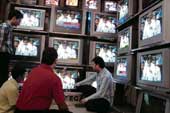
| Fair deal: Over 45 per cent of the market runs on exchange offers |
It starts every festive season and often stretches well into the new year. And if you have been planning to buy an electronic item, you couldn’t have missed the newspaper advertisements promising the best exchange deal in town. This is the season for dealers to cash in on the buying spree using their principal weapon ? lucrative exchange offers through which you can get rid of your old TV, fridge or music system and bring home a new one powered by the latest technology. But the real icing on the cake is the price that your ancient, ramshackle product with dated technology fetches in the bargain. But be warned ? in your excitement to trade your old set for a new one, you could well be settling for less.
Take Arunabha Mukherjee, for instance, who exchanged his five-year-old TV set for a brand new Sony flat screen set. The exchange price quoted to him by the dealer seemed fine and Mukherjee clinched the deal immediately. Months later, he found that another showroom was offering Rs 1,000 more for old sets. “I felt cheated,” says Mukherjee. So the primary rule is to do a thorough survey of the shops offering exchange deals.
Exchange prices vary, depending on the age, make and condition of a set. While some dealers offer a flat, uniform price, others pay more for relatively new products and for those that are in better shape. But there’s no standard rule for valuation and they depend on their own set of “experts” to do the job. Great Eastern Trading Company at Calcutta’s BBD Bag, for example, gives you a flat rate of Rs 1,500 for a running TV and Rs 1,000 for one that’s junk.
At Capital Electronics, Chowringhee, they offer a discount on the maximum retail price (MRP) and then give you an exchange price that might reduce the cost of a new TV set by Rs 4,000-Rs 5,000. “We don’t even check the old products and take the buyers’ word at face value,” says Pulak Das, senior salesman at Capital. But if you think you can’t get a better deal, keep in mind that it’s the dealer who stands to gain more. “More than 45 per cent of the market runs on exchange offers. It is an integral part of the marketing strategy, though exchange offers are made by dealers. Beyond a point, the market won’t grow unless goods are exchanged,” says Girish Rao, vice-president, marketing, at LG Electronics. Other than pushing sales, dealers also make a tidy profit by selling old products for which there is an organised system in place.
The exchanged goods make their way to second-hand shops in Chandni Market where they receive a facelift. A 21-inch colour TV comes for anything between Rs 3,000 and Rs 4,000, depending on its age and condition. “The showrooms sell each set at a profit of at least Rs 500-Rs 1,000 but our margin rarely crosses Rs 300. We have to spend on sprucing up the set to make it saleable. Also, with prices dwindling, the second-hand market has shrunk. So, while the exchange arrangement works out to the advantage of the dealers and the buyers, our profits are marginal,” claims an old TV seller at Chandni.
All these leave the consumers high and dry for there’s no standard price for old products. “Whatever you get is good for you. If your TV is less than five years old and in a running condition, you shouldn’t exchange it for less than Rs 3,000. In the case of a refrigerator, it should be Rs 2,000,” says Snehashish Bhattacharya of the trade-marketing division of Sony India. But consumers do get swayed by exchange offers and dealers take advantage of them. More than 60 per cent of old products are exchanged below this “reasonable price”.
Moreover, you won’t get cash for your old product; instead, the dealer will lower the price of the new product proportionately. Since each dealer charges a different rate, consumers have no way of finding out if the price promised to them is actually being given. For instance, a Sony flat screen 21 inch TV worth Rs 11,990 would, on an average, come to Rs 8,900 if it’s sold in exchange for an old TV set.
Now, there’s a cash discount involved in the scheme that varies and helps to cover the exchange price. The exchange price, too, is raised and lowered quite frequently depending on the demand for old sets in the market. So, even though the ads promise a uniform price, they hardly remain static for more than a fortnight. “The buyer has little choice for he can’t go around looking for the best price for his old product. To exchange it for a reasonable price is the best option and he goes for it. We have to exploit that,” explains Chatterjee.
Even manufacturers issue no guidelines to dealers on the exchange price. “We are not involved in exchange schemes. Old products come in various conditions, so the price differs for which we are not responsible,” adds Rao. Samsung India, too, follows a similar policy. “We don’t get into the nitty gritty of exchange offers. Dealers are allowed to keep a margin. So it is the buyer’s responsibility to ensure that he is getting a fair price,” says Bhattacharya. Even a consumer forum can’t help you unless the dealer refuses to pay anything for your old set. “This is entirely up to the dealer. And if there’s indeed any clandestine arrangement between dealers and second-hand shops, it is difficult to prove,” says Tamal Roy, assistant director, consumer affairs, government of West Bengal.
In such a scenario, the consumer has to be on his guard. Or else, he might have to take heart from the fact that he has been able to get rid of his old set.
exchange prices of old products
• Running TV: Rs 1500-Rs 5000 (depending on the age of the set)
• Junkset: Rs 1000-Rs 1,500
• Running fridge: Rs 1,000-Rs 1,500
• Junk fridge: Rs 500-Rs 700
• Not priceworthy: TVs with cracked pictures tubes fetch no price