 |
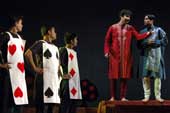
| Card play: A scene from Natyam’s Tasher Desh (Picture by Sanat K. Sinha) |
Social maladies demand ? and often bring out ? fitting responses from the stage. The best of the lot mirror social realities and evoke the horrors of contemporary life. On the other hand, the bad ones end up being half-hearted attempts at standing up for a just cause. Two recent plays in the city stood out as perfect examples in the second category, showing how socially-relevant issues can often be marred by unimaginative direction and an equally shoddy production.
Abashya Kartan, staged by Taki Natyam (Academy of Fine Arts, October 18) hinges on the familiar theme of dirty politics and how it has corrupted social life in Bengal. The local Marxist heavyweight frames an idealist doctor in a case of sleaze for personal gain. The drama, which is purely personal at this level, is handled with loud slogans, protest marches and inner-party intrigue as the backdrop.
Clearly, the ingredients of a charged political play are all there. But Abashya Kartan never manages to transcend the element of personal intrigue to tackle the larger social issues at stake. The doctor’s daughter-in-law, who is also the local MLA, remains strangely muted. She fails to tackle the rot within her party; she can’t even give adequate support to her father-in-law. The party heavyweight, supposedly a veteran of many elections, depends more on bluster than on his political cunning to carry out his plan.
One surely expects better from writer-director Ramaprasad Banik. The characters end up as broad, flat cut-outs rather than as thinking individuals. The pick of the lot is Soumen Basu’s ‘good inspector’. But the futile anger at having to fight against all odds ? facing interference from both the ruling party and the opposition ? is hardly there. The climax turns out to be the biggest let-down, with the party suddenly seeing light of day and deciding to rein in the mischief-mongers. Good improbably wins out and the ending becomes an exercise in wish fulfilment.
Natyam (no relation of the earlier group’s) addresses the problem of what constitutes true social order through Rabindranath Tagore’s Tasher Desh. The dig at state policing and its effects is too minor to be of any consequence. The actors try to give the play the feel of a costume drama by dressing up the card-characters in colourful costumes. Affectation is used both in speech and the movements of the card-characters across the stage. But affectation in speech ? which could be used brilliantly here ? often seems contrived.
The play, which revolves around the central character of the prince or Kumar (Souparna Chatterjee) who brings revolution to the land of the cards, falls flat mainly due to the actor’s insipid performance. His only saving grace is his singing. The cards play a good hand both as characters and as choral voices.
But even there the lack of coordination is jarring. The rhythmic march of the card-characters, the constant chant of their many voices speaking as one and their fixed and empty gazes are spoilt by slight aberrations. Chhaka and Panja and the other male card-characters often fall out of line when marching across the stage. Lack of synchronisation spoils what could have been a good performance.