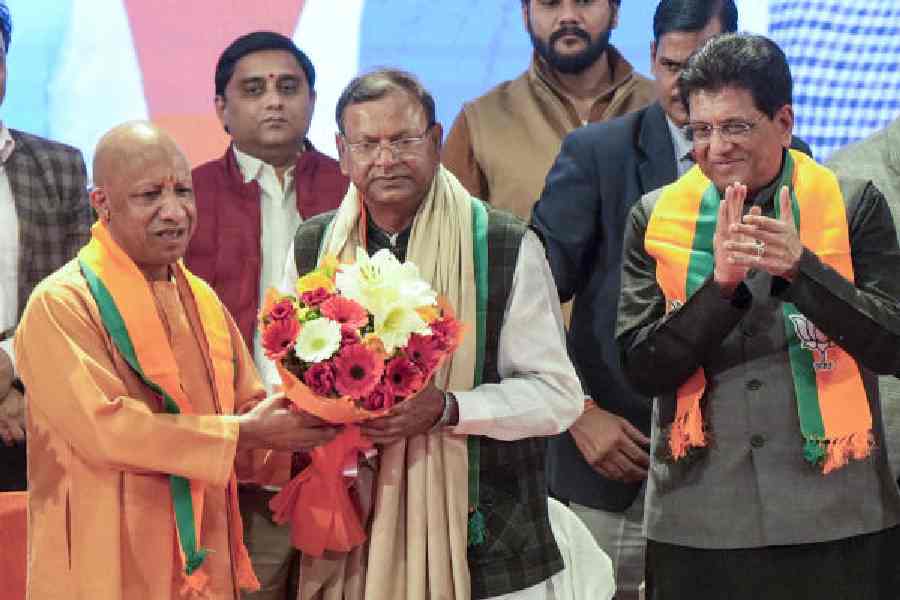
The unopposed election of Pankaj Chaudhary as the new BJP president of Uttar Pradesh threatens to affect the party’s equations with longtime ally Apna Dal (S).
Both Pankaj, Union minister of state for finance, and the Apna Dal (S) draw their strength from Kurmi votes in eastern Uttar Pradesh, and a conflict seems to be brewing in the run-up to the 2027 Assembly elections.
“The BJP allied with us only because of our Kurmi vote base but now it’s trying to build its own base (among Kurmis),” a senior Apna Dal (S) leader said, asking not to be identified. “This may confuse the voters and eventually lead to a conflict between us.”
He said his party leader Anupriya Patel, Union minister of state for health and family welfare, had “already warned the BJP against playing tricks on us”.
“We hope Chaudhary won’t try to lure away a particular caste, and that he would focus on the growth of his own party instead of trying to damage us,” he added.
The Apna Dal (S) has 13 MLAs in an Assembly of 403, and one MP out of the 80 from the state. Its Kurmi votes had smoothly shifted to the BJP in 2019 in seats that the bigger ally contested, but not in 2024.
In 2019, when the BJP contested 78 Lok Sabha seats from the state, giving only 2 to the Apna Dal (S), the two parties won 62 and 2 seats, respectively. Apna Dal (S) supporters were understood to have voted for BJP candidates in eastern Uttar Pradesh.
However, when the BJP and the Apna Dal (S) contested 75 and 2 seats in 2024, they won 33 and 1, respectively.
Most of the seats that the BJP lost, having won them five years earlier, had substantial Kurmi voters. The Samajwadi Party won from most of these constituencies.
The BJP performed below expectations in every part of Uttar Pradesh that has substantial Kurmi votes — the eastern and central regions and Bundelkhand.
The Maharajganj Lok Sabha seat, which has elected Pankaj seven times since 1991, has about 11 per cent Kurmi votes. The arithmetic is similar in Siddharthnagar, Gorakhpur, Allahabad, Mirzapur and many other constituencies in central and eastern Uttar Pradesh. Overall, Kurmis are 9 per cent of the population in eastern Uttar Pradesh.
“Kurmi votes are decisive in all the five Assembly seats in Siddharthnagar and all five in Maharajganj,” Kanhaiya Paswan, BJP district president of Siddharthnagar, which borders Maharajganj, said.
“Many districts have similar social dynamics. Caste pride is definitely going to help us in future elections because of Chaudhary’s election (as state party chief).”
Speaking in private to this newspaper, a BJP leader in Lucknow said: “The BJP has many Kurmi leaders, including Swatantra Dev Singh, the state Jal Shakti minister. But unlike Chaudhary, they have never projected themselves exclusively as leaders of the Kurmis.”
Addressing party members after his formal anointment as the state BJP chief on Sunday, Pankaj made the usual noises. “We don’t do caste politics; the BJP doesn’t belong to any particular caste,” he said.