
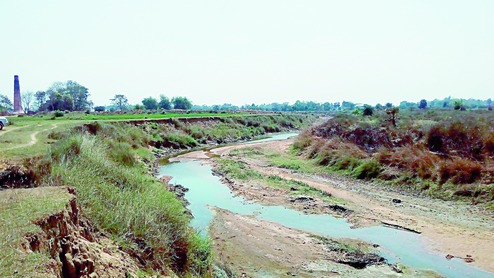

Two brick kilns mark the two ends of one of the several, continuous U-turns that the river Kopai takes as it meanders in Hanshuli Baank. They stand like two sentinels over the Kopai in Birbhum's Labhpur block. The river is in flood now.
But at the height of summer, the Kopai was just a trickle, flowing apologetically through a rough and barren stretch. The riverside at Hanshuli Baank was much busier, cluttered with stacks of freshly baked bricks. A thick pipe coiled up from the riverbed; water was being pumped up through it for one brick kiln. The riverbed was also supplying clay for making bricks.
As if on cue, a few feet from the kiln, on the adjacent bend on the left, appeared another example of a modern river-based industry. A group of men and some boys were digging into the riverbed for sand. They withdrew silently and disappeared without a trace as they saw strangers approaching.
There could not be a better demonstration of the two human interventions that are killing rivers now: brick kilns and sand-mining. In that, Kopai is not remarkable.
But the scene is quite extraordinary when we remember that the same river, around 70 years ago, was powerful enough to inspire one of the most celebrated novels in Bengali literature.
The Kopai runs through Tarashankar Bandyopadhyay's Hanshuli Baanker Upakatha (Folk Tales of the River Bend), published, according to the Bengal Publishers (Pvt) Limited edition, in July 1947 (Ashadh 1354), almost in the moment of Independence. The novel puts the area around the bends on the map, literally.
Hanshuli Baank, says Tarashankar, who used to live in his ancestral house in Labhpur, a town now and only a few kilometres away, is the sharpest of the several bends of Kopai. Hanshuli Baank took its name from " hanshuli", a collar-like neckpiece worn by a woman, and "baank" means a bend. When it rained, muddy Kopai running down from the hills shone like a golden hanshuli on the neck of a dark-skinned beauty.
"Our locality is special because of the novel it inspired," says Bahadur Bagdi, a young man studying for an MA in Bengali at Burdwan University.
He is fascinated by the novel. "There, in that ditch, Kaloshashi fell to her death," he adds, pointing at a distance. Kaloshashi was a tormented, adulterous woman in the novel. But even if she could have fallen to her death at that point, the forest around it from which she ran out does not exist.
The river, too, looks very different.
The novel, set in the 1940s - World War II has begun and Independence is looming on the horizon - is about 30-odd Kahar families living in the Hanshuli Baank village of Banshbadi. The Kahars were one of the "lower" castes whose traditional profession was bearing the palki (palanquin). When the use of palkis stopped, the Kahars were forced into farming.
The Kopai, which derives its name from "Kopavati", the wrathful woman, rules the lives of the Kahars. During the rainy season, when she is in full flood, she may, like the fierce, uninhibited Kahar women, go mad for a few days and destroy everything. But she is always fertile with sediment and yields good crops. Other than the rain months, the men battle with the soil, which is hard and unyielding like a desert.
The Kahars, however, do not matter much in the scheme of things, which is governed by landlords, or the gods. Babathakur, a vengeful, patriarchal, Brahmin demon-spirit governs the locality, and above all is Kalrudra, Shiva, the apocalyptic God of Time, whom even the Kopai obeys.
As Karali, the young Kahar to whom nothing is sacred, threatens to demolish the fragile old world, which sometimes seems held together by myths alone, by forcing into it something as banal as railroads, Tarashankar's powerful novel reveals a grand tragedy of human passions and at the same time portrays the traditional, feudal way of life crumbling before the strident march of democracy.
So it is a bit of a shock to see the mighty Kopai in summer, inert, disregarded, its bed reduced to pulp. The river was celebrated not only by Tarashankar, but also by Tagore, who apparently preferred the "small river" to the giantess Padma. Tapan Sinha made a film based on the novel.
Hanshuli Baank, which gives the area its identity and gets a mention on Google Maps, does not really exist, residents insist. The name was invented by Tarashankar for the novel, separated from which the place has no name. It is just a bend on the river.
Nor is the village Banshbadi found on any bend. Its name, too, was invented by Tarashankar, residents say.
On the face of it, Hanshuli Baank, or whatever the place is, looks as featureless as a place without a name can be, reminding one that an attempt to match the reality of a novel with the place of its origin could be a doomed project.
But in a different way, the reality, which the river reflects, mirrors the fiction.
The Kopai, despite what is being done to it now, pretty much serves the same function that it did when the Kahars changed their livelihood from bearing palkis to agriculture. It still provides the locality with its major livelihood.
The course of the Kopai has not changed, either, in the 70 years. The Kopai starts in Jharkhand and runs through most of its 110km course before it begins to meander into the tight bends after it is joined by the river Bakreswar.
It eventually falls into Langhalghata Beel, a vast waterbody, from which new streams emerge again to merge with the river Mayurakshi as its tributary. It flows past Santiniketan and is also a major tourist attraction.
Although residents of Pashchimkadipur, a large village near the bends with a small community of Kahars, practise agriculture now, the brick kilns, and to an extent sand-mining, are a much bigger draw.
The kilns are the Kopai's biggest problem, says Malay Mukhopadhyay, professor of geography, Visva-Bharati University, who had organised a research trip along the Kopai's course in the past and will organise another in December.

"The riverine environment is changing owing to human intervention. Several brick kilns have sprung up along the Kopai and they are damaging the river. The riverbed is being destroyed and the water is being drained away," he says.
The river still yields a good crop of rice, and another of mustard in winter. The floods, if they do not cross the line of danger, will help the paddy. But that does not mean much of a prospect for everyone.
Agriculture is not a viable option for most villagers, for it does not pay so much.
What Karali had ushered in has stayed on: a desire for modernity. "People are not happy with agriculture. They want other, modern livelihoods. They want out," says Bahadur. "Education has come in, but not enough. The brick kiln is an answer."
It provides day labourers - including children - with Rs 200 to Rs 300 a day. "We know this is destroying the river that is our pride, but we can't help it," says Bahadur.
The administration seems unaware of the developments. Asked about the Kopai, district magistrate of Birbhum P. Mohangandhi said: "We would definitely take action to preserve the historic Hanshuli Baank in Labhpur. I will immediately talk to local bodies as well as the BDO to repair the embankment and direct them to protect the river."
Mukhopadhyay adds that the river should be attended to for another reason: the bends are a unique geographical feature. "These, along with the literary legacy of the area, should be highlighted by the government and further damage through brick kilns and sand-mining should be stopped."
Pashchimkadipur also has certain treasures that should be preserved. Twin temples made of a black stone - called kashtipathar by the local people - with intricate carvings that look like they will crumble at the merest touch, seem to belong to the mythical time that the Kahars in the novel inhabited. Were they the temples of Kalrudra? No one knows for sure.
But Bangshibadan Das, who is almost a hundred years old, and like Bahadur, a Bagdi, clearly remembers Tarashankar as a regular visitor in the 1930s, arriving "in a taxi" from Labhpur day after day.
Bangshibadan says that Tarashankar became close to some of the villagers, including Suchandi, a woman who turns into Suchand, the keeper of stories, in the novel. He agrees that he has seen many different times and lives changing drastically, but his voice trails off. He is himself a bit like Suchand, his eyes resting on a grander sweep of time. He accepts change as inevitable.
The Kahars live further inside the village. Bearing the surname Bauri now, men and women sit in small clusters under trees in the afternoon sun. They identify a tree - a little uncertainly - as Babathakur's seat, where the demon-spirit lived, but the tree is ashwattha (peepal), not the imposing banyan where the killing of a giant snake, Babathakur's pet, had unleashed a disastrous course of events in the novel.
Standing in front of the two temples, a young man from the locality asks a desperate question. He says he is a "CSP" (customer service point) operator for a government bank, manning kiosks set up for the bank to talk about its services, but his commission rate has been slashed to 3 per cent from a double-digit figure. Can the visitors from the city help him?