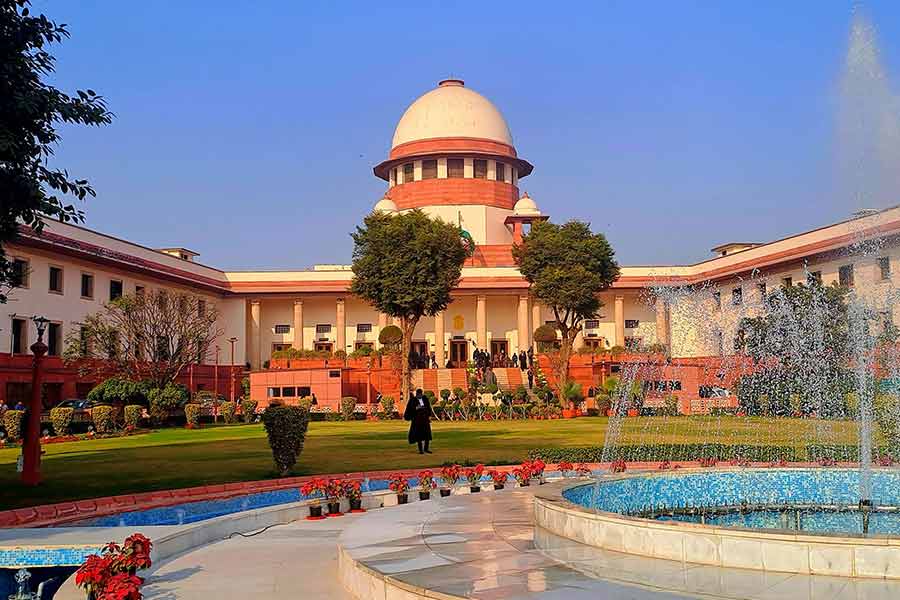
The Union government on Wednesday agreed to bring back a pregnant woman who had been deported to Bangladesh earlier this year, along with her eight-year-old son. The decision followed a push from the Supreme Court, which observed that the case required humanity to take precedence over technicalities.
After noting the Centre’s undertaking the court ordered that she receive immediate medical care and be allowed to stay near her family in West Bengal.
A bench comprising Chief Justice Surya Kant and Justice Joymalya Bagchi directed the West Bengal government to take care of the minor and instructed the chief medical officer of Birbhum district to extend all necessary medical support to Khatun—including “free of cost delivery”.
The court recorded the submission of Solicitor General Tushar Mehta, appearing for the Centre, that the competent authority had agreed to allow the woman and her child into India “purely on humanitarian grounds without prejudice to rights and contentions”, adding that the duo would be kept under surveillance.
The apex court was hearing the Centre’s appeal against the Calcutta High Court’s September 26 judgment, which had set aside the government’s decision to deport Khatun and others to Bangladesh and termed the action “illegal”.
The Supreme Court said they would eventually be taken back to Delhi, from where they were initially picked up and deported.
However, senior advocates Kapil Sibal and Sanjay Hegde, representing Khatun’s father, urged the bench to allow her and the child to be brought to their home district, Birbhum in West Bengal, where her family resides.
They also told the court that other members, including Khatun’s husband, remain stranded in Bangladesh and sought directions for their return as well.
Mehta opposed these claims, maintaining that the Centre would contest their assertion of being Indian citizens. He reiterated that the authorities considered them Bangladeshi nationals and that their return was permitted solely on humanitarian grounds. Justice Bagchi observed that if Khatun could prove she was the daughter of Bhodu Sheikh, “then it would be sufficient to establish her Indian citizenship.”
The matter will be heard next on December 10.
Khatun’s father has alleged that the families, who had been working as daily wage labourers in Sector 26 of Delhi’s Rohini for over two decades, were detained by police on June 18 on suspicion of being Bangladeshis and subsequently pushed across the border on June 27.
On December 1, the Supreme Court had asked the Centre to consider allowing the woman and her child to re-enter India while keeping her under “surveillance”.
The court had also directed the Solicitor General to seek instructions on facilitating her entry through the Indo-Bangladesh border at Malda, West Bengal.
Hegde informed the bench that the woman and others were waiting at the Bangladesh side of the border, adding that “their deportation to Bangladesh has been held illegal and they are Indian citizens.”
The Calcutta High Court’s September 26 order had quashed the deportation of Khatun and Sweety Bibi—both residents of Birbhum—along with their families, calling them “illegal immigrants”. It directed the Centre to bring the six deported individuals back to India within a month and declined to stay its order.
The high court issued two orders in response to habeas corpus petitions filed by Bhodu Sheikh and Amir Khan. Sheikh said his daughter, her husband Danesh Sheikh and their five-year-old son had been detained in Delhi and pushed into Bangladesh. Khan made a similar allegation regarding his sister Sweety Bibi and her two children. The deportees were reportedly arrested by Bangladesh police.
In its affidavit before the high court, the Centre stated that the FRRO, Delhi, acting as a civil authority, had been repatriating illegal Bangladeshi migrants under a May 2, 2025 memo issued by the Union home ministry.
The memo outlines the protocol for deporting Bangladesh/Myanmar nationals staying without authorisation, requiring an inquiry by the concerned state or Union territory before initiating deportation.
However, the high court criticised the authorities for violating these procedures, observing that “the proceeding for deportation was conducted in hot haste” and noting that “the detainees have their relations residing in the State of West Bengal...the kind of overenthusiasm in deporting the detainees, as visible herein, is susceptible to misunderstanding and disturbs the judicial climate in the country.”