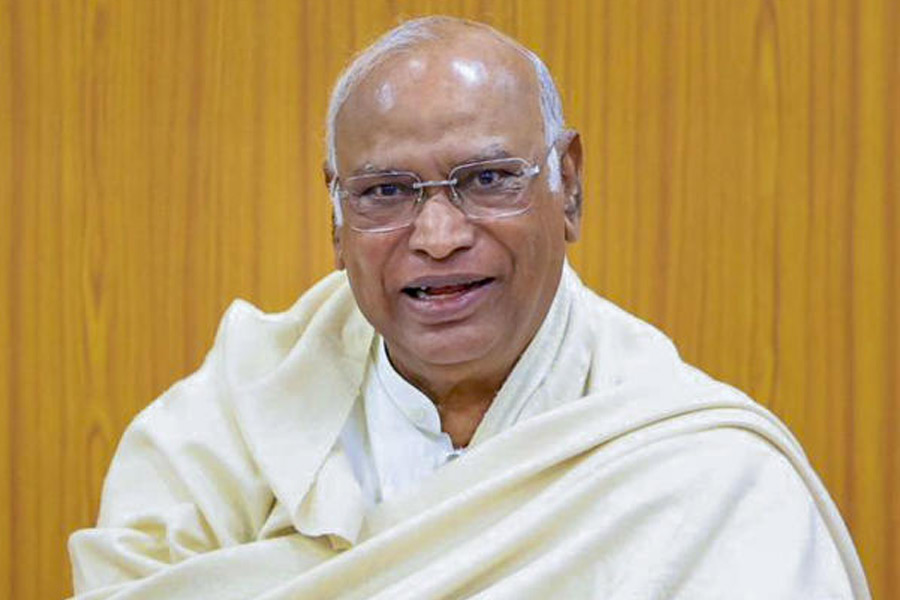
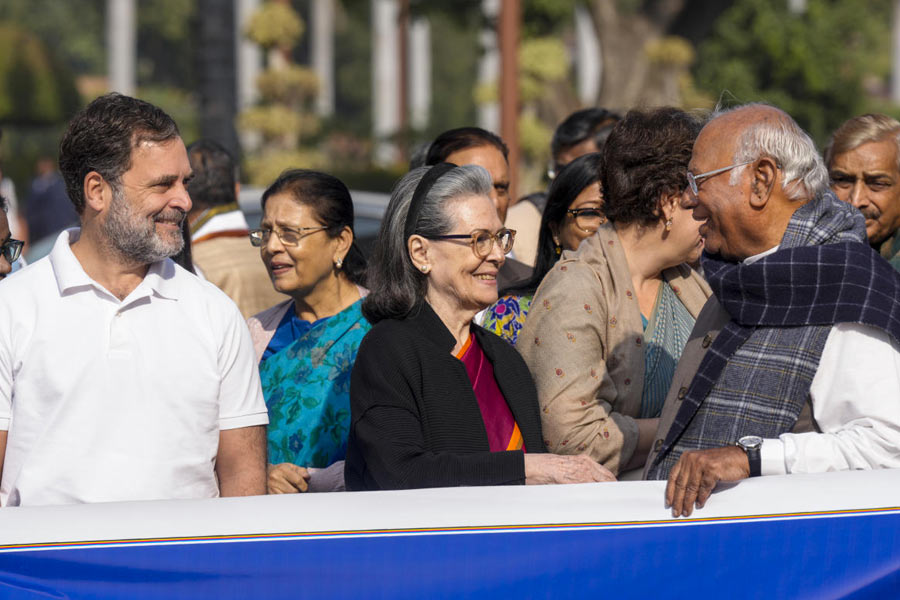
The Narendra Modi government is “anti-labour, anti-worker and” pro-crony capitalists, Congress president Mallikarjun Kharge alleged on Wednesday after his party members joined other Opposition MPs at a protest in the Parliament premises against the new labour codes.
In a detailed post on X, Kharge detailed the Congress charge against the Modi government.
He outlined what he called the threat to job security, problems with working hours and shifts, weakened trade unions and collective rights, weakened safety and welfare and other concerns.
“Layoff threshold raised from 100 to 300 workers i.e. more than 80% of factories in India can now lay off or retrench workers without government approval, reducing job security,” Kharge wrote.
“Expansion of Fixed Term Employment (FTE) will end many permanent jobs. Companies can now hire workers on short-term contracts, avoiding long-term benefits.”
On working hours, he said, “Although the Code keeps an 8-hour day on paper, states can allow 12-hour shifts through flexible scheduling. Coupled with state-determined overtime limits, this effectively permits much longer workdays, increasing fatigue and safety risks even when labelled “consensual.”
“Weakened Trade Unions and Collective Rights: Workers must wait 60 days before striking, plus a 14-day cooling-off period,” he wrote.
“This prevents quick action against unsafe or unfair conditions. Requiring one union with 51% membership to be the sole negotiator sidelines smaller unions and reduces representation for diverse worker groups. Even the alternative negotiating council (comprised of 20% of workers) may leave many workers without a meaningful voice. If 50% of workers take leave together, it is treated as a strike. This increases the chances of penalties and makes collective bargaining harder.”
He highlighted standing orders and medium-sized units, pointing out: “Standing orders will not apply to units with fewer than 300 workers. Basic rules on working hours, leave, and termination will not be mandatory.”
This, he wrote, “may increase arbitrary “hire and fire” practices in medium-sized units.”
On weakened safety and welfare, he said: “By raising the definition of a factory to 20 workers (with power) and 40 workers (without power) where violations and unsafe conditions are most common, they fall outside the law’s safety net.
“Sector-specific protections for vulnerable groups (journalists, beedi workers) have been merged into general codes, reducing safeguards.
“Important details, such as floor wage calculation and social-security thresholds, are no longer fixed in the main law. They are to be notified as Rules, which the government can change through simple notifications, weakening parliamentary oversight and worker protections.
“Since the state governments can exempt any workplace from the Social Security Code, core safety and welfare protections can be easily bypassed,” he wrote.
The leader of Opposition in the Rajya Sabha also underlined the impact on migrant and informal workers.
“The Code fails to extend safeguards for migrants, removing the displacement allowance and retaining a restrictive ₹18,000 income cap that leaves many migrants without protection,” he said.
“Mandatory Aadhaar-based registration risks leaving out migrants and informal workers who often face documentation errors or limited digital access, creating barriers to social-security enrolment.”
Kharge slammed the new labour codes for what he called weak accountability for violations.
“By allowing offences to be settled for a fee, the Code turns wage violations into a payable cost, weakening accountability and effectively monetising illegality,” he wrote.