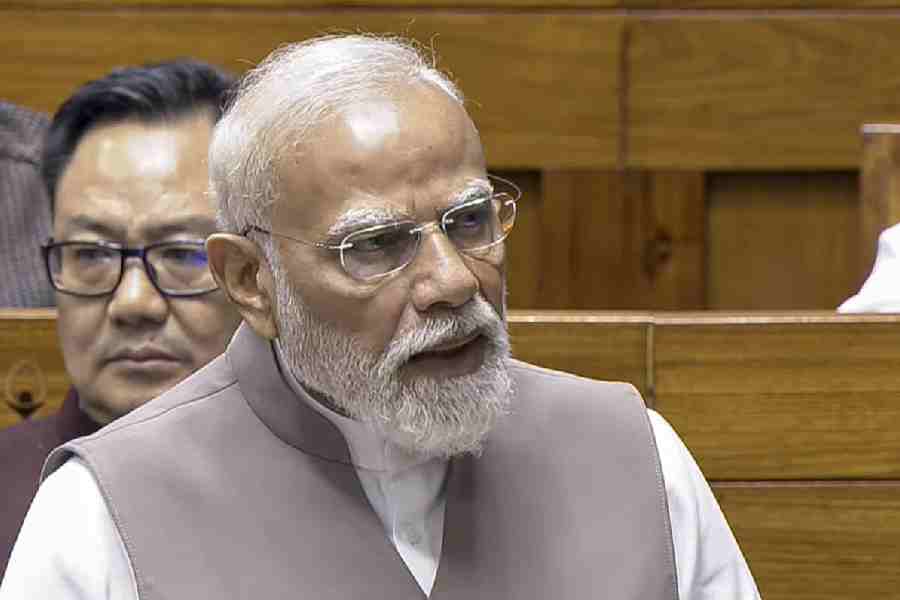
Prime Minister Narendra Modi on Monday called the West Asia situation “worrisome” and highlighted the US-Israeli war on Iran’s wide-ranging impact on India’s energy security, economy and diaspora even as he stressed that the fundamentals of the economy were strong, there was no crisis yet of fertilisers during the summer crop-sowing season or coal or fuel.
"The current situation in West Asia is worrisome. This crisis has been going on for more than three weeks, having a very adverse impact on the global economy and on people's lives. The entire world is urging all parties to resolve this crisis as quickly as possible," Modi said in his address to the Lok Sabha.
The war, which began last month, has disrupted sectors from air travel to shipping and gas supplies, including by the near-closure of the Strait of Hormuz, which serves as a conduit for 40 per cent of India's crude oil imports and 20 per cent of global crude.
The prime minister reassured Indians watching energy prices and mentally calculating the impact on household budgets. "Our government has tried to ensure that petrol, diesel and gas supply shouldn't get disrupted and that households shouldn't suffer," he said.
"We all know that India imports 60 per cent of its LPG needs. Due to uncertain supply, the government is prioritising domestic supply. LPG production in the country is also being increased," he said.
He said that India has made enough arrangements of fertilisers for the summer crop season.
"Adequate arrangements have also been made for fertiliser supply for the summer sowing season that starts in June-July, and for coal to meet the rising demand for electricity as temperatures rise," Modi said.
"India has sufficient petroleum availability with strategic reserves currently exceeding 5.3 million metric tonnes and work underway to create reserves of another 6.5 million metric tonnes," he added.
"Indian farmers are protected from the crisis. Organic farming has been encouraged and the government will continue to help farmers," Modi said.
"A large quantity of essential items like crude oil, gas, and fertilisers come to India through the Strait of Hormuz,” he pointed out. “The government is keeping an eye on shipping routes in the Gulf so that oil, gas or fertiliser ships for these products reach India safely."
An estimated 63 per cent of India's nitrogen fertiliser imports, which includes urea and ammonia and 32 per cent of DAP or di-ammonium phosphate come from Gulf nations, critical for Indian economic growth given it is agriculture-reliant.
“At present, we have enough coal stocks,” Modi said, promising that power supply won't be disrupted.
He said India has made diplomatic efforts towards peace. “But attacks on commercial shipping, and the disruption of Hormuz Strait are not acceptable”.
He also said that cargo movement through the Strait of Hormuz has been a challenge from the beginning of the war, yet the government is ensuring that gas and fuel supplies remain the least affected.
The prime minister also said the conflict has created unexpected challenges, including economic, humanitarian and those related to national security.
"The countries affected by the conflict share extensive trade relations with India. The region fulfils a significant portion of our crude oil and gas requirements. It is also important because around 1 crore Indians live and work there," he said.
It is essential that a unanimous and united voice on this crisis reaches the world from Parliament, he said.
Modi also said that since the conflict began, every Indian in the affected areas has been provided with necessary assistance.
"I have spoken with most of the heads of state in West Asia over the phone in two rounds. And they have all assured the safety of Indians," he said.
Unfortunately, the prime minister said, some people have lost their lives, and some have been injured in the conflict.
Help is being provided to the affected families, he said.
Asked about the PM’s speech, Congress leader Priyanka Gandhi Vadra told reporters in Parliament House complex: "He informed the country about the situation, did not say anything new.
"The notice we have given for discussion should happen so that we can also reply and all sides can put forward their views. It would be good that a discussion happens in Parliament," she said.