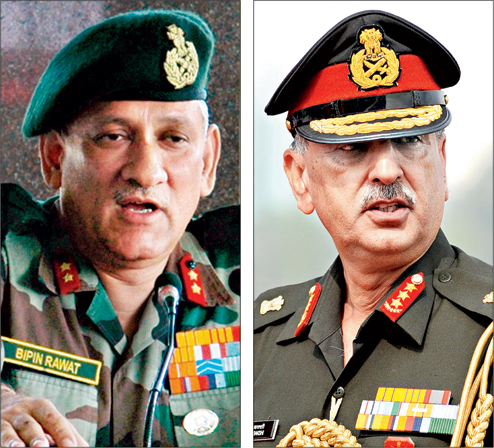

New Delhi, Dec. 17: The Centre has named Lt Gen. Bipin Rawat as the next army chief, superseding two officers in the first such instance in 33 years and appearing to give more weight to infantry combat experience than seniority to find a candidate that suits its preferences.
The biggest casualty of the leapfrogging is Lt Gen. Praveen Bakshi, who heads the Eastern Command at Fort William and was next in line to take over the army. Rawat supersedes Southern Command chief Lt Gen. P.M. Hariz too.
The vice-chief of air staff, Air Marshal B.S. Dhanoa, will be the new chief of the Indian Air Force. Rawat will succeed Gen. Dalbir Singh while Dhanoa will replace Arup Raha in the IAF. The change of guard will take place in the afternoon of December 31, the defence ministry tweeted.
Army sources said both Rawat and Bakshi were meritorious but the government appeared to have tilted towards the infantry. Rawat is an infantry officer while Bakshi is from the armoured corps.
Although both have combat roles, the infantry can be used for non-conventional warfare such as counter-insurgency operations while the armoured corps concentrates on conventional war such as frontline action with tanks.
The surgical strikes in Myanmar in 2015, in which 38 Naga militants are believed to have been killed, was overseen by Rawat who commanded the Dimapur-based 3 Corps.
PTI quoted government sources as saying Rawat was found best suited among the lieutenant generals to deal with emerging challenges, including a reorganised and restructured military force in the north, the continuing terrorism and proxy war from the west, and the situation in the Northeast.
Rawat has served in combat areas and handled operational responsibilities along the Line of Control with Pakistan, the Line of Actual Control with China and in the Northeast. He is said to be well versed in mechanised warfare focused on the western borders in coordination with the other two services.
Bakshi, the Calcutta-based officer who has been bypassed, is from the Skinner's Horse, the regiment under the then East India Company that quelled the 1857 rebellion in Delhi. But he has had only two field command postings.
A senior defence ministry official said: "Lt Gen. Rawat has more operational experience than Lt Gen. Bakshi and Lt Gen. Hariz and that is why he is more relevant to the current situation."
The official was speaking against the backdrop of terror attacks in Kashmir, including the one today in which three soldiers were killed.
Being "passed over" for the top job is an exception rather than the rule, and had led to tumult earlier. In 1983, when the Indira Gandhi government had chosen A.S. Vaidya over S.K. Sinha as army chief, the latter had resigned in protest.
Sinha, who died almost exactly a month ago, was known to have been vocal in his support for better rewards and remuneration for jawans, which apparently stood in the way of his promotion. In the case of Sinha, too, operational inexperience was suggested as the reason for passing him over.
After his resignation, Sinha entered public life and served as governor of Assam and Jammu and Kashmir. Vaidya, who was army chief when Operation Blue Star was launched at the Golden Temple, was shot dead in Pune in 1986 after his retirement.
In 1972, the Indira government had sidestepped Lt Gen. P.S. Bhagat, one of the handful of Indian Victoria Cross recipients during World War II, who was in line to succeed General (later Field Marshal) Sam Manekshaw.
At Fort William, several officers said they had been hearing for the past three months that Rawat could supersede Bakshi.
"The speculation grew stronger after the Uri army camp attack.... It appears that the RM ( raksha mantri or defence minister) has opted for someone with stronger operational command," a senior officer said.
Sources said Bakshi kept to himself in the evening and his immediate reaction remained unknown.
The army was recently caught in a crossfire between the Bengal government and the Centre over a "data collection exercise" but the Eastern Command had said there was "no change in the working relations with the state government" and that it "always maintains good contacts at local levels".