
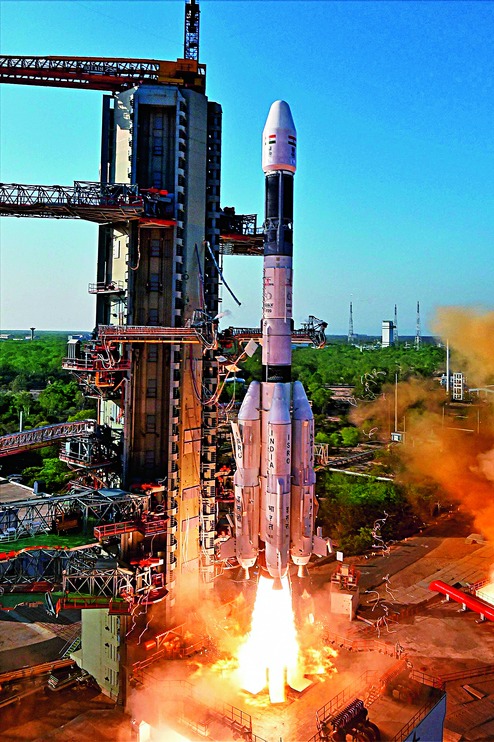

New Delhi, May 5: India's space agency today launched a satellite offering space-related facilities to six other South Asian nations, marking Prime Minister Narendra Modi's biggest regional diplomatic achievement so far through an initiative pregnant with messages for Pakistan and China.
The satellite's 4.57pm lift-off was followed by televised congratulatory messages for Modi from the leaders of Bangladesh, Sri Lanka, Afghanistan, Nepal, Bhutan and the Maldives, the beneficiary countries other than India, some of which had suggested a more low-key launch.
The Rs 235-crore communication satellite is designed to support telecommunication, tele-education, tele-medicine and disaster management services across these seven countries, allowing each to design some facilities specific to its needs.
Initially christened the "Saarc satellite" by Modi when he first proposed it in June 2014, the project had sputtered on its way to today's lift-off from the island of Sriharikota.
Pakistan had opted out of the initiative, forcing a change in name to the "South Asia satellite", while Bangladesh and Afghanistan hesitated before joining it, causing delays.
At least two South Asian countries had indicated ahead of the lift-off that they would prefer avoiding a ceremony that might aggravate domestic criticism that their governments were relying too heavily on New Delhi, officials told The Telegraph.
But Friday's successful launch is likely to help Modi buttress his image diplomatically as a leader who delivers on his promises, while signalling his ability to push through regional initiatives without allowing Pakistan to act as a roadblock.
The launch marks New Delhi's clearest declaration yet of a regional space competition with China, which is now the leading Asian supplier of space technology and facilities to many of India's neighbours.
"Two years ago, India made a promise - a promise to extend advanced space technology for the cause of growth and prosperity of our brothers and sisters in South Asia," Modi told the leaders of the other participating nations in a televised video-conference, also attended from Sriharikota by scientists from the Indian Space Research Organisation (Isro).
"The successful launch of the South Asia Satellite marks the fulfilment of that."

Isro used its Geosynchronous Satellite Launch Vehicle (GSLV) rocket to launch the 2230kg satellite into its planned transfer orbit, from where it will be nudged in the coming days into its final parking slot above the equator. It will become operational on May 25.
The 17-minute flight of the GSLV today was the fourth consecutive success of this home-grown rocket powered by an Indian-made cryogenic engine, a sophisticated rocket engine running on liquid hydrogen and oxygen.
The spacecraft will provide broadcasting and telecommunication facilities in a frequency range known as the Ku-band, used for uplinking and downlinking of satellite communication.
India has set up a ground station facility in New Delhi where officials from the six other countries will be trained on using the satellite for television transmission in their respective languages. Television transmissions from the satellite will then be made available across these countries, and can be accessed by viewers using set-top boxes, officials said.
Each country has transponders - devices that transmit and receive signals - on the satellite, whose use it can tailor to its needs: from television broadcasts, e-governance and the mapping of groundwater and forests to cellular communication and Internet banking.
In addition, India has proposed a common ground facility that can use the satellite to collate meteorological data that can assist all the seven participating countries.
But the project also has deeply strategic goals, which were evident in Modi's comments.
" Sabka saath, sabka vikas (Support for all, development of all) can be the guiding light for action and cooperation in South Asia," Modi said, referring to his government's signature slogan.
"Our coming together is a sign of our unshakeable resolve to place the needs of our peoples in the forefront. It shows that our collective choices for our citizens will bring us together for cooperation, not conflict; development, not destruction; and prosperity not poverty."
President Ashraf Ghani of Afghanistan, locked like India in a near-daily battle of words with Pakistan over cross-border terrorism, referred to Islamabad's opposition to a pan-Saarc motor transit agreement. "If we can't cooperate on land, we can at least cooperate in space," Ghani said.
Nepal Prime Minister Pushpa Kamal Dahal, better known as "Prachanda", Maldives President Abdulla Yameen, Bangladesh Prime Minister Sheikh Hasina and Bhutan Prime Minister Tshering Tobgay each congratulated and thanked Modi for the initiative. Yameen and Tobgay also referred to the Modi government's slogan.
The launch represents the second time in less than a year that the seven countries other than Pakistan in Saarc have come together, led by India.
Last year, India had led a boycott of the planned Saarc summit in Islamabad after the September terrorist attack in Uri. The six other nations participating in the satellite initiative also either announced they would skip the meeting or said the regional atmosphere was not conducive for the summit.
Still, Friday's success comes after three years of at times uneasy talks with India's neighbours, many of which are developing their own space programmes and do not want to be viewed domestically as freeloaders.
Pakistan was the most vocal against what it suggested was India's attempt at monopolising the initiative.
On Friday, Pakistan's foreign ministry spokesperson said the country had offered to "share its expertise and technical know-how and was keen to participate in the project".
"However, as India was not willing to develop the project on a cooperative basis, it was not possible for Pakistan to support it as a regional project under the umbrella of Saarc," Nafees Zakaria said.
But some other countries were uneasy too, while still others weighed the need for joining the project when they were already busy planning their own launches in collaboration with other nations.
Bangladesh signed an agreement with India confirming its participation in the project only in late March, days before Hasina's visit to India. The country plans to launch its first satellite ---- the Bangabandhu-1, built by the private European firm Thales Alenia Space ---- from Cape Canaveral in the US in December.
Sri Lanka has had a communication satellite in space since 2012, when China launched the island nation's first spacecraft. Afghanistan obtained its first satellite in 2014, leasing a satellite already in space and owned by European firm Eutelsat.
Nepal has won an orbital slot allotted by the International Telecommunications Union and has put out a tender for a satellite instead of turning to Isro.
For India, these independent initiatives by its South Asian neighbours only magnified the need for an assertive diplomatic move in projecting itself as a space provider, especially because of China's growing influence in the field in Asia.
The Maldives, Myanmar, Laos, Thailand and Brunei are among countries in India's extended neighbourhood that have in recent years either indicated interest in tying up with China in developing their satellites, or have entered formal negotiations.
"I am convinced that when we join hands and mutually share the fruits of knowledge, technology and growth, we can speed up our development and prosperity," Modi said today. "You will find a strong and committed partner in India."