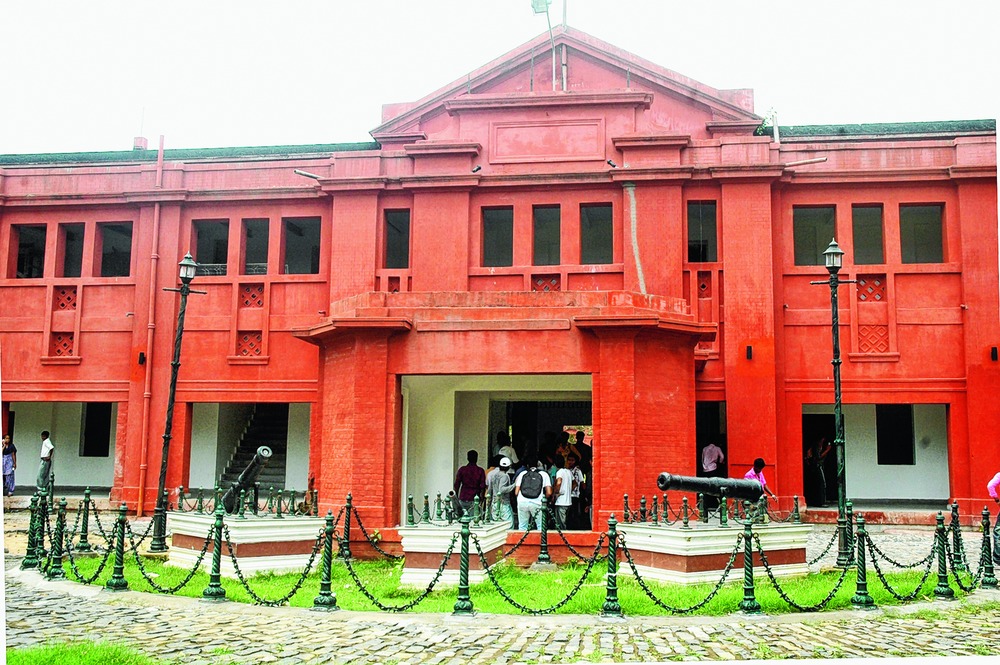

The suggestion to change the name of the Ravenshaw University (earlier known as Ravenshaw College), which was published in The Telegraph on March 27, 2017, is ill-conceived and appears to be an outcome of distorted priorities.
The word "Ravenshaw" is no longer perceived in public mind, both in Odisha and outside, as the appellation attached to the body of a white man who happened to be an administrator in Odisha more than a century ago. Through its association with a premier college that has played a stellar role in Odisha's intellectual and political history for decades, the word has acquired a new salience and now represents an iconic 'brand image' compared to, say Oxford or Cambridge in the UK, though in the limited Indian context. To that extent, the name is nationality-and-race-neutral, neither foreign, nor local.
The college has nurtured great scholars and teachers and has produced, over the years, distinguished intellectuals, literary figures, political leaders, administrators, lawyers and scientists who have shaped the destiny of Odisha. Many of them have also made their mark nationally and internationally. The college was closely associated with the various phases of the freedom movement and provided the venue for the initial meetings of the Legislative Assembly of Odisha in the 1930s. Educational institutions attain excellence over time by traditions built in academic and relevant non-academic areas, and the name associated with it works as its flag-bearer. It would be sheer lunacy to abandon this legacy and heritage.
From this viewpoint, what Ravenshaw did or did not do is immaterial. However, it may clear the air somewhat if we also touch upon some arguments for change, though most seem irrelevant. Take, for example, the comparison of Ravenshaw with General Dyer. The latter directly organised troops and commanded them to open fire at Jallianwala Bagh. No one has yet accused Ravenshaw of "organising" the famine of 1866! Famines and scarcities were regular features in the 19th century Odisha; there had been nearly 10 famines before 1866 and an equal number between 1867 and 1900. The absence of suitable means of transportation and communication, premature cessation of rainfall and lack of irrigation facilities were the main causes, along with some administrative deficiencies.
In fact, Ravenshaw had joined as officiating commissioner only in 1865, a year before the famine. It is possible that he initially misjudged the developing tragedy due to inexperience and a lack of familiarity with the ground situation. In fact, the Campbell Commission (on the famine) said as much. The fact that Ravenshaw stayed on as the (full-fledged) commissioner for the next 10 years means that his bosses had full faith in his abilities. Such happenings are not unusual in government administration, even today.
However, in these latter years, Ravenshaw seems to have blossomed to his full potential and made a significant contribution for the development of education facilities in Odisha. He took several steps for the progress of primary, secondary, technical and female education these included improvement of elementary village schools and the establishment of a medical school in Cuttack. His crowning achievement, however, was the establishment of a full-fledged degree college in Cuttack in 1876 for which he worked ceaselessly at various levels of the government, with the support of Krushna Chandra Bhanjdeo, the Maharaja of Mayurbhanj, who made the mandatory financial contribution. It was in 1878, after Ravenshaw had left Odisha, that the college was named after him, on the suggestion of the Maharaja of Mayurbhanj. The man should be judged by the totality of his work and not by picking bits and pieces to justify an argument.
Further, a somewhat populist argument has been made to say that the names of white men must be removed as has happened in the cases of the Victoria School and Marwood Park or Russelkonda. Grouping Ravenshaw College with some schools and parks portrays the absence of a sense of proportion. For, Ravenshaw belongs to a different class that comprises distinguished educational institutions such as St Stephens College in Delhi, Elphinstone College in Mumbai or Bethune College in Calcutta. All these colleges, including Ravenshaw, were established in the latter part of the 19th century and had established reputation for excellence. All of them have retained their original names, to maintain their legacies built over many years.
In a sense, the name-changing debate is a non-issue. The real issue is how to prevent the deteriorating educational standards in our colleges and universities and how to improve the living standards of our people. Not surprisingly, therefore, the proposal for change of name has received lukewarm response, as its chief protagonist has complained. Frankly speaking, it deserves no better.