|
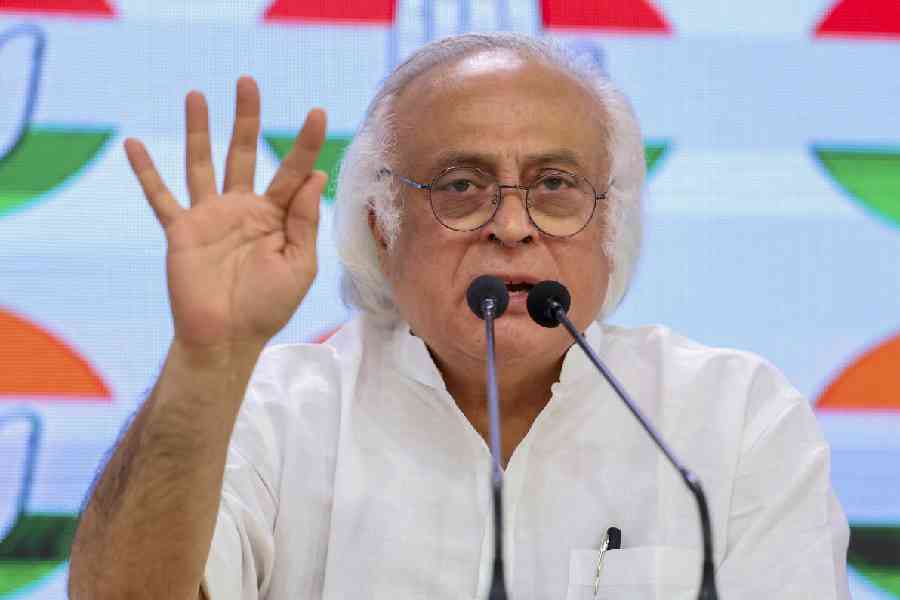
| Ashoke Sen |
New Delhi, July 31: Physicist Ashoke Sen, whose work seeks to unify two bedrock theories of physics and realise Albert Einstein’s dream, has become one of nine scientists to receive the inaugural Fundamental Physics Prize, launched by a Russian physicist-turned-Internet investor.
Sen, 56, a scientist at the Harish Chandra Research Institute in Allahabad, has received the $3-million prize for pioneering work on string theory, an attempt to unify the theories of gravity and quantum mechanics and an effort to complete a task that Einstein had begun.
The prize announced today by the Milner Foundation, an international not-for-profit organisation set up by Russian investor Yuri Milner, carries a cash award nearly three times that of the Nobel Prize. The Foundation said Sen’s research had opened up “the path to the realisation that the multiple string theories are different limits of the same underlying theory”.
Sen’s work has essentially rescued string theory physicists from embarrassment. During the mid-1980s and 1990s, physicists had churned out several string theory versions, all of which appeared correct and thus drew scepticism from some fellow scientists.
The techniques that Sen developed were, however, picked up by other physicists to show that the multiple string theories were all different manifestations of the same underlying theory.
“This prize came as a complete surprise,” Sen told The Telegraph over the phone from Allahabad. “I see it as an encouragement to young people to come into fundamental physics. There is still so much more to be discovered.”
The other inaugural prize-winners include physicists who have helped advance ideas of the early universe, black holes and the mysterious dark matter, among other topics. The Milner Foundation said it was seeking to advance understanding of the universe at the deepest level by awarding annual prizes for scientific breakthroughs.
A spokesperson for the Foundation said that unlike the Nobel Prize, given only for research that has been experimentally corroborated, the Fundamental Physics Prize is open to any physicist or group of physicists who have done outstanding theoretical work.
Milner, who had studied theoretical physics before becoming an entrepreneur, himself picked the nine recipients of the inaugural prize, the spokesperson said. Future prizes will be awarded by a selection committee made up of the nine inaugural recipients, the spokesperson added.
“I hope the new prize will bring long overdue recognition to the greatest minds in the field of fundamental physics,” Milner said in a statement issued through the Foundation, which has also announced New Horizons in Physics Prizes for promising junior researchers.
The other inaugural recipients of the Fundamental Physics Prize are American-Canadian Nima Arkani-Hamed, American Alan Guth, Russian-American Alexei Kitaev, Russian Maxim Konstevich, Russian-American Andrei Linde, Argentinian Juan Maldacena, Israeli American Nathan Seiberg and American Edward Witten. All of them, like Sen, are superstars of fundamental physics.
Linde, Witten and Seiberg, like Sen, have contributed to string theory, among their other achievements.
Sen, who graduated from Calcutta University, obtained a master’s from the Indian Institute of Technology, Kanpur, and a doctorate from the State University of New York. He has been a professor at the Harish Chandra Research Institute since 1995.