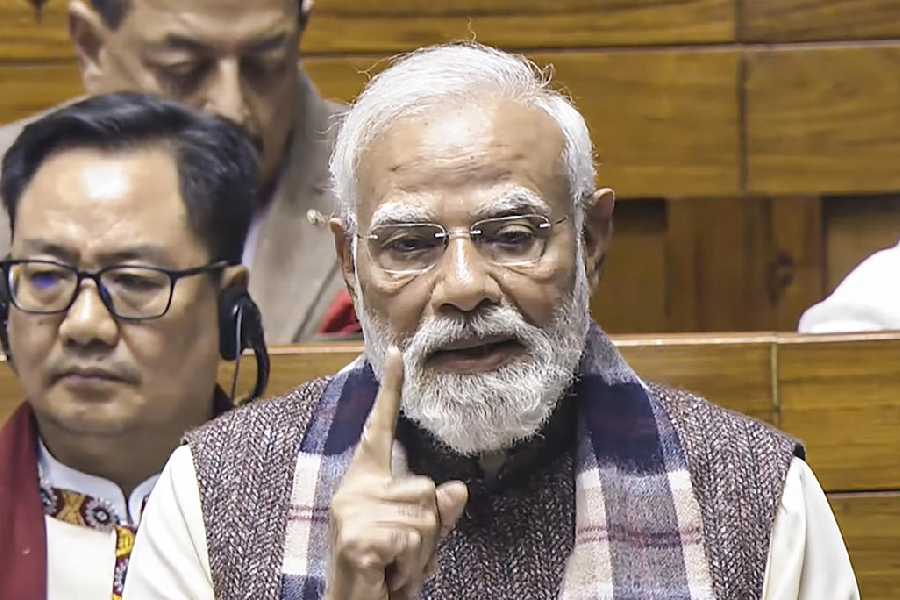
Prime Minister Narendra Modi on Monday used the Lok Sabha debate on Vande Mataram’s 150 years to assail Jawaharlal Nehru and the Congress, while linking the national song to the Vedas and Ram.
The Opposition accused Modi of using the discussion to “rewrite history” and politicise the song, a symbol of national unity, with an eye on the upcoming Bengal elections.
Wayanad MP Priyanka Gandhi Vadra charged Modi with selectively quoting Nehru, and urged the Treasury benches to list all their insults for Nehru, set aside a time to debate the subject, and close the chapter “once and for all”.
Initiating the discussion, the Prime Minister reaffirmed his allegation that Nehru had buckled under pressure from Mohammad Ali Jinnah and removed certain stanzas from Vande Mataram. He claimed Nehru’s “appeasement politics” eventually led to the partition of India.
“The politics of the Muslim League opposing Vande Mataram gathered pace in 1937. Mohammed Ali Jinnah raised slogans against it,” Modi told the House.
“Nehru saw his throne shaking. Instead of condemning the slogans of the Muslim League and expressing loyalty to Vande Mataram, he wrote to Netaji Subhas Bose, agreeing with Jinnah.
“The CWC (Congress Working Committee) decided to investigate Vande Mataram itself. Nationalists across the country held protest marches. But the Congress, unfortunately, surrendered before the Muslim League and partitioned Vande Mataram. This was part of the appeasement politics of the Congress. Later, the Congress also surrendered to the Partition demand....”
Priyanka stressed the need to understand the chronology of the events that led to Vande Mataram being chosen as the national song by the Constituent Assembly.
She said Bankim Chandra Chattopadhyay wrote the first two stanzas in 1875, while the additional ones figured in his novel Anandamath seven years later, in 1882.
Priyanka read out excerpts from the correspondence between Nehru and Bose, and between Nehru and Rabindranath Tagore.
“Let me share an excerpt from the letter in which Gurudev (Tagore) says that the two stanzas that were always sung were so significant that he had no difficulty in separating them from the rest of the poem and the passages in the book,” she told the House.
She stressed that it was Tagore who suggested that “the stanzas added later could be interpreted as communal and their use would be inappropriate in the atmosphere of that time”.
“Subsequently, on 28 October 1937, the Congress Working Committee, in its resolution, declared Vande Mataram as the national song,” Priyanka said.
“Gurudev Rabindranath Tagore played the most significant role in the selection and determination of both our national anthem and national song. This was also accepted by the Constituent Assembly.
“Raising questions on this is not only an insult to the heroes and great personalities of our freedom movement, but also an insult to the entire Constituent Assembly.”
Priyanka said this amounted to “a direct attack on our Constitution”.
“Have the people in power in the government today become so arrogant that they have started considering themselves greater than great personalities like Mahatma Gandhi, Netaji Subhas Chandra Bose, Dr Ambedkar, Dr Rajendra Prasad?” she said.
Priyanka underlined that none of the members of the Constituent Assembly — who included BJP icon Syama Prasad Mookerjee — had objected to the decision.
She slammed the government benches for repeatedly targeting Nehru and suggested: “Let’s have a discussion on the mistakes of Nehru, Indiraji, Rajivji, and dynastic politics. Let it continue for 24 hours, 40 hours. Let us finish it once and for all... then let us talk about unemployment, paper leaks….”
Modi said Bankim had composed the song at a time the 1857 revolt had left the British rattled.
“They (the British) were oppressing people. Their national anthem, God Save the Queen, was being taken to Indian homes. At this time, Bankim penned Vande Mataram. In 1882, it was added to Anandamath,” he said.
He linked the spirit of Vande Mataram to the Vedas and Ram. “Vande Mataram was not just a mantra for political independence. It was not limited to our independence; it was way beyond that,” he said.
“The freedom movement was a war to free our motherland from the clutches of slavery.… In our Vedas, it was said, ‘This land is my mother, and I am the son of the soil’. This same idea — ‘motherland above heaven’ — was conveyed by Shri Ram when he gave up Lanka. Vande Mataram is a modern avatar of our great cultural legacy.”
Modi also referred to “Hindu Rashtra” proponent V.D. Savarkar, saying: “When recordings of Vande Mataram were reaching every corner of the world, Veer Savarkar played it at India House in London.”
He said Mahatma Gandhi considered Vande Mataram “as a kind of national anthem”, and accused the Congress of sidelining the song.
“Why was injustice meted out to Vande Mataram in the last century? Which force prevailed over the sentiments of Mahatma Gandhi? The chaste song was made controversial. We should share this with our young generation. The Muslim League was opposing Vande Mataram.”
Trinamool MP Mahua Moitra said the government was pushing the Vande Mataram debate hoping it would divert attention from its failures and impress the Bengal electorate.
“Some half-wit BJP IT cell minion had probably advised that the Vande Mataram card, if played right, will give advantage to the BJP in the 2026 Assembly elections. There is no other reason behind holding the debate,” Mahua said.
She said the Trinamool was delighted. “It will only prove how removed you are from the soul of Bengal, and how our ‘Ma’ will never be hostage to your narrow electoral goals.”
Mahua, too, stressed that it was Tagore who had advised editing out certain stanzas of the song, and challenged the BJP to face the Bengal elections on this plank.
“If you have the guts, target the man who wisely edited the song. It was neither Nehru nor Bose. It was Rabindranath Tagore,” she said.
“If you have the courage… come, fight an election in Bengal in 2026 by saying that Tagore was responsible for dividing India….”
Samajwadi Party chief Akhilesh Yadav said that those who had failed to take part in the freedom struggle were now talking about the values of Vande Mataram.
He said the song should not be used to target any community.