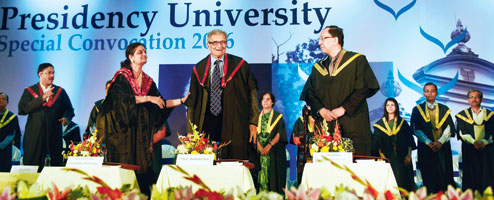

Calcutta, Jan. 20: Presidency University conferred an honorary DLitt (honoris causa) on economist Amartya Sen at a special convocation today.
The following are excerpts from Sen's speech. The italicised sentences are annotations by this newspaper.
Not a govt initiative
In 1817 January, the college started as Hindu College and then it turned into a government institution in the middle of the century. It is very important to recognise if you think about some special features of the Presidency College, that it was a civil society initiative, it was not a government initiative... members of civil society like Radhakanta Deb, David Hare - a watchmaker-turned-educationist - and a number of others. The institution attempted to be an elite institution in addition to its civil society background.
Elitist institution
Presidency as a college had extraordinary teachers that hardly any institution could match. The college had Satyen Bose, Prafulla Chandra Roy, Meghnad Saha, Acharya Jagadish Chandra Bose, Sushovan Sarkar, Prasanta Chandra Mahalanobis as teachers. A number of major things happened in every area of knowledge.
I don't think there is anything to be apologetic about being an elitist college. Education must require a cultivation of excellence, uncompromising excellence and in a way that to make room for any value other than any educational excellence, ultimately is defeat.
Elitism in the best sense is a cultivation of excellence, recognition of a social role understanding that scepticism is not disrespect, scepticism in a way is a commitment to argument and reasoning.
(Sen did not make any reference to any specific instance or regime. But some veteran academics later pointed out to this newspaper that the erstwhile Left Front government had denounced elitism. It wanted Presidency, then a college, to be like any other. So, the front would try to get teachers of its choice transferred to the college and transfer those who did not toe its line to colleges in the districts. Several eminent teachers had quit during this phase to protest this intervention.)
No govt dominance
When we live in a society where there are major issues to be addressed, we have to address them not as a government college, but remember our origin is a civil society. Presidency would certainly want government help, but not the dominance. We have to cultivate the highest quality of education, elitism in that sense. Detachment to the society will not work.
Scepticism and reasoning must be a major part of whatever we are doing, whether in economics, in history or in mathematics or in literature or in any other subject.
(Again, Sen did not cite any specific instance. The reference to the government's role made some recall how chief minister Mamata Banerjee had announced on the campus last year an allocation of over Rs 100 crore for Presidency. A controversy had erupted then over whether the chief minister should have used the platform to score brownie points when the situation was fraught because of student protests and whether the vice-chancellor should have facilitated such an exercise. Education minister Partha Chatterjee had then repeatedly asserted: "The government funds universities and colleges, so it has a right to intervene.")
Tolerance
Derozio was sceptical in a kind of amazing way. This was the time when scepticism was flourishing in some sense in Europe. Prior to that, the general idea was to accept any kind of belief that comes from any side. Tolerance, of course, is a great virtue and right now in India, we need this very badly. But in addition to that, there is a need for sceptical tolerance, which was one of the things that Derozio had. He didn't have enmity for any group but questions for every group.
(Henry Louis Vivian Derozio was a poet and teacher of English literature at Hindu College, the first avatar of Presidency. At the college, he drew a group of young students around him and inspired them to think freely against the rigid rules of society. His students came to be known as Derozians. Derozio criticised the social practices and religious beliefs of orthodox Hinduism. Accused of irreverence by his students' orthodox Hindu parents, he was forced to resign by the directors of Hindu College.)
Minority rights
Now if you think about India, when we say that democracy may be under some threat... what are the issues? Well, first of all, one of the issues is democracy is not just a majoritarian rule, it also involves minority rights, it involves liberty and liberty of expressions and so on. What is now called majority is, in fact, not majority but plurality.
Presidency's role
Presidency has to ask constantly 'are we relevant in India' or in the world? What can we do?' We live in very difficult times with violence, with battle against hunger, under-nourishment, illiteracy and lack of education and bad education at the school level being the dominating feature of the country.