 |
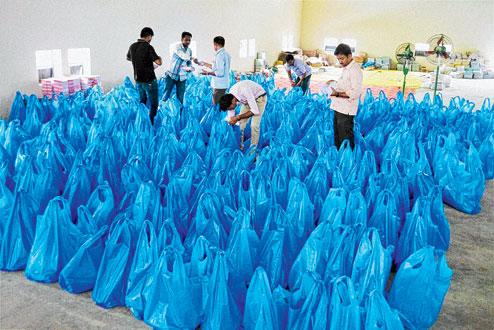
| Election workers on Sunday prepare for the Assembly polls in Karad, Maharashtra . (PTI) |
For over two decades, Imtiyaz Jaleel covered elections. Now he is contesting one.
“It’s an altogether different ball game,” said the tall, well-built and soft-spoken 40-something former journalist as a battery of workers prepared for the day’s campaign outside his Aurangabad home. “It’s amazing.”
Jaleel had quit a career in television journalism after the Lok Sabha elections and returned from Pune, where he worked, to his hometown Aurangabad, wondering what to do. “I’d decided to give up journalism, but was not sure what I should be doing; I wanted a break,” he said.
Then, in a quick turn of events, he found himself filing his nomination for the coming Assembly elections from Aurangabad (Central) on the ticket of a party seeking to expand its base — the Majlis-e-Ittehadul Muslimeen (MIM).
“I took this offer because I genuinely feel my community needs a voice and, if I could be that, I will be very happy,” he said.
The Hyderabad-headquartered MIM is an emerging story in Maharashtra’s crowded political scene and one that is giving the Congress — recently divorced from the NCP — sleepless nights. The MIM had sprung a surprise in 2011 when it sent seven councillors to the Nanded municipal corporation in former chief minister Ashok Chavan’s home turf.
Now, it has fielded 25 candidates in Marathwada, Mumbai and Malegaon where Muslims account for a sizeable chunk of the population. In Aurangabad, it accounts for a third of the population while Dalits make up over 12 per cent.
“The condition of Muslims has gone from bad to worse in the last 15 years when the Congress-NCP was in power,” MIM chief and Lok Sabha member Asaduddin Owaisi told The Telegraph over phone. “There is space for a new political party in Maharashtra because of the disenchantment of Muslims and Dalits.”
In September, the MIM had announced its tie-up with the Dalit Panthers, an erstwhile Dalit movement in the state, to forge a new social alliance between Muslims and Dalits, who together account for about 25 per cent of Maharashtra’s voters.
Panther leader Gangadhar Gade is contesting from Aurangabad (South).
The MIM is trying to replicate what it did in Hyderabad: forge an alliance between Muslims and Dalits.
Abu Baker Rahber, a veteran journalist in Aurangabad, said Muslims were looking for an alternative in Marathwada and other parts of Maharashtra out of desperation.
Till 1971, the Muslims of Marathwada had supported the Left in return for social and political support. The Congress won the Aurangabad municipal elections for the first time with Muslim support that year and since then remained the only political platform for the community. The party gave political representation to the community but, over the past decade, it has progressively declined.
The Hindu-Muslim rift, which existed but remained largely invisible, surfaced when the Shiv Sena entered Marathwada in 1987 for the first time outside its citadel of Mumbai. In 1988, over 20 major riots were engineered, and the region was irreparably polarised.
According to Rahber, the rift has widened over the past four decades, while lack of economic progress, adequate political representation and arrests of Muslim youths in connection with terror cases have all led to a collective disenchantment with existing parties.
In the lead-up to the October 15 elections, Sena candidates have been narrating the story of Shivaji’s victory over Aurangzeb to incite passions against the MIM and polarise voters.
Owaisi said his party did not put up candidates during the Lok Sabha polls in Maharashtra for fear of splitting secular votes. “In Assembly elections, we stand a good chance,” he said.
The party’s rallies all over the state have been drawing huge crowds. In Aurangabad, a rally in late September was so spectacular that people compared it with Bal Thackeray’s public rally in 1987.
Owaisi and his younger brother Akbaruddin have been campaigning in the state for some time, holding rallies, road shows and public meetings.
“Muslim youths are getting attracted to the MIM, though the traditional Muslim voter of the Congress will not turn against the party,” Mehtab Momin, an NCP worker in rural Nanded, said. But he added that the MIM would damage the prospects of Congress and NCP candidates wherever it polls a sizeable number of votes.
The presence of three MIM candidates in the three urban Assembly segments of Aurangabad does not bode well for the Congress, despite the BJP-Sena split.
In Nanded, too, where it has a presence in the civic body, the MIM is in contention in one of the two Assembly segments of the city — South Nanded.