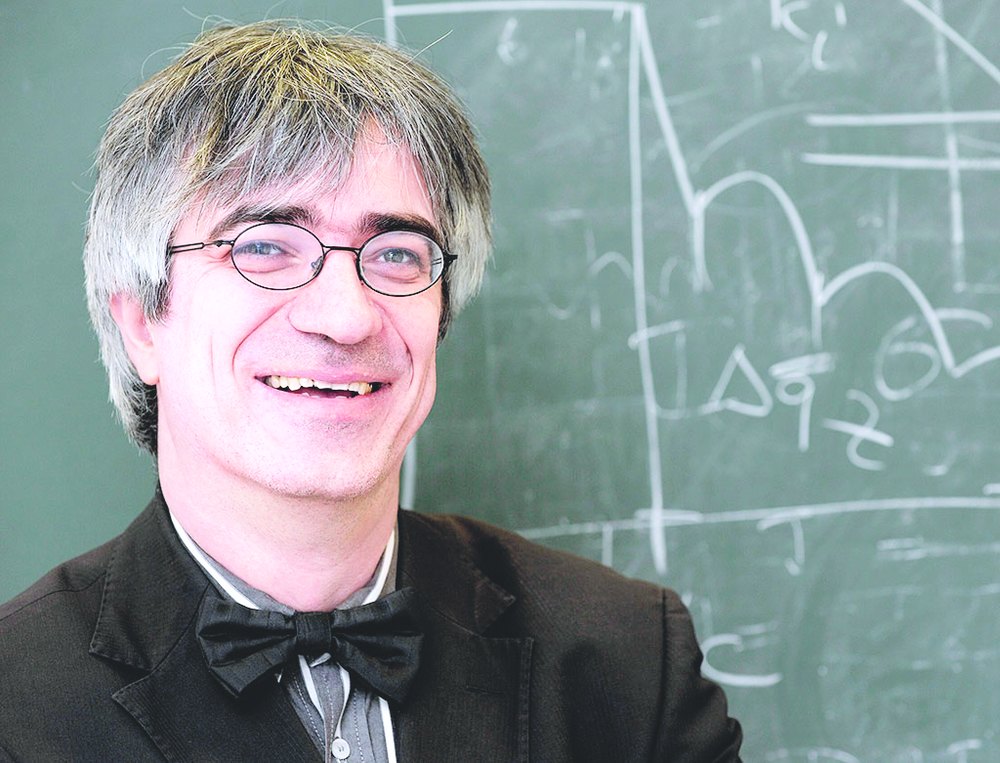

New Delhi, April 1: No one really seems to mind when Metin Tolan carries clips of James Bond movies into his physics classroom lectures. Not even when he decodes 007's myriad feats, gadgets and stunts through the lens of a physicist.
Tolan, an experimental physicist at the Technical University of Dortmund, Germany, and a fan of Bond movies, has figured out what it'll take for Bond to chase a pilotless plane, use a magnetic wrist-watch to draw a spoon, and perform stunts that appear to, but do not necessarily, defy physics.
His efforts to combine his passion for physics with his hobby of watching Bond has also helped Tolan determine why Bond's martinis are always shaken, and not stirred. When stirred, the molecules get equally distributed, when shaken, the molecules associated with the taste of the drink move to the surface.
"In the classroom, physics problems taken from textbooks can sometimes appear boring - the Bond movies throw up far more interesting problems," said Tolan, who says he's watched each of 23 Bond movies - from Dr No starring Sean Connery and released in 1962 to Skyfall starring Daniel Craig and released in 2012 - many times over.
Tolan, who otherwise studies how X-rays interact with polymers and biomaterials, is currently in India to deliver public talks on the interface of Bond and physics.
In the 1995 film Golden Eye, Pierce Brosnan playing Bond is shown diving after and chasing a pilotless plane that goes over a cliff, catching up with the aircraft, climbing inside to take control and prevent it from crashing and make his escape.
"Is it possible? Well, under certain circumstances, yes," Tolan, 50, told The Telegraph . "To do that, Bond would have to have a streamlined body over 20-fold better than the streamlined surface of the plane - to reduce the resistance that he experiences from air to be able to catch up with the plane."
"Maybe the (British) secret service has found a way to streamline his body," he said.
The secret service may also find it a challenge to explain how Roger Moore playing Bond in the 1973 movie Live and Let Die uses a wrist-watch - rigged to function as an electromagnet - to draw a spoon towards him from a distance of about a metre.
Tolan throws a question that physics undergraduate students might answer: what is the current required for the wrist-watch electromagnet to pull a spoon a metre away. The most sophisticated electromagnets would demand a current of about 5 Amperes. He throws a follow-up question - this one aimed at senior school physics level: how much heat will 5 Amperes generate? "About 250°C - again," Tolan said. "Bond has found a way to tolerate that heat."
A three-wheeler autorickshaw chase in the 1983 Bond movie Octopussy, shot in India, turned into a problem from classical mechanics for Tolan. In the sequence, the former Indian tennis player Vijay Amritraj drives Moore in a speeding autorickshaw, trying to get away from a bunch of baddies.
At one point, the vehicle goes over a ramp inclined at an angle of about 20 degrees, takes a parabolic path to reach a height of about five metres and drops on the ground. "The autorickshaw would have to be travelling at about 100kmph to be able to do this," Tolan said.
The German Research Foundation gave Tolan its Communicator Award in 2013 for his efforts to carry ideas from physics to the public.
Tolan has a blog on the physics of football, and he has authored two books, Shaken, Not Stirred: James Bond and Physics and The Titanic: The physics of sinking.
His interest in Bond movies, however, has also helped Tolan trace the origin of the name. Tolan believes the real James Bond was a Florida-based ornithologist, born in 1900, died in 1989, and had authored a book, Birds of West Indies. Ian Fleming, he said, borrowed the name.