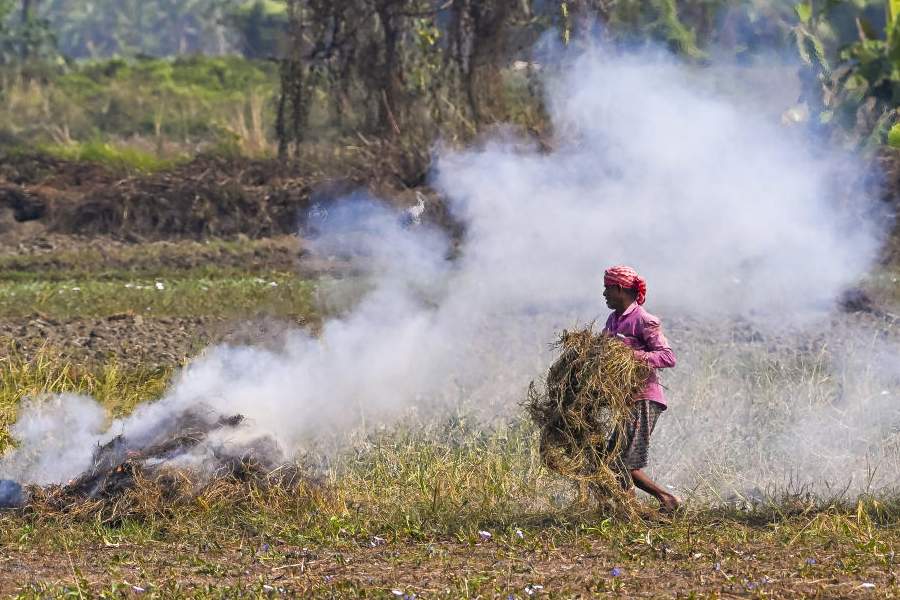
More than 90 per cent of large farm fires in Punjab and Haryana are now escaping official detection, says a new analysis that points to a shift in farmers’ burning patterns and a monitoring system that has not kept pace.
The Stubble Burning Status Report 2025, released on Monday by the International Forum for Environment, Sustainability and Technology (iFOREST), argues that the government’s current surveillance protocol misses most fires because it relies heavily on polar-orbiting satellites that observe India only between 10:30 am and 1:30 pm.
Farmers, the report notes, have moved their burning to the late afternoon. The result, iFOREST says, is a major underestimation of the contribution of stubble burning to Delhi’s winter air.

Chandra Bhushan, CEO of iFOREST, said, "Our analysis provides incontrovertible evidence that India's current stubble-burning monitoring system is structurally misaligned with ground realities. Farmers have shifted burning to the late afternoon, while our monitoring relies on satellites that capture active fires only during a narrow time window (10:30 am to 1:30 pm). The result is a massive underestimation of fires, emissions and their contribution to air pollution in Delhi. We urgently need to overhaul the system."
The report uses a combination of MODIS and VIIRS satellite data, high-resolution Sentinel-2 burnt-area mapping and 15-minute geostationary observations from the SEVIRI instrument on Meteosat-8 and 9.
The SEVIRI layer, which tracks fires throughout the day, shows how much the current system misses.
According to the analysis, in Punjab, over 90 per cent of large fires in 2024 and 2025 occurred after 3 pm. In 2021, the figure was just 3 per cent. In Haryana, most large fires have been taking place after 3 pm since 2019.
iFOREST warns that missing these fires leads to major errors in estimating emissions and forecasting Delhi-NCR’s air quality. Current models, it argues, are working with incomplete inputs.
At the same time, the report points to real movement on the ground: burnt areas in Punjab and Haryana have fallen between 25 and 35 per cent in recent years.
Sentinel-2 data show that Punjab’s burnt area during the Kharif season dropped from a peak of 31,447 sq km in 2022 to around 20,000 sq km in 2025 — a 37 per cent decline. Haryana’s burnt area has reduced from 11,633 sq km in 2019 to 8,812 sq km in 2025.
Bhushan added, "Burnt areas provide a more reliable picture of stubble burning. Our analysis shows that Punjab and Haryana have reduced burnt areas by 25-35 per cent, which is good news and indicates that in-situ and ex-situ stubble-management practices are being adopted. But this is not the time to become complacent. Even in 2025, close to 30,000 sq km of paddy fields were burnt in Punjab and Haryana, making them a major source of air-quality degradation in Delhi-NCR and the wider Indo-Gangetic region."
The report urges the government to reform the national monitoring system. It recommends that CREAMS, the body that currently publishes active fire counts, also release burnt-area data.
It also calls for the Indian Institute of Tropical Meteorology to revise its air-quality modelling methods.
Ishaan Kochhar, Programme Lead at iFOREST, said, "We cannot manage what we do not measure accurately. Policy decisions are currently being shaped by incomplete information. To solve the stubble-burning problem in the Indo-Gangetic plain, the government must urgently reform the monitoring protocol to integrate burnt-area mapping and geostationary data. We also need to expand our focus beyond Punjab and Haryana to the emerging hotspots in Uttar Pradesh and Madhya Pradesh."
The report notes that stubble burning appears to be rising in states beyond the traditional hotspots, with active fire counts already showing increases in Uttar Pradesh and Madhya Pradesh.