The Opposition on Tuesday questioned whether the RSS and the BJP have ever respected the national song, the national anthem and the Tricolour, as the government alleged that generations of the Nehru-Gandhi family had opposed Vande Mataram.
Participating in a discussion on 150 years of Vande Mataram in the Rajya Sabha, AAP member Sanjay Singh said the song symbolised devotion to the motherland and had inspired freedom fighters who “sacrificed their lives” singing it. He challenged the ruling party to name “four RSS leaders who went to jail” for raising the slogan during the freedom struggle, claiming the organisation had “no contribution” to the movement.
“Freedom fighters sacrificed their lives, went to jail, giving the slogan of Vande Mataram,” Singh said.
Singh added: “Please tell us the names of four RSS leaders who went to jail for raising the Vande Mataram slogan. You cannot give (us names) because you had no contribution in the freedom movement.”
He cited a 2001 incident in which an FIR was allegedly filed by RSS functionaries against three individuals for hoisting the Tricolour at the organisation’s headquarters in Nagpur. He recalled that Sardar Patel, as home minister, had banned the RSS in 1948 after Mahatma Gandhi’s assassination and that arrested RSS leaders were released from jail after 18 months on the condition that they respect the national flag.
“However, the Tricolour was never hoisted at the RSS headquarters for 52 years. But three persons hoisted the national flag at the RSS headquarters, and the RSS filed FIRs against them. They fought the case for 13 years. Those who oppose the Tricolour are not the true sons of India,” Singh said.
He also referred to an article in RSS mouthpiece Organiser dated December 28, 1949, in which the choice of Jana Gana Mana as the national anthem was questioned.
“The Organiser wrote, ‘What is the moral sanction behind the choice of Jana Gana Mana except that it can be made an item of entertainment.’ You opposed the Tricolour and the national anthem. You never sang Vande Mataram,” he said.
Singh cited the instances of the Hindu Mahasabha, part of the Sangh Parivar, forming governments in coalition with the Muslim League in Bengal, Sindh and the North-West Frontier Province in the late 1930s. He alleged that the Mahasabha had close relations with Muhammad Ali Jinnah, the founder of Pakistan.
Leader of the Opposition Mallikarjun Kharge said the Congress made Vande Mataram the slogan of the freedom movement and sang it at all party events. He asked if the BJP ever sang the song at its meetings.
Kharge said it was Rabindranath Tagore who suggested adopting the first two stanzas for singing at public events as a mark of respect for the motherland. The proposal was adopted by the Congress at a meeting attended by Mahatma Gandhi, Netaji Subhas Chandra Bose, Nehru and Tagore.
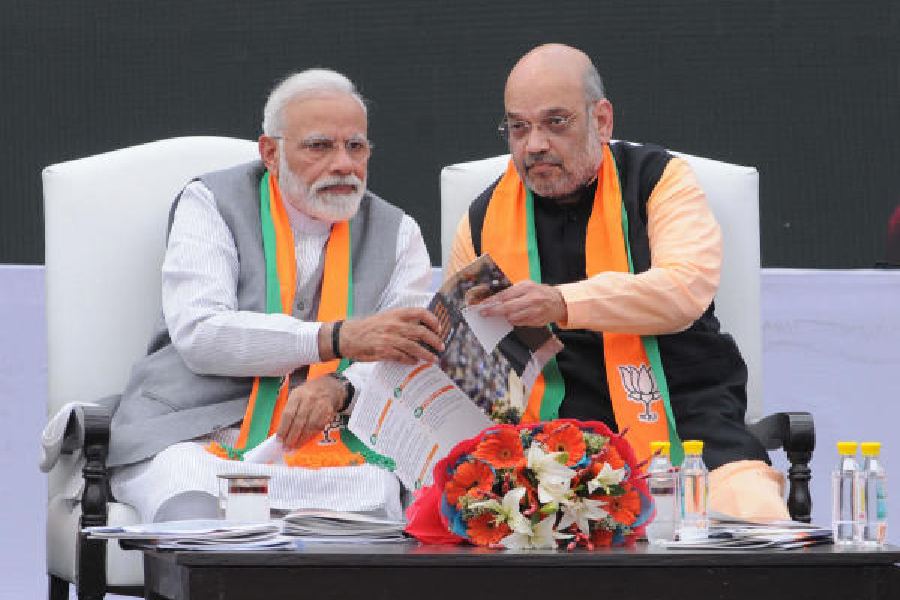
Home minister Amit Shah initiated the discussion and said Bankim Chandra Chattopadhyay wrote Vande Mataram in 1875 against the backdrop of the country facing Islamic invasion and then coming under British rule.
Without taking her name, Shah criticised Priyanka Gandhi Vadra, who on Monday said that the discussion on Vande Mataram was an effort to divert attention from current issues.
“Some Congress leaders questioned the necessity of a debate on Vande Mataram and called it an attempt to divert attention from other issues. Nobody is afraid of a discussion on issues. If you allow Parliament to run, then discussions on all issues can be held. But this mindset of avoiding a debate on Vande Mataram is not new,” Shah said.
The minister alleged that Nehru divided the song into two parts and limited the song to two stanzas, and said it marked the beginning of the appeasement that led to the partition of the country. In its 100th year, Vande Mataram was not celebrated because Indira Gandhi had imposed the Emergency, Shah said.
“Yesterday, in the Lok Sabha, (when) discussions were held to start the celebration of (150 years of the) song, both members of the Gandhi family were absent. The opposition to Vande Mataram continues in the blood of the Congress, from Nehru to the present leadership of the Congress,” Shah said.