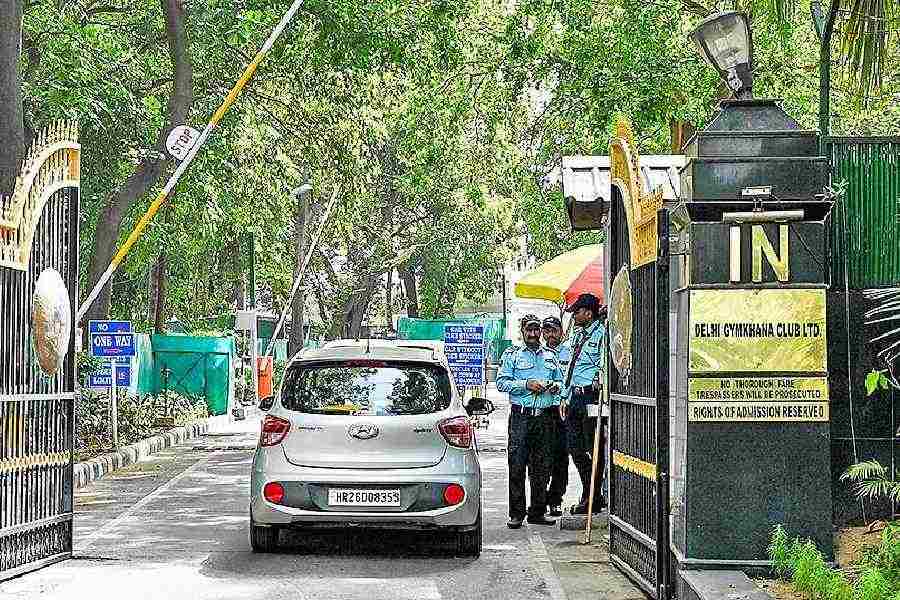
Members of the Delhi Gymkhana Club on Monday moved Delhi High Court against the Centre’s order asking the club to hand over its premises to the government by June 5.
Senior advocate Abhishek Manu Singhvi mentioned the matter before Justice Avneesh Jhingan for an urgent hearing. The court listed the lawsuit for hearing on
Tuesday.
The Union government has asked the Gymkhana Club in Lutyens’ Delhi to hand over its premises by June 5 on the ground that the 27.3-acre land parcel is required for “strengthening and securing defence infrastructure”.
The order, issued by the land and development office under the Union housing and urban affairs ministry, stated that the premises, located in a highly sensitive and strategic area of Delhi, were critically required for the strengthening and securing of defence infrastructure and for other vital public security purposes.
Another lawsuit by the Delhi Gymkhana Club Ltd Staff Welfare Association against the Centre’s order is also scheduled to be taken up by Justice Avneesh Jhingan on Tuesday.
It says that the cooks, waiters, kitchen and housekeeping staff, gardeners and groundsmen, electricians, plumbers, lifeguards and security personnel employed at the club want protection of their source of livelihood as well as their fundamental rights under Articles 14, 19(1)(g) and 21 of the Constitution.
Seeking to quash the Centre’s May 22 order, the plea says the club was not a place of leisure for them but their workplace.
Vijay Khurana, a 79-year-old Gymkhana Club member who filed the first lawsuit, said the “vague and generalised reasons” of defence infrastructure and security given by the Centre were just a “sham” and the move was an “attempt to effect forced eviction” instead of following the due process of law.
The takeover is through a “premeditated and coordinated design” and not for any “genuine or emergent public requirement”, the plea claimed.
Khurana said more than 500 members of the Delhi Gymkhana Club supported the lawsuit.
It seeks to restrain the central government from “illegally determining” the Gymkhana Club’s perpetual leasehold rights and to prevent any forced dispossession from the premises situated on 2, Safdarjung Road, adjacent to the Prime Minister’s residence on Lok Kalyan Marg.
The lawsuit says urgent interim protection is necessary, claiming that the Centre had “threatened” to take possession of the plot on June 5 through “coercive measures” and police assistance, which will result in an “irreversible” and “irreparable” situation.
In the lawsuit, Khurana emphasised that the Delhi Gymkhana Club and its members have invested substantial resources towards the development, maintenance and modernisation of the facility, and the Centre is seeking to dismantle its institutional existence and irretrievably extinguish the “valuable associational, participatory and membership rights accrued over decades”.
He also claimed that the Centre’s notice, dated May 22, is malicious and neither provides for any compensation nor establishes a “bona fide public purpose” in terms of the perpetual lease deed to unilaterally take away “century-old” rights.
The lawsuit argued that the Centre’s decision is in flagrant violation of Article 300A of the Constitution, as records showed that the Delhi Gymkhana Club has proprietary rights over the land, which cannot be taken away arbitrarily without an acquisition process and payment of compensation.
Article 300A states that no person can be deprived of his property except by the authority of law.
“The uninterrupted recognition of Defendant No. 2’s (Delhi Gymkhana Club) perpetual leasehold rights for nearly a century, coupled with continued acceptance of rent and performance of contractual obligations, created a legitimate expectation of continuity and non-arbitrary treatment,” the lawsuit, filed through lawyer Naman Joshi, said.