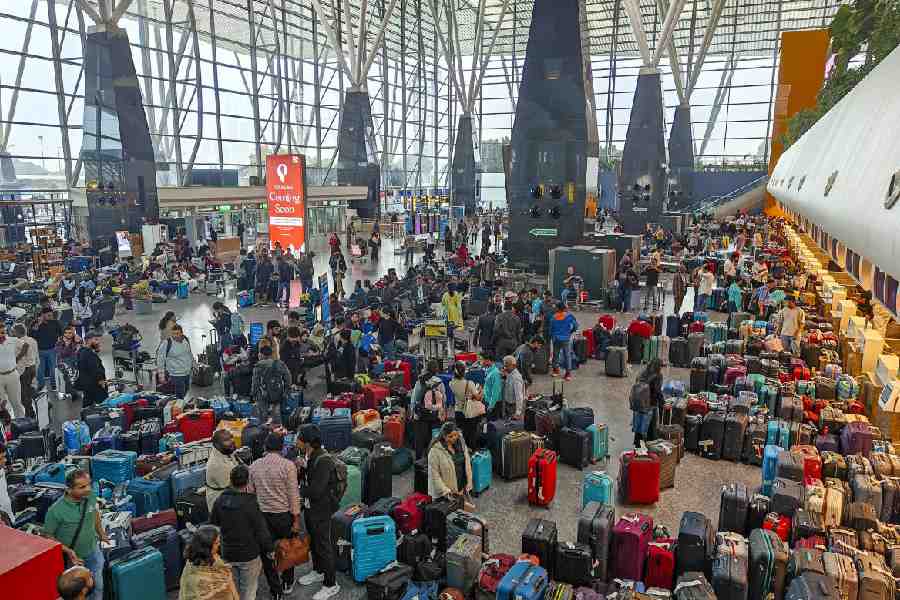
As IndiGo cancelled over 1,000 flights on Friday, continuing the mayhem of the past three days, aviation authorities provided relief by freezing the new aircrew fatigue rules while forming a committee to review the airline’s “deficiencies” that caused the crisis.
Civil aviation minister K. Ram Mohan Naidu gave IndiGo three days to resume full flight services, but a statement from company CEO Pieter Elbers later said normalcy would be restored between December 10 and 15.
Trying to resolve the mess, aviation regulator DGCA had initially said it would allow all airlines to substitute the new weekly rest period for aircrew with leave — to be presumably claimed later — and waive the night-duty limits for pilots.
Later, the aviation ministry announced that the entire gamut of Flight Duty Time Limitations (FDTL) — introduced from November 1 to provide adequate rest to pilots and cabin crew — would remain in abeyance. It did not say for how long.
A livid DGCA suggested that IndiGo has been asleep at the wheel.
Naidu said the decision had been taken solely in the interest of the passengers, especially the elderly, students, patients and others who rely on timely air travel for essential needs.
A pilots’ association repeated its claim that the massive flight disruptions were an IndiGo ploy to arm-twist the authorities into easing the new FDTL rules, after failing to plan in advance for them and continuing a recruitment freeze.
Elbers apologised publicly for the situation and said IndiGo would reduce cancellations from Saturday after rebooting all its systems and schedules. He thanked the DGCA for the relief, which came after a meeting between the regulator, IndiGo and the government.
Regulator rap
The DGCA, however, had a few stinging remarks for the airline, which it accused of “inability to accurately forecast crew availability, conduct timely training, and realign rosters” despite advance knowledge of the new FDTL rules that curtail work hours and lengthen rest periods.
It said IndiGo had “acknowledged that it has failed to anticipate the actual crew requirement under the revised norms and that significant planning and assessment gaps existed in implementing” the new rules.
Saying this warranted “an independent examination”, the regulator formed a committee to review and assess the circumstances behind the crisis.
Its members are joint DGCA director-general Sanjay K. Bramhane, deputy DG Amit Gupta, senior flight operations inspector Captain Kapil Manglik, and flight operations inspector Captain Lokesh Rampal.
The regulator also urged all the pilots’ associations to help restore smooth flight operations.
The government has decided on a high-level inquiry into what went wrong at IndiGo, fix accountability, and suggest ways of preventing repeats.
The Airline Pilots’ Association of India reiterated its allegation, first made on Thursday, of an “artificial crisis”.
“IndiGo failed to organise its roster and instead increased its operations for winter,” it said in a statement on Friday.
“It is equally questionable how such large-scale disruptions surfaced 35 days after” the new rules were enforced, it added.
Passenger care
The aviation ministry told airlines to provide regular and accurate online updates to passengers so they can monitor flight status from their homes.
“In case of any flight cancellations, the airlines will issue full refunds automatically, without the need for passengers to make any requests. Passengers who are stranded due to prolonged delays will be provided hotel accommodation arranged directly by the airlines,” the ministry said.
“Special priority is being accorded to senior citizens and differently abled. They will be provided lounge access and every possible assistance to ensure that their travel experience remains comfortable. Furthermore, refreshments and essential services will be provided to all passengers affected by delayed flights.”
Hotel fares
Hotel fares have surged as has occupancy in the upscale Aerocity, 3-5km from the various terminals of Delhi airport, following the flight cancellations.
“Hotel prices change with occupancy, and bookings have risen sharply because of the wedding season. The flight cancellations, too, have pushed more travellers into hotels,” a source said.
A flood of bookings by Russian delegates accompanying President Vladimir Putin, too, has raised occupancy at the luxury hotels.
Besides, how early or late one books a hotel room can heavily affect the price. For instance, a room at the Lemon Tree Premier that charges ₹13,000 if booked a week in advance costs ₹31,000 if booked for the same day.
The government had in January last year indicated changes to flight duty norms to give aircrew more rest. After the go-ahead from Delhi High Court in April this year, the new FDTL was implemented in two phases: July and November.
All airlines had been repeatedly advised to plan their manpower and restructure their rosters for a smooth switch. But IndiGo, which operates 2,300 flights daily, cancelled 1,232 flights in November, 755 of them because of crew shortage. Then came the latest chaos.
Aviation expert and Avialaz Consultants CEO Sanjay Lazar told The Telegraph: “Despite having fewer pilots, IndiGo chose to operate 900 more flights in winter and stopped pilot recruitment six months ago. It is shocking that IndiGo had not planned its winter schedule like all airlines normally do....”