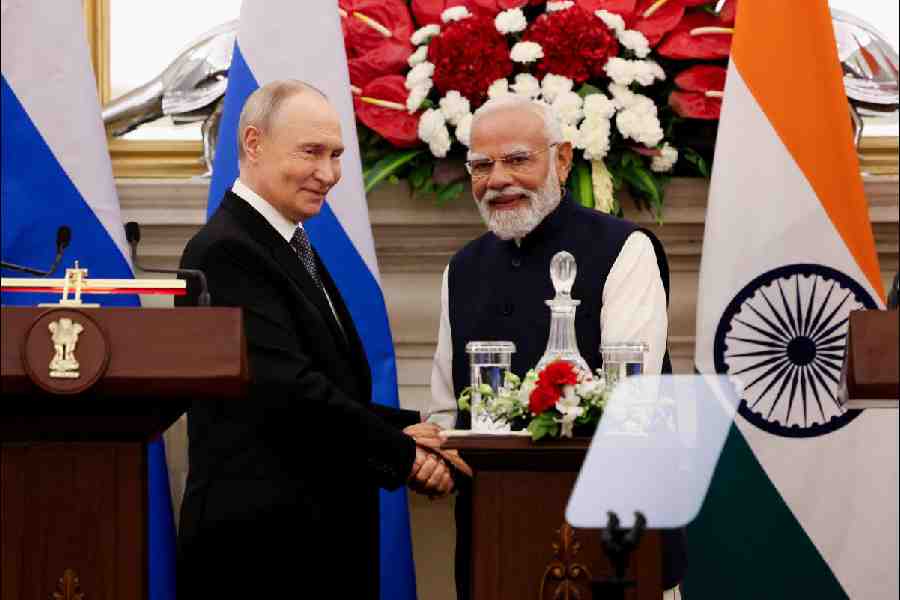
India and Russia staged a diplomatic love-in on Friday, using Vladimir Putin’s first trip to New Delhi in four years to showcase to the world a partnership they both insisted was as warm and unshakeable as ever.
No one is yet sure how much concrete will come out of the day’s sweeping announcements, but the choreography left little doubt India was signalling to Washington it has no intention of cooling ties with Russia despite US pressure.
Against the backdrop of stalled trade talks with Washington, punishing US tariffs on Indian goods over its purchases of Russian oil and tightening American sanctions on Russian crude shipments, Prime Minister Narendra Modi rolled out the red carpet for Putin.
Modi cast the partnership as historic and unshakeable: “Over the past eight decades, the world has witnessed many challenges, but the India-Russia friendship has remained steadfast like a Pole Star.”
Putin echoed him: “Our relations are deeply rooted in history, but it is not words that matter; it is the substance, which is profound.” For Putin, the visit was a chance to demonstrate that Russia still has good friends despite the war in Ukraine.
Modi hosted Putin at Hyderabad House for the 23rd annual India–Russia summit, where the two leaders unveiled an ambitious “Vision 2030” roadmap and an economic cooperation programme aimed at pushing annual trade to $100billion by 2030, though the details remain to be fleshed out.
At the end of his whirlwind 27-hour visit on Friday evening, Putin was hosted at a grand state dinner at Rashtrapati Bhavan where the Tri-Services military band played a medley of Indian and Russian classics.
About 150 guests, including senior government officials and business leaders, gathered under the chandeliers, but not everyone made the cut. Congress MP Shashi Tharoor was on the invite list while party president Mallikarjun Kharge and Rahul Gandhi were snubbed, drawing charges from Congress that the government was “breaching all protocols.”
Modi and Putin said the bilateral partnership was entering a new phase after Russia emerged as India’s key supplier of cheap crude following Western sanctions on Moscow following its invasion of Ukraine.
Modi said that India–Russia trade was now settled “96 per cent in national currencies” and that the two sides could reach their $100bn trade target “ahead of 2030.” Putin, standing beside him, pledged that Russia would remain a dependable energy partner.
“Russia is a reliable supplier of oil, gas, coal and everything that is required for the development of India’s energy… We are ready to continue uninterrupted shipments of fuel for the fast-growing Indian economy.”
Russia remains India’s largest arms supplier, despite a decline in its share. Putin reminded Modi that Moscow had supported India’s armed forces for “the last half century,” providing air defence, aviation and naval systems.The Russian leader, who was accompanied by a large business and government delegation, also highlighted cooperation in “hi-tech aircraft, space exploration and artificial intelligence,” signalling Moscow’s effort to modernise the relationship beyond its pillars of defence and energy.
The summit expressed support for a Free Trade Agreement with the Eurasian Economic Union, which both sides cast as a key tool for diversifying trade, particularly in pharmaceuticals, food products, agriculture and consumer goods.
But while Modi and Putin agreed to expand commerce “in a balanced and sustainable manner,” no specific measures were announced that would substantially reduce India’s massive trade deficit with Russia, which has been fuelled by the surge in India’s buying of Kremlin crude oil since the start of the Ukraine war in 2022.
Civil nuclear energy was one of the few areas with clearly defined projects. Putin said Russia was working with India to bring the Kudankulam nuclear plant to full six-reactor capacity.
“Two of the six reactor units are already connected to the grid, while four more are under construction,” Putin said.He added that both countries were exploring small modular reactors, floating nuclear plants, and industrial and agricultural uses of nuclear technology.
Modi called nuclear cooperation “crucial to realising our shared clean energy priorities,” promising to continue “this win-win partnership.”
India and Russia signed agreements on migration and mobility, ports and shipping, food safety and health, plus a framework that would make it easier for Indian workers to move to Russia.
Modi also announced a move to promote cultural ties. “We will soon be launching a free 30-day e-tourist visa and a 30-day group visa for Russian citizens,” he said.
Modi reiterated India’s familiar position on the Ukraine war. “India has advocated for peace on the Ukraine issue from the very beginning… We welcome all efforts for a peaceful and lasting resolution.”Putin told Modi he valued India’s diplomatic engagement.“We are working with some partners, including the US, on a possible peaceful settlement,” he said.
Putin began his day at Rashtrapati Bhavan, where he was received by President Droupadi Murmu. Modi greeted him with a long handshake and broad smile. The two then travelled together, unusually, in the Indian prime minister’s Toyota Fortuner.
At Rajghat, Putin laid a wreath at Mahatma Gandhi’s memorial. In the visitor’s book, he wrote that Gandhi “made an invaluable contribution to the cause of peace on the entire planet.”