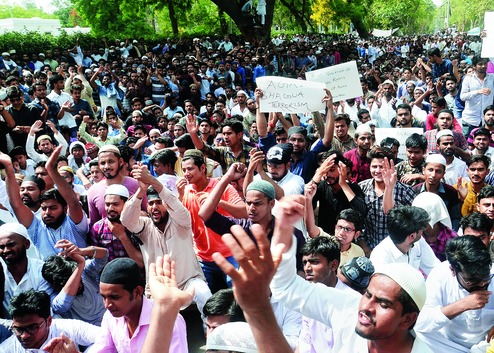

New Delhi: Aligarh Muslim University has urged the Centre to frame a policy on how institutions should deal with pictures of, or references to, controversial personalities following the uproar over Muhammad Ali Jinnah's portrait on its campus.
"The government should come up with a legal framework on how to deal with controversial issues, including portraits in educational institutions," the university's public relations officer, Omar Peerzada, told The Telegraph.
He could not confirm whether the university would officially write to the Centre about this.
Varsity sources cited how Jinnah House in Mumbai bears the Pakistan founder's name, and how the Indian Institute of Advanced Studies (IIAS) website mentions Jinnah in connection with the Shimla Conference of June 1945, held at the Viceregal Lodge to discuss India's progress towards full self-governance.
"From 25 June to 14 July 1945 the conference was held at the lodge. A wide spectrum of Indian political leadership was present - Pandit Jawaharlal Nehru, Maulana Azad, Liaqat Ali Khan, Bhulabhai Desai, Master Tara Singh and Mohammed Ali Jinnah," the website says.
Khan later became Pakistan's first Prime Minister.
Bhalchandra Mungekar, a professor who was IIAS chairperson from 2007 to 2012, defended the website's reference to Jinnah and the display of his picture at the AMU students' union office.
"Jinnah was born in undivided India. The Viceregal Lodge witnessed discussions on the transfer of power, and Jinnah was present. It's fine to mention him," Mungekar said.
He said the protests against the AMU portrait were driven by "divisive politics".
"If Jinnah's portrait had not bothered anyone from the time of the Partition in 1947 till today, why should it be an issue now?" said Mungekar, former vice-chancellor of Mumbai University (earlier Bombay University, from which Jinnah had earned his matriculation).
"It's a pretext to arouse communal passions and seek political polarisation solely from the point of view of elections. All Sangh parivar affiliates should desist from politics in the nation's long-term interest."
The human resource development ministry has so far not intervened in the Jinnah controversy at AMU, a ministry spokesperson clarified on Friday.