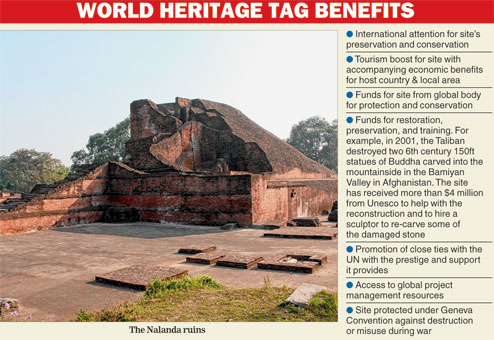
Patna, July 17: Nalanda and Bihar are celebrating the World Heritage seal pinned on the Nalanda University ruins but the feat has been achieved after a lot of last-minute persuasion, which puts a lot of responsibility on the newest member of the elite list to match the expected standards.
Picture this: there are no hotels or quality eateries near the ruins, hence tourists don't stay the night. As per the commitment to the World Heritage Committee of Unesco, venders on the approach roadhave to be rehabilitated. Vehicular movement on the approach road has to be stopped by providing alternate routes. Parking areas are to be developed and only battery-operated vehicles are to be allowed in the vicinity of the ruins.

Besides, there should be provisions for foreign exchange, cloak room, waiting room, amenities for differently-abled persons. A site management plan is to be strictly followed by the Archaeological Survey of India (ASI) and state authorities, and construction has to be be restricted in the buffer zone. Connectivity is also poor from Patna and elsewhere in the state; there are no government-run tourist buses to Nalanda.
Unlike the gradual urbanisation around Mahabodhi Mahavihara in Bodhgaya (the first monument from Bihar to be included in the World Heritage list back in 2002), the Nalanda ruins are still seen as an archaeological site surrounded by rural settlements. Though most countries ensure they meet pre-requisites related to development in and around the proposed site before they approach Unesco, authorities here hardly took any such measures at Nalanda even six years after 2009, when the ancient university was included in the tentative list of World Heritage sites.
"The World Heritage status has come with a lot of responsibilities," Manoj Saxena, ASI's assistant superintending archaeologist at Nalanda, told The Telegraph. "There are several proposals to ensure tourists coming here from across the world get a comfortable stay and the local people benefit. Both the central and state governments now need to work together to execute such proposals in a time-bound manner." Apart from the proposals in the dossier submitted to Unesco, officials from the ASI as well as the state made commitments to Japanese expert Masaya Matsui, who assessed the Nalanda ruins in August 2015 for the International Council of Monuments and Sites that advises Unesco on World Heritage sites.
The Telegraph highlights key aspects of the proposals to help the Nalanda ruins match World Heritage standards:
Pending plan
This deals with development of facilities at the site and the conservation plan over the next five years. ASI assistant superintending archaeologist Saxena said world-class facilities would now have to be provided at the Nalanda ruins. "There are certain proposals in the pipeline for future development of the site, including a new drainage system, reverse-osmosis drinking water supply for visitors, dedicated pathways for the visually impaired and wheelchairs," he said.
Vehicle regulation
All heavy vehicles coming to the ruins are to be parked near the lake in front of Nava Nalanda Mahavihara, an institute of Pali language 400m south of the site. Battery-operated vehicles are proposed to take tourists from the drop point to the ruins. A parking area is to be developed on a plot around a kilometre from the heritage ruins, where smaller vehicles are to be parked. These vehicles are also to take alternate routes to reach the parking area; the entire approach road is to be made traffic-free.
Construction curbs
The ASI initially wanted a 1km buffer zone around the excavated site but the state government agreed to restrict it to 300m. Minimal construction and other human activities are permitted in the buffer zone. Deepak Anand, a heritage scholar at Nalanda, claimed construction activities happen within the restricted buffer zone as well. Sources claimed that the ASI is acquiring land in the buffer zone to prohibit construction.
Shopping areas
To comply with the mandate of economic uplift of the local population, shopping complexes and commercial establishments need to be developed near the ruins to rehabilitate around 50 shops on either side of the approach road.
Officialspeak
Nalanda DM Thiyagarajan S.M. said: "A cultural village is being developed at Xuanzang Memorial, close to the ruins. Ponds around the ruins are also to be beautified. Footpaths are proposed to be constructed in the buffer zone."