|
 |
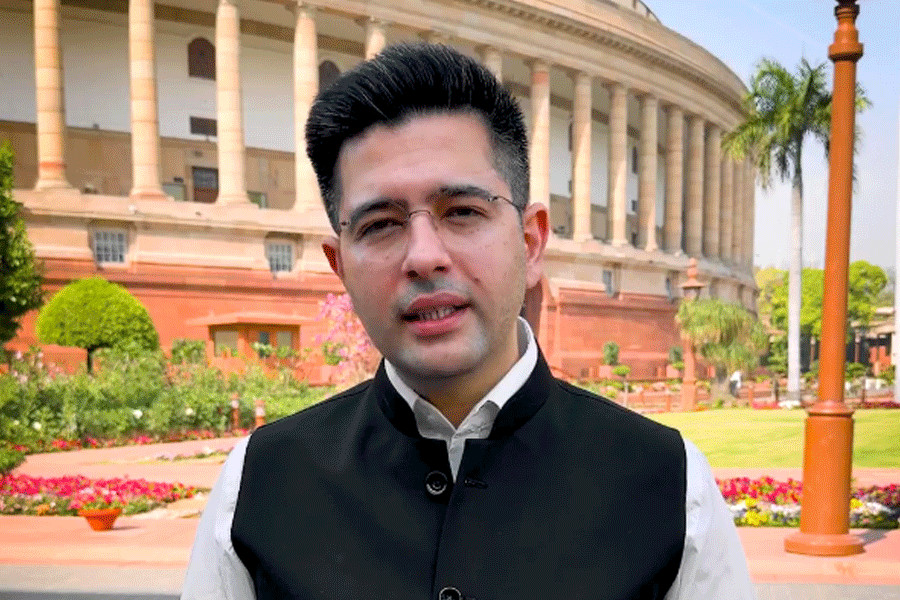
| (Top) Ramakrishnan with wife Vera Rosenberry at Windsor Castle; Queen Elizabeth and Pratibha Patil at the welcome ceremony. (Reuters) |
London, Oct. 27: Venkatraman Ramakrishnan, the unlikeliest hero of our times, was last night the focus of attention, not once but twice, when President Pratibha Patil met members of the Indian community.
“There are too many Indian persons present here today for me to single them out individually but it would be remiss if I did not recognise Professor Venkatraman Ramakrishnan who was very recently awarded the Nobel Prize for chemistry,” announced Nalin Surie, the Indian high commissioner.
In the cavernous Westminster Ballroom of the Mariott Hotel in Grosvenor Square, there were 40 tables, each with 11 Indians. All had come for an evening with the President at the start of her state visit to the UK.
Ramakrishnan, who had come with his wife Vera Rosenberry, a children’s author, was next praised by the President herself.
“Most recently,” Patil said, “we were delighted at the news of the Nobel Prize for chemistry being conferred on Dr Venkatraman Ramakrishnan, an Indian-origin scientist currently working at the University of Cambridge. He is here today — we all congratulate him.”
Table by table — for some strange reason they were named after English flowers —went up in groups to be photographed with the President.
A master of ceremonies kept up a running commentary: “…and now she is meeting the Nobel winner….”
A cross section of Indians present was asked the same question: “The President of India — the first woman President — is here, so how do you feel?”
“Great,” said Lord (Swraj) Paul as he chatted with Indian foreign secretary Nirupama Rao.
Lord (Raj) Bagri repeated: “Great.”
Ever the intellectual, Lord (Bhikhu) Parekh commented: “I feel great,” but elaborated, “what we have here is the cream of the community. It shows how much we have advanced in 50 years.”
Patil’s presence had clearly touched a chord.
Rini Kakati, an Assamese community worker, said simply: “I feel so honoured to be here, so proud to be Indian.”
“It’s good the President wants to meet us,” said Vina Mithani, a Tory councillor from Harrow who had come to Britain at 15 from Ethiopia.
“I feel thrilled that India is setting an example to the world,” said Lady (Sandip) Verma, a Tory.
“India is no more a Third World country,” insisted Kanti Nagda, who had to flee Uganda in 1972 when she was 24. “Indians can find water on the moon.”
Maneck Dalal, who is 90 and has lived in Britain for 72 years, walked in with veteran actor Saeed Jaffrey.
“We feel deeply about our roots,” said Maneck, who was once regional director for Air India in London.
As for the future, Tory MP Shailesh Vara, who led a Conservative Parliamentary Friends of India delegation on a recent trip to the country, said leader of the Opposition David Cameron would make India a priority if he won the next election.
Anwar Hasan, the managing director of Tata, exuded optimism: “We employ 47,000 people in the UK. I think there are even better times to come for Brand India and Brand Tata.”
Jaideep Prabhu, the first Jawaharlal Nehru Professor of Indian Business and Enterprise at Cambridge, felt “very excited”.
“We are at a very important stage in our relationship,” Prabhu said.
Mayor Boris Johnson’s transport adviser, Kulveer Ranger, hailed the “forward thinking, dynamic powerhouse” that is India.
There was only one crucial element that no one had mentioned. No one had thought to recognise that Britain had provided an exceedingly hospitable environment in which Indians had flourished. Perhaps at some point, President Patil will remember to say “Thank you” on behalf of nearly 2 million Indians settled in the UK.