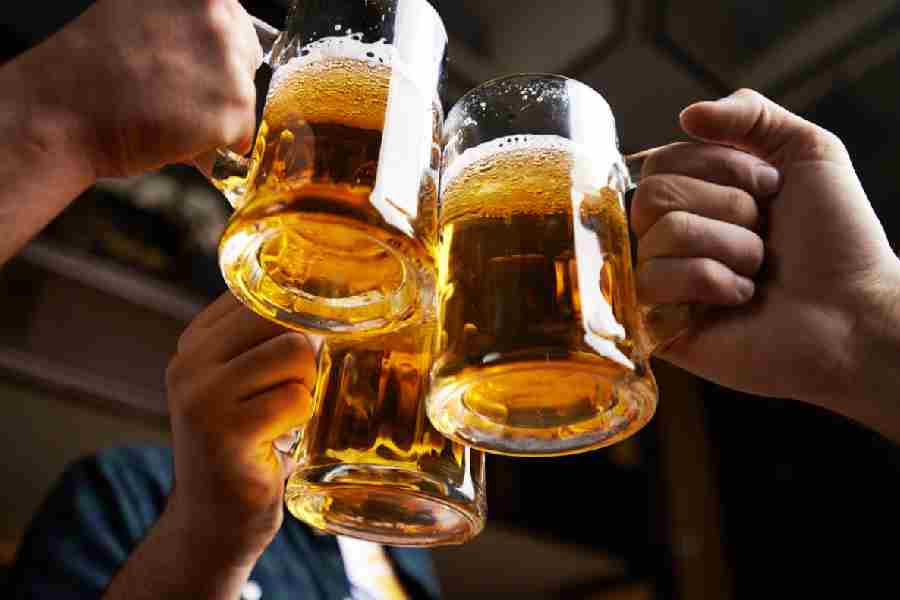
Just a few gulps of beer a day can increase the risk of mouth cancer, researchers reported on Tuesday, adding to evidence that there may be no safe limit for alcohol consumption.
The researchers at the Tata Memorial Centre (TMC) cancer epidemiology unit have found a 59 per cent higher risk of mouth cancer in people who drank, on average, just two grams of alcohol from beer daily, compared with those who didn’t drink.
Their study is India’s first large-scale analysis probing the link between alcohol and cancer of the buccal mucosa — the pink lining of cheeks and lips. Buccal mucosa cancer is the second most common malignancy in India after breast cancer, with estimates of 1,40,000 new cases and nearly 80,000 deaths each year.
People who consume more than one glass of alcohol a day and chew tobacco are nearly five times more at risk of developing mouth cancer compared to those who neither drink nor chew tobacco.
The findings, published on Tuesday in the journal BMJ Global Health, suggest that the joint impact of alcohol use and tobacco chewing accounts for 62 per cent of buccal mucosa cancer cases in the country.
“We see an unmistakable pattern: the more alcohol people drink, the greater their risk of buccal mucosal cancer,” Sharayu Mhatre, head of the molecular epidemiology and population genomics unit at the TMC’s Centre for Cancer Epidemiology in Navi Mumbai, who led the study, told The Telegraph.
Among 100 patients diagnosed with locally advanced buccal mucosal cancer in India, 57 die within five years, a stark mortality rate that researchers say makes the disease an urgent target for prevention and control.
Beyond reinforcing the alcohol-cancer link, the study found that the highest risks were associated with unregulated, locally brewed drinks, which often contain higher levels of ethanol than regulated beverages.
The researchers analysed the duration, frequency and type of alcohol consumption among 1,803 patients with buccal mucosal cancer and 1,903 healthy controls, including beer, whisky, vodka, rum, flavoured low-alcohol beverages and locally brewed drinks.
The ethanol concentrations ranged from 5 per cent in beer to 40 per cent in whisky or vodka, about 60 per cent in bangla — a distilled spirit consumed in Bengal — and 90 per cent in tharra, consumed in parts of northern India.
Overall, alcohol consumption was associated with a 68 per cent higher risk of buccal mucosal cancer compared with those who did not drink. The risk rose to 72 per cent among consumers of regulated drinks and 87 per cent among those who drank locally brewed liquor.
Elevated risks were evident even at low levels of consumption, such as two grams of alcohol a day from beer or about nine grams — roughly one glass — from stronger drinks like whisky or vodka.
The study has also found what the researchers say is a “more than additive” risk. Tobacco chewing alone came with a 200 per cent enhanced risk, alcohol alone to a 76 per cent risk, but the combination a 346 per cent risk.
Mhatre said the findings were consistent with earlier research suggesting that ethanol can alter the structure of the mouth’s inner lining, increasing its permeability and making it vulnerable to carcinogens in tobacco.
Rajesh Dikshit, director of the Centre for Cancer Epidemiology, said the results underscored the need for greater public awareness about the risks associated with even moderate amounts of alcohol and scrutiny of unregulated locally brewed liquor.
The World Health Organisation had in 2023 cautioned that no level of alcohol is safe for human health. The agency had cited research data indicating that half of all alcohol-linked cancers in the WHO’s European Region are caused by “light” or “moderate” alcohol consumption.