Sunday, 28 June 2026
Sunday, 28 June 2026
Sunday, 28 June 2026
Man in UP takes a ‘power’ nap
The thin — and increasingly blurry — line between reel and real has faded a little more in Uttar Pradesh.
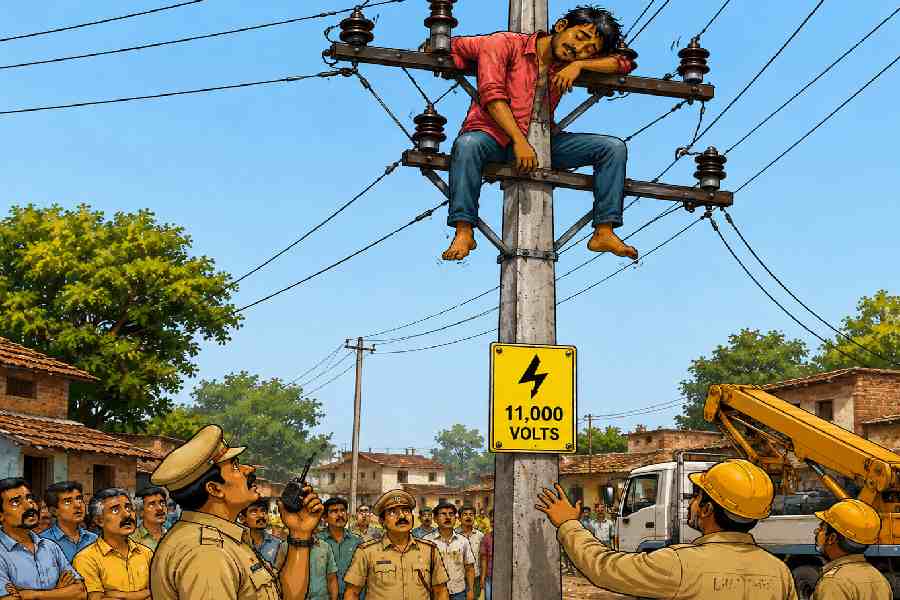
Now replace the water tank with an 11,000-volt electricity pole and remove the romantic subplot altogether. Suddenly, what sounds like a rejected Bollywood script turns into a police case.
The protagonist of this real-life drama was a man from Uttar Pradesh's Maharajganj district, who, in an inebriated state, climbed a 11,000-volt electricity pole and remained perched there. His motive, however, was neither love nor protest. According to reports, the man simply wanted to sleep on the electric wires and, hopefully, sleep off his hangover.
The incident, which occurred on Tuesday in Parsa Khurd village, left residents horrified and social media thoroughly entertained.
Watching videos of the bizarre episode, one social media user quipped, "Alcohol equals Aaj Kuch Toofani Karte Hain" — borrowing the iconic slogan of soft drink brand Thums Up. Another remarked, "That's one hell of a power nap."
One man's hangover was enough to send both the police and the electricity department scrambling. Meanwhile, residents bore the brunt of the drama under the unforgiving summer heat, as power supply to the entire area had to be suspended to avert a tragedy.
Jyoti Basu, Fifa and a quiz
Bengalis may often dislike — or even oppose — the stereotypical lens through which the rest of India views them. Yet, more often than not, the stereotypes hit the bull's eye.
Take, for instance, the FIFA World Cup quiz competition to be held at the Jyoti Basu Centre for Research on July 4. A celebration of football hosted in honour of former chief minister Jyoti Basu is perhaps the most Bengali event conceivable — a classic cocktail of Marxism and football, loudly ticking every stereotype box.
Playback singer Manna Dey had long immortalised Bengal's football obsession in 'Sab Khelar Sera Bangalir Tumi Football' (Of all games, you, Football, are the best for Bengalis).
Now throw Marxism into the mix — embodied here by Basu, the CPM's most revered statesman, on whose 113th birth anniversary the quiz is being organised. The only thing missing to complete Bengal's holy trinity is fish.
Love reaches new heights
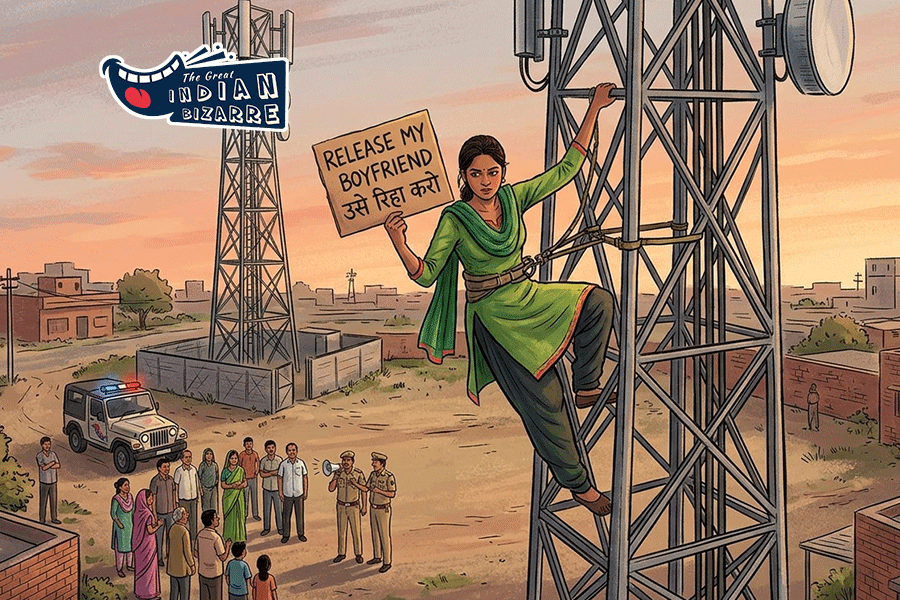
Love reached new heights again in Jharkhand’s Bokaro district, after a 17-year-old girl on Tuesday climbed a 100-foot mobile tower and tried to stage a protest demanding the release of her jailed boyfriend.
The scene might look something out of a Bollywood movie; however, the chaos erupted when the teenager refused to climb down from the mobile tower unless her 22-year-old boyfriend was let go and released from Tenughat jail. This left the police, onlookers, and the residents of the nearby villages trying to find ways to get the girl down safely.
The boyfriend's troubles began after the girl's mother filed a complaint accusing him of abducting her daughter. While the police did not have a hard time locating the couple in Ranchi's Sukhdeo Nagar area, they had trouble trying to bring the girl down from the 100-foot mobile tower.
And while the authorities scrambled to convince the teenager to descend safely, the mobile tower became a symbol of rebellion and relationship goals gone wildly off-script.
Maharashtra farmer takes unusual route to demand debt relief
A farmer in Maharashtra captured social media attention after he arrived at a Tehsil office riding a bull to press for a farm loan waiver.
The farmer rode a bull inside the office to protest against mounting debt and the economic hardships confronting the agricultural community.
Videos of the protest quickly spread across social media platforms, where the unusual scene sparked widespread discussion. Many users expressed sympathy for the farmer's plight, while others pointed to the incident as a reflection of the broader agrarian crisis affecting several parts of the country.
The viral video has now renewed focus on long-standing issues that have plagued the farmers for a longtime including farm indebtedness, crop losses caused by unpredictable weather, and the challenges of sustaining agricultural livelihoods.
Constable lathi-charged SDM
A routine attempt to disperse protesters took an unexpected turn after a police officer's lathi reportedly landed not on a demonstrator, but on a senior official overseeing the operation.
Social media users who saw the viral video said the officer, amid the confusion of the lathicharge, appeared to momentarily "upgrade" his target list, accidentally striking the SDM instead. The protest, for a few seconds, became the only event where the administration found itself on both sides of law enforcement.
Observers noted that while the police were tasked with controlling the crowd, one officer briefly demonstrated that hierarchy can be flexible under pressure. It seemed like crowd control, like justice is also blind.
The officer is not believed to have intended the blow, though the internet has already promoted him from constable to "equal opportunity enforcer."
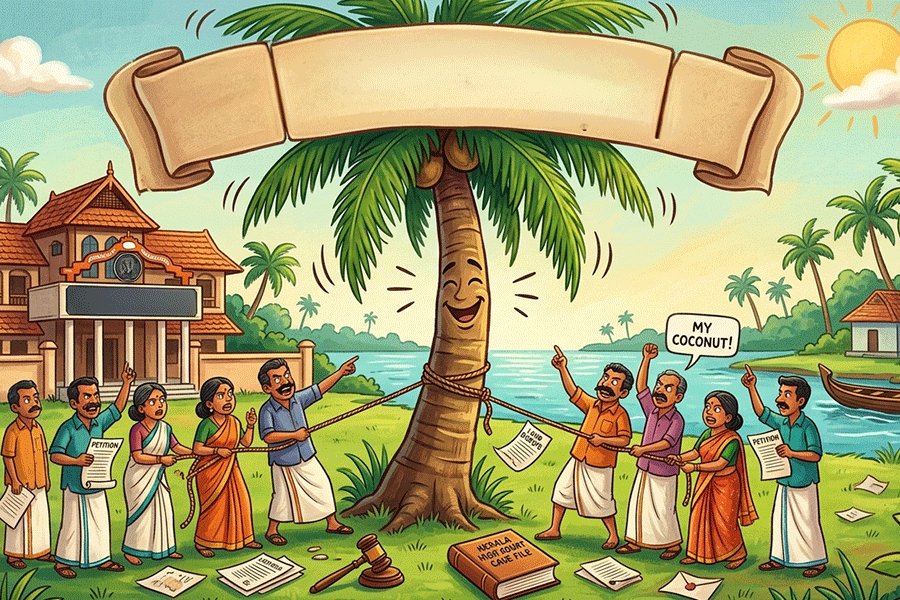
Kerala HC uses humour, Bible to end dispute over coconut tree
A dispute over a coconut tree became a High Court matter before ending with a judicial recommendation for tea instead of litigation.
Hearing a petition over coconuts allegedly falling onto a neighbour's vehicles, Justice P.V. Kunhikrishnan urged the feuding homeowners to stop fighting and start talking.
The homeowner had claimed that coconuts falling from a tree on his neighbour's property endangered his family and damaged his vehicles. But the court concluded that the real problem appeared to be less about coconuts and more about egos.
Quoting the Bible, the judge reminded the neighbours to "Love your neighbour as yourself," before directing them to "sit together over coffee or tea to resolve the dispute."
Justice Kunhikrishnan then delivered what may become one of the year's most memorable judicial observations: "If a coconut tree has the capacity to laugh, the coconut tree might have laughed towards these fighting neighbours... The ego seems far less flexible than the coconut tree in question."
Although the judge remarked that both parties deserved to pay costs for consuming valuable judicial time, he ultimately let them off.