Monday, 15 June 2026
Monday, 15 June 2026
Monday, 15 June 2026
The European Commission and several other countries have condemned Tel Aviv’s decision to make death by hanging the default sentence for Palestinians convicted of deadly attacks and of murdering Israelis.
A European Commission spokesperson on Tuesday called the move “very concerning”.
"This is a clear step backwards," the spokesperson said. "We call Israel to abide by its previous principled position, its obligation under international law and its commitment to democratic principles."
He added he had no speculation to make regarding any steps that could be taken by the EU Commission over Israel's move.
Germany said it regretted the decision and warning that the law is likely to apply almost exclusively to Palestinians in the Palestinian Territories.
"Understandably, Israel has taken a hard line against terrorism since October 7. However, the German government views the law passed yesterday with great concern," a government spokesperson said.
Germany, which opposes capital punishment, said it cannot endorse Israel’s decision.
Spain’s Prime Minister Pedro Sanchez criticised the law, calling it unequal.
"The Spanish government condemns the death penalty against Palestinians" recently approved by Israel’s parliament, he wrote on X.

He called the measure "asymmetrical," adding that it "would not be applied to Israelis who commit the same crimes."
"Same crime, different punishment. That is not justice," Sanchez said. "The world cannot remain silent."
The Arab League said the law violates international humanitarian law and entrenches discrimination against Palestinians.

It warned the move could lead to further escalation in the region.
Portugal also criticised the decision.
“Portugal, a pioneering country in the abolition of the death penalty, condemns and regrets the decision of the Israeli parliament to approve a law that broadens the scope of the application of the death penalty. Such a decision represents a civilisational setback that gravely undermines human dignity,” Portugal’s ministry of foreign affairs said in a statement.

The Council of Europe called the approval a “serious setback”. Its leader Alain Berset said the law is a “legal anachronism” and any discriminatory application would be “unacceptable” in a state governed by the rule of law.
Ireland raised concern over what it described as the discriminatory nature of the legislation.
“The right to life is a fundamental human right and Ireland is consistently and strongly opposed to the use of the death penalty in all cases and in all circumstances,” a statement said.
Italy’s foreign minister Antonio Tajani said Italy, Germany, France and the United Kingdom had asked Israel to withdraw the bill before it was passed.
“The commitments undertaken, especially with the resolutions voted on at the United Nations, for a moratorium on the death penalty cannot be disregarded,” Tajani wrote on X. “For us, life is an absolute value; arrogating to oneself the right to take it away in order to inflict a punishment is an inhuman measure that violates the dignity of the person.”
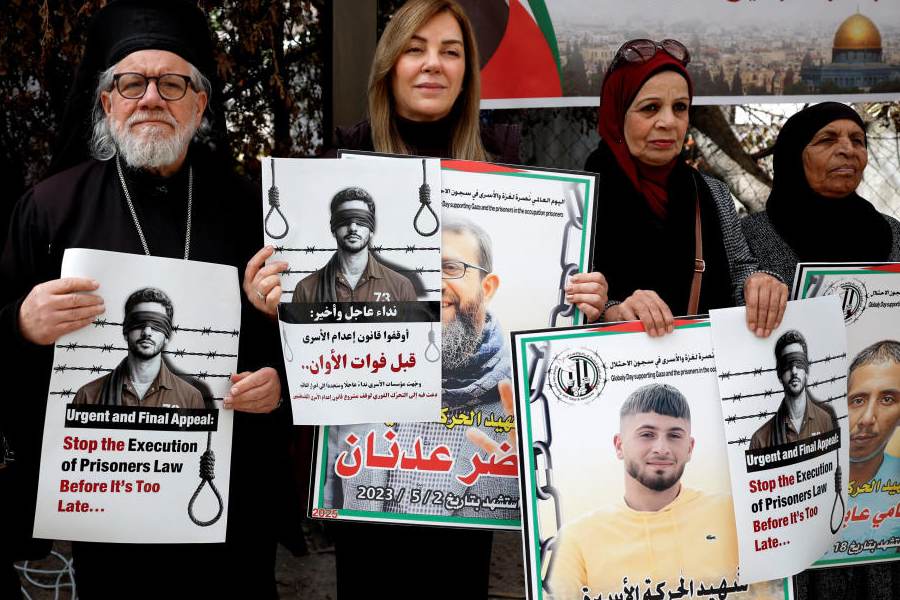
On the ground, protests broke out across the West Bank. In Nablus, demonstrators held signs reading: "Time is running out, and silence is deadly," and "Stop the law from executing prisoners, before it's too late."
The law applies to West Bank military courts, which try only Palestinians, making the death penalty the default sentence in such cases. It will not apply to current prisoners but has raised fears about future cases.
Israel’s national security minister Itamar Ben-Gvir, who pushed for the law, said it was long overdue. The law is set to take effect in 30 days, though it could face legal challenges.
Palestinian authorities have called for international action. The Palestinian foreign ministry urged sanctions and said: "The law represents a critical turning point in the formalisation of extrajudicial killings under a legal guise. The Ministry stresses that this law, in its essence, constitutes an institutionalised policy of field executions based on discriminatory and racist standards."
Amnesty International said the law could violate the right to life and protections against cruel punishment under international law.
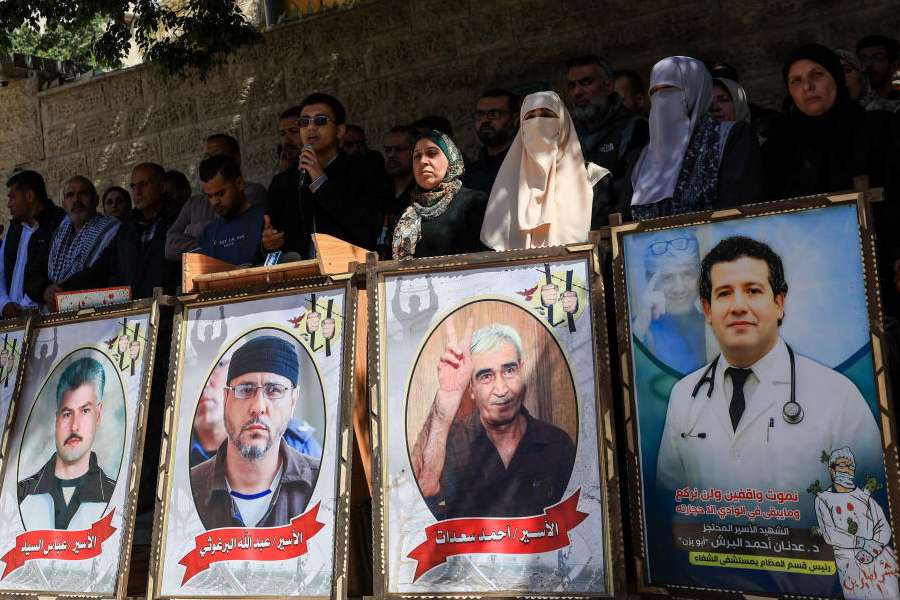
In Gaza, protests were also held outside the Red Cross headquarters, where demonstrators carried photographs of prisoners, including Marwan Barghouti.
The law also extends to Israeli courts in cases of nationalistic murder. Legal experts say the wording effectively limits its use to Palestinians, including Palestinian citizens of Israel, while excluding Jewish citizens.
The bill was passed late Monday in Israel’s parliament and will come into force next month if not delayed by court proceedings.