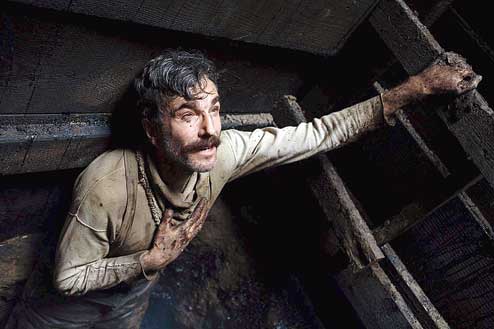

1. THERE WILL BE BLOOD
Paul Thomas Anderson, 2007
Manohla Dargis: There Will Be Blood is a 21st-century masterpiece about love, death, faith, greed and all the oil and blood gushing through the American 20th century. It distils a harrowing story through a prospector — played with demonic intensity by Daniel Day-Lewis — who pursues a savage, hollow dream. He embodies the best of the United States only to become the very worst of it. The film offers a profound and deeply unsettling vision of the country, but it’s also a testament to one of this nation’s sublime achievements: the movies.
A.O. Scott: While I am endlessly fascinated by what this movie is about — the dynamic, infernal spirit of American capitalism; the dialectic of faith and greed; the invention of California; the melodrama of modern masculinity — I am perpetually astonished by what it is. It is stranger than any of its themes, mightier than its influence and bigger than any of the genres it explores. That opening sequence lasts almost 15 minutes before the first line of dialogue is uttered, and it sets the table (or stirs the milkshake) for the many bravura set pieces that follow, like the explosion of the drilling rig midway through. I never tire of thinking about There Will Be Blood. But every time I watch it, I find it outruns all my thoughts. Not many films do that.

2. SPIRITED AWAY
Hayao Miyazaki, 2002
This is what Guillermo del Toro, a Miyazaki fan and a formidable movie magician in his own right, told A.O. Scott over the phone.
Guillermo del Toro: I discovered Miyazaki when I was a kid in Mexico. The way they describe him as the Disney of the East I think is a tremendous misnomer: Miyazaki’s all his own. In Spirited Away, you have a girl right at the threshold of becoming a young woman and leaving her childhood behind, figuratively and literally. Chihiro starts the narrative as a child. She evolves to being a young woman and coming into her own, and in that position she has to go through the loss of everything. There’s a beautiful, very melancholic meditation — the same melancholy that permeates all Miyazaki’s films.
Miyazaki has an approach to making monsters that is unique. They are completely new in design, but they feel rooted in ancient lore. They seem to represent primal forces and, in many cases, spirits that are rooted to the earth, to the wind, to the water. He always looks for grace or power, and he can use power for good guys and bad guys equally, and he can use grace for destructive monsters or beneficial monsters. That’s the beauty of him.

3. MILLION DOLLAR BABY
Clint Eastwood, 2004
Scott: Clint Eastwood sometimes releases his movies the way he shoots them: quickly and efficiently, without a lot of fuss and hype. Eastwood has always been most at home in the classic American film genres: the western, the crime flick, the combat picture. And, in this case, the boxing movie, perhaps the most susceptible to sentimentality and cliche. The glory of Million Dollar Baby is that rather than strain for novelty, it settles into the conventions of the genre with masterly confidence and ease, and discovers deep currents and grace notes of feeling that nobody had noticed before. Morgan Freeman and Hilary Swank each won Oscars for their performances.

4. A TOUCH OF SIN
Jia Zhangke, 2013
Dargis: Steeped in violence and sorrow, A Touch of Sin is an astonishing movie from Jia Zhangke. Divided into four chapters, it was inspired by a series of widely reported violent conflicts in China that haunted him. Together the vignettes allow Jia — as he put it to me in an interview — to “paint the face” of contemporary China. Zhao Tao, Jia’s wife and frequent star, plays Xiao Yu, a young receptionist at a sauna. She’s in an affair with a married man and his wife not only knows it, but one evening assaults Xiao Yu with the help of two thugs. Like all the sections, this one is largely a slice of brute naturalism spiked with beguilingly surrealistic moments, many involving animals.
Xiao Yu’s chapter culminates not long after she’s been beaten and has knocked off work for the day. She carries some water to a small, dimly lit room lined with palm-frond wallpaper. There, all alone, Xiao Yu begins washing blood from her shirt when a man abruptly opens the door, demanding that she give him a massage. She explains that she’s not a masseuse and shuts the door. He returns — she shoos him off —and then he returns with a second man.
We’ve seen the second guy before; he’s a local thug. He too demands a massage — “we can afford you,” he says — and once again Xiao Yu declines. “I’m not a prostitute,” she says. “Go home to your wives.” She’s strong, stubborn and as unreadable as Clint Eastwood’s Man With No Name. Then the thug hits her head with a stack of bills and keeps hitting her, once, twice, three times, four, 20, 30 — he keeps hitting her as her cheeks redden. She looks at him silently, and then turns away. A sudden cut to a raised arm with knife clutched in the hand changes the violence, the mood and the realism.
Jia may have taken his inspiration from contemporary China, but here he also borrows from King Hu’s A Touch of Zen, a 1971 martial arts classic. All at once, a scene of ugly, recognisably and disturbingly real violence turns into an interlude of stylised violence with sharp editing, exaggerated gestures and images bordering on the hieroglyphic. One minute, the only red is that colouring Xiao Yu’s flushed cheeks; the next, a man has been sliced open and an ordinary woman has become the hero of her own story.

5. THE DEATH OF MR. LAZARESCU
Cristi Puiu, 2006
Scott: The title is a spoiler. When we first meet Dante Lazarescu, a retired Bucharest resident in his early 60s, he is complaining of stomach pains. A little more than two-and-a-half hours later, he has left this world, unmourned and all but unnoticed. Why should we care? That is the question — not at all rhetorical — posed by Cristi Puiu’s bleak, gripping, weirdly funny second feature. At the Cannes Film Festival, The Death of Mr. Lazarescu was a word-of-mouth sensation. “Did you see that three-hour Romanian movie? Oh, man. You’ve gotta see it.”
Puiu’s film... is a harrowing and darkly humorous metaphysical fable disguised as a slice-of-life tragedy.

6. YI YI
Edward Yang, 2000
Scott: A packed, enthralling three-hour chronicle of modern Taiwanese family life, Yi Yi has the heft and density of a great novel. Its point of view is shared among Yang-Yang, his older sister, Ting-Ting, and their father, N.J., a video-game designer in the grip of a quiet but intense midlife crisis. Yi Yi is one of those movies that you remember less as something you saw than as something you experienced, as if you were one of the Jians’ Taipei neighbours. The character of modern cities — spaces of loneliness and intimacy, where the shiny global future rests on a buried bedrock of local tradition — is among Yang’s main themes.

7. INSIDE OUT
Pete Docter and Ronnie del Carmen, 2015
Dargis and Scott: Pixar Animation Studios has upheld the venerable ideal of making movies for everyone. And everyone, it seems, has a different favourite Pixar movie.... In fairness to all the other movies in the world, we had to limit ourselves. The Pixar movie that belongs in the top tier of this list of classics is Inside Out, by far the most inventive, moving, captivating and philosophically astute cartoon about developmental psychology of the 21st century. The personification of abstract concepts and the visual rendering of human consciousness from the inside are astonishing feats, executed with unparalleled inventiveness. And the message — that Sadness is as essential in our lives as Joy — is perfectly matched by a story that elicits laughter and tears in almost equal measure.

8. BOYHOOD
Richard Linklater, 2014
Manohla Dargis asked Linklater about making the film
Richard Linklater: It was deeply personal to people and I didn’t really anticipate that, I was just telling this little intimate story. But then when those responses came in, I was like, well, of course — it was powerful. This movie pulls you into caring about people and feeling what it’s like for time to pass, for life to change, for relationshipsto change. I thought it would be older people who maybe responded, but I realised that I was telling the life and times of a generation.
We all go through the world trapped in our story, our own point of view. But a film can really enforce those other points of view — that’s storytelling power.
9. SUMMER HOURS
Olivier Assayas, 2009
Dargis: Olivier Assayas is the kind of director who sends critics into reveries, but he’s also a smart, shrewd storyteller. Summer Hours opens on a birthday party for a 70-year-old woman (Edith Scob), who’s surrounded by her family, including her three adult children. You’re immediately plunged into their complex, thorny relations partly because mothers are great triggers. The film also draws you in because everything is so effortlessly lovely. Summer Hours is about life, death, impermanence (and cinema), but it’s also about being French. Assayas is deeply sensitive to the urgency of the next generation, which is why I think this is also a film about cinema.
Scott: A practical problem of a kind that many families have faced — what to do with a dead parent’s property — becomes a surprisingly gripping drama about mortality, family and the effects of globalisation on European life. Summer Hours is a love letter to French cinema, but also a hard look into its future.

10. THE HURT LOCKER
Kathryn Bigelow, 2009
Dargis: Kathryn Bigelow made history when she became the first woman to win the Oscar for Best Director, for The Hurt Locker. It was a cinematic and political milestone then; it still is. That violence is also self-annihilating is an anguished truth in The Hurt Locker, which is set in and around Baghdad during the war in Iraq the year after the American invasion. The French director Francois Truffaut once said, “Every film about war ends up being pro-war.” I wish he had lived long enough to see The Hurt Locker, a movie that is antiwar not because it offers an easy critique of war but because it reminds us of how human beings need war, how they live for war as intensely as die for it.
Bigelow, who directed from a script by Mark Boal, told me by email that they faced the challenges of making it with as much honesty as they could. “The Iraq war,” she added, “was painfully underreported at the time — I looked at the film as a form of journalism, felt that more information was needed for this highly contested military engagement.”

11. INSIDE LLEWYN DAVIS
Joel and Ethan Coen, 2013
Dargis and Scott: Ranking the oeuvre of Joel and Ethan Coen is a minor industry on the Internet, so it wasn’t surprising that our request for assistance in picking the best Coen feature of the 21st Century met with a swift and clamorous response. We asked the Coens themselves to pick a favourite (to no avail). We looked for messages carved into our teeth and encoded in the lyrics of old folk songs. We went with the drama Inside Llewyn Davis because … because of the cat. Because of the sly circularity of the story. Because of the soundtrack. Because of Oscar Isaac’s sad eyes and capable finger-picking. If we misjudged or screwed up, fine. That’s just what people in Coen brothers movies tend to do.

12. TIMBUKTU
Abderrahmane Sissako, 2015
Dargis: The quietly devastating Timbuktu creeps up on you crystalline scene by crystalline scene. The genesis of Timbuktu is a horrific 2012 incident in which an unmarried Malian couple was stoned to death by members of the Islamist group Ansar Dine. The jihadists accused the couple, who had children, of having sex outside of marriage. Sissako, a Muslim, began working on Timbuktu the next year, seeking to draw attention to this atrocity. The movie is a great work of art but it is also a tribute to Muslim victims of terror that, as Sissako once put it, “makes Islam into something imaginary.”
Timbuktu is a tragic movie but not a nihilistic one. Sissako doesn’t shy away from showing violence, but he never sensationalises any of the horrors. Instead, he answers those atrocities with visual beauty and moments of everyday joy and pleasure that, as the story unfolds, register as acts of artistic resistance. He also insists on humanising the jihadists, as when an older man vainly directs a younger one on how to deliver a speech for a propaganda video.

13. IN JACKSON HEIGHTS
Frederick Wiseman, 2015
Ava DuVernay, who rewatched some of Wiseman’s movies before shooting 13th, her documentary on institutional racism and the American penal system, told Manohla Dargis about his influence
Ava DuVernay: I saw High School at UCLA, I was just riveted. First of all, just the form — ‘What is this? What am I watching?’ — just the intimacy of it. It’s fascinating how he finds this intimacy within the epic and that there’s life there in systems that are very lifeless. The way the camera moves and what it’s interested in I’m interested in even though I didn’t know I was interested in it until he looked at it, until he showed it to me. Seeing it for the first time, it just felt raw. I cannot think of a documentary that I saw before High School. That was a documentary to me.

14. L’ENFANT
Jean-Pierre & Luc Dardenne, 2006
Scott: L’Enfant — a sinewy and suspenseful crime story that is also a spiritual fable — concerns Bruno, a young petty criminal (Jeremie Renier), whose girlfriend, Sonia (Deborah François), becomes pregnant. To say Bruno is unequipped for fatherhood is an understatement, and his solution to the problem of a new baby is all the more appalling because it makes perfect sense to him. I just watched it again and... I was... holding my breath even though I knew exactly what was coming. The Dardennes make enthralling movies that — as in the case here — are as gripping as a great thriller, but they also turn viewers into moral and political philosophers. To put it in Netflix terms, if you like The Wire and foreign-language movies — voila!
15. WHITE MATERIAL
Claire Denis, 2010
Robert Pattinson, an admirer of White Material and of Denis, answered a few questions by email put to him by Manohla Dargis
Robert Pattinson: I saw White Material about seven years ago and she became an immediate favourite.... You can just feel the freedom she gives her actors. She creates an entire world for them to behave in. And I think having such wide parameters to capture things from means her movies can be built from an enormous amount of incremental details rather than a narrow narrative thrust. Her movies feel like waves building and breaking.
16. MUNICH
Steven Spielberg, 2005
Dargis and Scott: There’s a strong case to be made that Steven Spielberg is among the most underrated American filmmakers of the 21st Century. In the 1990s, he made the transition from popular artiste to prestige auteur, bookending the decade with the imposing historical dramas Schindler’s List and Saving Private Ryan. His post-Ryan career has been distinguished by extraordinary productivity and equally remarkable range, but it hasn’t enjoyed the same level of acclaim. And yet, with characteristic verve and discipline, he has plunged into science fiction, history, politics, animation and espionage.
We settled on Munich, a controversial, frequently misunderstood drama about violence, righteousness and revenge. Set in the 1970s, as a group of undercover Israeli operatives ferret out the terrorists responsible for a horrific attack at the Munich Olympics, the film is a twisty and suspenseful thriller with unsettling and ambiguous ethical questions at its core. What is the line between justice and vengeance? How can human decency survive the fight against fanaticism? These questions have not hardly lost their relevance, and neither has Munich.

17 THREE TIMES
Hou Hsiao-hsien, 2006
Three Times is divided into three sections: A Time for Love, set in 1966; A Time for Freedom, set in 1911; and A Time for Youth, set in the present. Among Hou’s admirers is Barry Jenkins, whose Moonlight won the Academy Award for Best Picture this year and was partly inspired by Three Times. He shared his thoughts with A.O. Scott via email.
Barry Jenkins: Hou Hsiao-hsien is beyond cinema. I mean that not in the sense that his formalism is antiquated or de rigueur, but more to accentuate the synesthetic quality of his work. His craft is as evocative as any of the more brawny stylists we revere as auteurs, but the effect it arrives at is much more delicate, elusive by nature.
The structure of Three Times is the sole impetus for the structure of Moonlight. The source material the film originated from was not in triptych form. Beyond that, this idea of a delicate treatment of roiling emotions, of interiority translated through external imagery (and SOUND) rather than interior monologue, these things I kept in heart
and head as Moonlight evolved into the film that it is.
18. THE GLEANERS AND I
Agnes Varda, 2000
Scott: Inspired by a famous 1857 painting by Jean-Francois Millet, The Gleaners and I is a cinematic essay on the importance of valuing what we might be tempted to overlook or throw away. The result is a documentary that is difficult to characterise and impossible to forget. Though it can feel charmingly miscellaneous — a free-associative tour of its maker’s mind and sensibility — it has an unmistakable coherence and rigour, like a museum exhibit or an art installation. The Gleaners and I is precious because it’s a perfect example of its own argument — a small thing of nearly incalculable value.

19. MAD MAX: FURY ROAD
George Miller, 2015
Dargis and Scott: We took to Facebook to find the best action movie of the 21st Century and... this was not a close call. The best action movie of the 21st century — the action movie that sails into contention as one of the best movies, period — is Mad Max: Fury Road. By a dusty outback mile.
Do you need to ask why? Okay, fine. Because George Miller is an old-school choreographer of chaos, favouring practical effects over their digital counterparts. Also because the movie drags the snarling, anti-authoritarian, punk-rock wit of the first Mad Max movies into a new era, updating and conserving in a single gesture. And finally because in Imperator Furiosa, Charlize Theron’s one-handed, buzz-cut, kohl-eyed avenger, the movies that famously didn’t need another hero found the one we all needed.
20. MOONLIGHT
Barry Jenkins, 2016
Scott: From the first time I saw it, I felt an unusually intense and intimate affection for it, an almost protective investment in its flourishing. And I think part of the reason is that Moonlight solicits that kind of affection for its main character, Chiron, as a boy, an adolescent and a man. You feel close to him. Responsible for him. Moonlight also demonstrates that honest, alert storytelling and formal inventiveness can have political implications. Like Chiron, the movie never raises its voice or makes an overt argument.
Dargis: Part of the movie’s genius is how it folds its argument into its actual narrative structure. Moonlight is an art film, but it is also an act of resistance against a system that traffics in degrading, offensive images of black masculinity.
21. WENDY AND LUCY
Kelly Reichardt, 2008
This stripped-down tale of desperation and hope in hard times — a Raymond Carver story for the Great Recession — stars Michelle Williams, who talked with A.O. Scott about the experience of making it.
How did you first come to work with Kelly Reichardt?
Michelle Williams: Mutual friends. Laura Rosenthal, the casting director — we used to live in the same neighbourhood and she stalked me at the local coffee shop. And then I watched Old Joy [by Reichardt] and I knew that Kelly was making the movies that I wanted to be a part of.
Was there a challenge for you in getting into that character?
Michelle Williams: Kelly is very clear about what she wants. She is a really easy collaborator because she is so precise, so things happen very quickly. You understand the place and the person very quickly because she’s very specific about what she wants. She’s still open. I would shoot her ideas and she would say, ‘Come back in a week when you’ve honed that thing down from your garish, stupid, big idea to something that I might actually like, Michelle’.
Her characters aren’t very expressive or easy to read. That has to be a challenge for an actor.
Michelle Williams: I find Kelly’s characters get to maintain a lot of dignity and self-respect because they aren’t always giving themselves away. And I find that kind of tricky. It’s an incredibly fine line to walk. Is anybody going to know me? Is anybody going to understand who I am as this person? Are they going to care? Is there going to be a there, there? These characters don’t feel compelled to explain themselves. You have to sort of train your ear and your eye and get to know them slowly. It’s like not sleeping with someone on the first date when you watch her movies. You’re like, let me take a little time to get to know you and absorb you.
22. I’M NOT THERE
Todd Haynes, 2007
Scott: I’m Not There, Todd Haynes’s film about Bob Dylan, is not a biopic. It’s an extended essay in Dylanology, with six actors (among them Richard Gere, Heath Ledger and Cate Blanchett) incarnating aspects of the future Nobel laureate’s protean personality. In that spirit, we have compiled the following brief Q&A, which should clear up any mysteries about this film and its subject.
Where have you been, my blue-eyed son? Where have you been, my darling young one?
I was riding on the Mayflower, when I thought I spied some land. I yelled to Captain A-Rab, I’ll have you understand. Who came running to the deck and said, ‘Boys, forget the whale. We’re going over yonder! Cut the engine! Raise the sail!’
Once upon a time, you dressed so fine, you threw the bums a dime in your prime, didn’t you?
Someone’s got it in for me. They’re spreading stories in the press. Whoever it is I wish they’d cut it out quick. But when they will, I can only guess.
With your sheets like metal and your belt like lace, and your deck of cards missing the jack and the ace, and your basement clothes and your hollow face — Who among them can think he could outguess you?
I wish that for just one time, you could stand inside my shoes. And for that one moment I could be you. Yeah — I wish that for just one time, you could stand inside my shoes. You’d know what a drag it is to see you.
How many roads must a man walk down, before you call him a man?
I’m out here a thousand miles from my home. Walking a road other men have gone down. I’m seeing a world of people and things. Of paupers and peasants and princes and kings.
Now your dancing child with his Chinese suit, he spoke to me, I took his flute. No, I wasn’t very cute to him, was I?
You might like to eat caviar. You might like to eat bread. You might be sleeping on a floor. You might be sleeping in a feather bed. But you’re going to have to serve somebody.
You know something is happening here but you don’t know what it is. Do you, Mr. Jones?
There’s too much confusion. I can’t get no relief.
Oh, I’m sailing away my own true love. I’m sailing away in the morning. Is there something I can send you from across the sea, from the place that I’ll be landing?
I’ve got to get back into my hotel room. I’ve got me a date with Botticelli’s niece. She promised she’d be there with me, when I paint my masterpiece.
23. SILENT LIGHT
Carlos Reygadas, 2008
Dargis: Mexican director Carlos Reygadas does more than tell a religious story — he invites you into a world of grace and wonder so beautiful that it turns his film into a kind of prayer. The narrative is minimal; the filmmaking lush. Set in an isolated Mennonite community in Mexico, it traces the agonies of a farming couple, Johan and Esther, who are being torn apart by his love for another woman. Little seems to happen but this is a movie about everything: what it means to love, to have faith, to live in the world.
Much of what Reygadas does — both narratively and visually — seems intended to draw you close to his characters, to look intently into the faces framed inside his lingering close-ups.... Characters act and speak much as people do in life.
24. ETERNAL SUNSHINE OF THE SPOTLESS MIND
Michel Gondry, 2004
Dargis and Scott: We like movies about great love affairs that never quite happen as well as those that flare up and flame out. The winner of our survey is a movie that combines laughter and melancholy, nostalgia and hope. It’s a movie about how you never forget your first love, unless you have a mad scientist with a fluky homemade gadget to help you out. It’s also about how desire and loss are inseparable, and about how the yearning to clean the slate and start over is just another case of eternal recurrence.
Eternal Sunshine of the Spotless Mind is a wintry pop song of a film, one you want to play on repeat with a cast in top form. In addition to the startlingly credible Jim Carrey and the irresistibly orange-haired Kate Winslet as lovers, it has Kirsten Dunst and Elijah Wood, Tom Wilkinson and Mark Ruffalo. Charlie Kaufman’s writing has the perfect equipoise of cynicism and sensitivity, and finds a perfect correlative in Michel Gondry’s whimsical ingenuity. The only thing better than seeing it again would be wiping it from your memory and rediscovering it for the first time.
25. THE 40-YEAR-OLD VIRGIN
Judd Apatow, 2005
Dargis: When The 40-Year-Old Virgin was released, I had no idea I was watching a defining movie about stunted masculinity or that its director, Judd Apatow, would soon emerge as a force in American comedy. I had expected jokes, though not scenes of violent chest-waxing and lonely tuba playing and certainly not such depth of feeling. The image of Steve Carell’s title character, Andy, painting his little collectible soldiers remains a perfect encapsulation of its themes and a desperately poignant vision of an American tragedy.
Scott: Its great theme — pioneered by Apatow’s erstwhile housemate Adam Sandler and pursued by a swarm of man — and (more recently) woman-children — is the fight against maturity. Sometimes the battle is nasty and sometimes sweetly naive, but this movie is the one that manages most successfully to have it both ways.