
It was the 2010 World Cup final in South Africa. Geared with food in the football-crazy family that I have, we all huddled in front of the newly purchased TV to watch the match. I’d been following football for a year or two, and being heavily influenced by statistics and newspaper reports, rooting for David Villa, with all his charm, was easy. But with that goal four minutes before the end of extra time, Andres Iniesta won hearts and my awe. An image that has stayed with me since that day — the goal and his tribute to Dani Jarque, his late friend.
Eight years since and inching towards another World Cup, I now know men like Andres Iniesta Lujan are rare. In my mind, almost immortal. Born out of the Barcelona youth system, short and shy and controlling the midfield like the true magician he is, Iniesta is easy — and also very hard — to miss. I grew up with this man, with the trebles and the trophies throughout the year, and through the games that were lost.

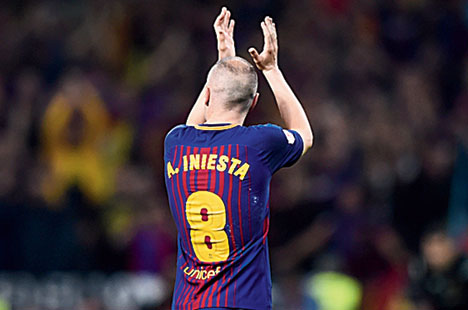
So when Barcelona were minutes from yet another Copa del Rey triumph last month, it all seemed normal. But it wasn’t. When the Wanda Metropolitano stadium in Madrid rose to give him a standing ovation, they all stood with chants of “Iniesta”. That’s the thing about him. You can’t help but love him, no matter which team you support. As he walked up to collect the 34th trophy of his career, soon to be followed by the 35th, this was the moment that made me cry: To see him lift that trophy one last time, marking the end of an era for Barcelona.
Pep Guardiola, as a Barcelona player, once famously told Xavi: “You’re going to retire me. This lad (Iniesta) is going to retire us all.” But now that he’s leaving the club, it seems all too unreal. That next season would not have him controlling the midfield, passing the ball to Messi, assuring that everything would always be okay, marks the end of an era, an era of football. Between the race for the Ballon d’Or, the constant Internet battles comparing Messi and Ronaldo, and the recent rise of Salah, Iniesta was comfort, the home you kept going back to when things went wrong. Seeing the tears as he took the bench before the end of the final, I knew I had lost yet another home.


As the end of the season inches closer and Iniesta is all set to depart the club for his Chinese adventure, all I’ll now have is memories — memories of a stellar era of football. Here’s to my number six and eight forever.
Tiash De
What do you love about Iniesta? Tell t2@abp.in
Andres Iniesta Lujan
DoB: May 11,1984
Birthplace: Fuentealbilla, Albacete, Spain
Height: 5ft 7in
Position: Midfielder
Preferred foot: Right
Jersey number: 8 (Barcelona), 6 (Spain)
Andres Iniesta is set to leave the club he joined reluctantly at the age of 12, the club where he has racked up an enviable list of honours. FC Barcelona will see the Spaniard depart at the end of the season, possibly for a Chinese side. Like former midfield partner Xavi, Iniesta bids farewell in the twilight of his career, having been a one-club man for 22 years.
Iniesta grew up supporting Barcelona — besides his local club, Albacete Balompie — and idolised the Danish playmaker, Michael Laudrup. He switched loyalties to Real Madrid when Barcelona defeated Albacete 7-1 in a league match in 1992, but it was the Catalan club that came knocking to convince his parents to let the 12-year-old be taken away to La Masia, the prestigious Barcelona youth academy. He was a shy boy and terribly homesick in his initial days at the academy, but he gradually grew into his new life and began showing glimpses of his talent. His first-team debut for Barcelona came in the year 2002, at the age of 18; the rest, to use an apt cliche, is history.
Iniesta’s 35 trophies, the latest being the current season’s La Liga title, make him the most decorated Spanish player ever. Undoubtedly one of the best midfielders of all time, he garnered the admiration and respect of his peers and followers of the game with his ball control, range of passing, and vision. With Xavi he formed a deadly midfield duo for club and country, putting into practice the legendary Johan Cruyff’s philosophy of Total Football, and terrorising opponents with technique. When he wasn’t creating goals, he was scoring them — like in the 2010 World Cup final, when he back-heeled the ball to Cesc Fabregas in midfield, only to pounce on it 12 seconds later in the box and make it a historic night for Spain. Or the year before, when he struck in stoppage time to break Chelsea hearts in the Champions League semi-final.
Barcelona is not going to be the same without him; one wonders if he’s going to be the same without Barcelona.
Manjis Kar