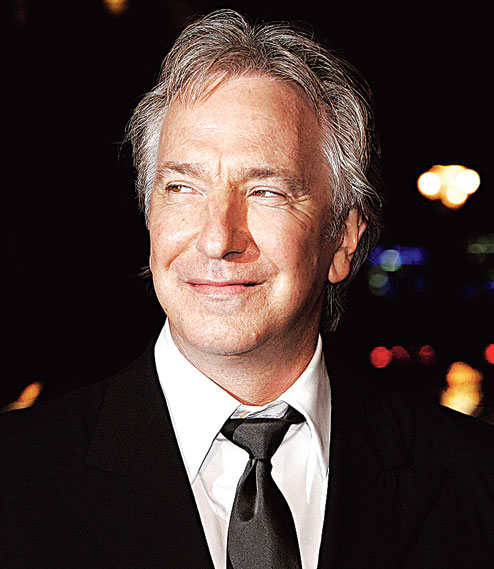

- ALAN RICKMAN was a wickedly good actor who made a virtue of playing villainous parts. In a range of stylishly malevolent roles, from the vulpine French aristocrat the Vicomte de Valmont in Les Liaisons Dangereuses [in theatre] and the slithery Obadiah Slope in The Barchester Chronicles, to the evil Hans Gruber in Die Hard and the madly creepy Severus Snape in the Harry Potter films, nobody sneered, snarled and scowled with more venom than Rickman.
- His villainy was so convincing that David Yates, the director of four Harry Potter movies, found him to be “really prickly and quite unpleasant” on their first professional encounter — “but there’s a method to his madness,” Yates came to realise. “He has to get in that zone when he’s on the set. When I finally met him away from the job, he was a lovely guy.”
- Peter Mandelson — a man nicknamed “the Prince of Darkness” by his political enemies — nominated Rickman without hesitation when asked who he would like to play him in a film of his life.
- Rickman was, according to the former Times film critic James Christopher, “an actor to savour”. He “made you wait for his lines before inviting you to feast on them”. You could “measure how withering he was about to be by the beady glint in his eye and the slightly camp, sadistic pause before he button-holed an errant pupil at Hogwarts or kissed a velvet glove in Les Liaisons Dangereuses. The anticipation was everything”.
- It was an image that proved hugely attractive to women. Lindsay Duncan, his co-star in the RSC’s production of Les Liaisons Dangereuses, famously noted that audiences would leave the theatre wanting to have sex, “preferably with Alan Rickman”.
- His sex appeal also led Sharleen Spiteri, lead singer with Texas, to recruit him as her dance partner in the video for the group’s hit In Demand. “I thought it had to be someone who would rip your coat off and pull you into the tango, so I thought of Alan Rickman,” she said.
- Irritated by his “wicked” image, he turned down the chance to play a Bond villain opposite Pierce Brosnan in Goldeneye because he felt he was being stereotyped.
- His versatility was enormous, ranging from popcorn to art house. Against the bombast of Die Hard and Robin Hood, there were nuanced performances as Colonel Brandon in Ang Lee’s adaptation of Sense and Sensibility and the Irish politician Eamon de Valera in the historical biopic Michael Collins. “You try to find things that are challenging and interesting and hopefully it will be the same to the audience,” he said.
- When the words he was expected to deliver were sub-standard, he simply changed them. During the making of Robin Hood, he felt that the official script was so banal that he recruited Ruby Wax and the playwright Peter Barnes to assist him in coming up with new lines. “I did hijack the script,” he admitted. “The dialogue became more and more a daily conversation as it developed. I slipped in lines where I thought they would work.” The improvisations helped him to win a Bafta.
- In 2008, a team of linguists claimed to have worked out a mathematical formula to find the “perfect” human voice; the formula was based on the combination of tone, speed, frequency, words per minute and intonation. Their researches concluded that the most appealing male voices belonged to Alan Rickman and Jeremy Irons.
- Ironically, his silky tone and languid delivery were the result of a speech impediment after he was born with an inoperable condition that left him unable to move his jaw properly.
- He met his partner, Rima Horton, in 1965 when they were teenage students at the Chelsea School of Art. After living together for 35 years, they eventually married at a private ceremony in New York in 2012.
- Rickman shared Rima’s political activism and said he was “born a card-carrying member of the Labour party”. On a rare night off during his premiership, Tony Blair went to see him on the West End stage in Private Lives in 2002. The story at the time was that Cherie Blair had insisted. One of the first to pay tribute on Twitter on the news of his death was the Labour party leader Jeremy Corbyn.
- Alan Sidney Patrick Rickman was born in 1946 and grew up on a council estate in Acton, west London, the second of four children. His father, Bernard, a painter and decorator, died of cancer when Alan was eight. His mother, Margaret, married again, but divorced his stepfather after three years.
- At primary school, he was taught in the Montessori method, with its emphasis on psychological development; he won a scholarship to Latymer Upper School, where he was encouraged by his English teacher, Colin Turner, to pursue a theatrical career. Schoolfriends claim that elements of Turner’s voice and mannerisms were detectable in Rickman’s acting style.

- Initially, Rickman envisaged a career as a designer, which, he said, at the time seemed “more sensible” than drama school. After attending Chelsea College of Art and Design, and then the Royal College of Art, he took a job as a graphic designer with the Notting Hill Herald, and later became a partner in a graphic design studio.
- He was 26 when he wrote to the Royal Academy of Dramatic Art (Rada) to request an audition; he funded his studies by working as a dresser for Ralph Richardson.
- His first professional engagements came with rep companies in Leicester and Sheffield, followed by a year at the RSC.
- His breakthrough came in BBC television’s 1982 adaptation of Anthony Trollope’s Barchester novels, in which he appeared alongside established stars such as Donald Pleasance and Nigel Hawthorne.
- When the RSC production of Les Liaisons Dangereuses transferred to Broadway and Stephen Frears adapted it for the big screen, it should have led to Rickman’s first film role. Instead, the part of Valmont went to John Malkovich. Rickman was reportedly furious, but, at 41, he did not have much longer to wait for his Hollywood debut.
- Among those who had seen him in the Broadway production was the producer Joel Silver, who was searching for a villain to take a Christmas party hostage and threaten to blow up a skyscraper in Die Hard.
- Die Hard made Rickman into a Hollywood star, although he retained his love for the theatre. His return to the stage led to one of his few failures when he had a miserable time playing opposite Helen Mirren in Antony & Cleopatra in the National Theatre’s 1998 production.
- At the time of the first [Harry Potter] film, JK Rowling had only written the first three books and Rickman was one of the few that she took into confidence about how the story would develop.
- As a late starter, he sometimes regretted the parts he had not played. On his 60th birthday, he said that he looked in the shaving mirror every morning and waved goodbye to yet another major role in theatre or film: “Suddenly, you’re 20 years too old for all those roles you planned to do.”
- He retained his belief that as an actor and director, the dramatic arts were about more than mere entertainment. “Talent is an accident of genes, and a responsibility,” he said. “There is nothing wrong with being purely entertaining. We make people’s lives easier, but we can also challenge them.”