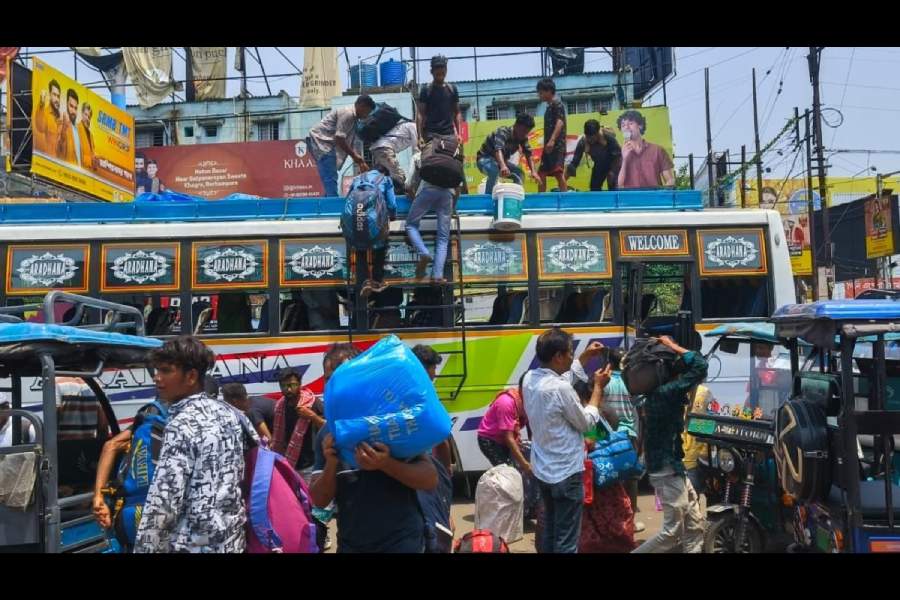
The cascade of migrant workers returning to Bengal to vote has had both Trinamool and the BJP claiming advantage, and left political analysts scratching their heads.
While Trinamool claims the migrant vote will seek to avenge the large-scale deletions during the SIR, the BJP is underscoring how it facilitated the return of tens of thousands of migrant workers from NDA-ruled states on reserved trains and buses.
Some researchers have tried to glean insights by studying the April 23 voting patterns in districts that are home to large numbers of migrant workers, such as Murshidabad, Malda, West Midnapore and East Midnapore.
They claim the spike in the male turnout in the first phase of polling indicates heavy voting by migrants.
In Murshidabad, the turnout among male voters skyrocketed from 72.94 per cent in the 2024 general election to 91.6 per cent on Thursday — a rise of 18.66 percentage points, data from the Sabar Institute, a research organisation, show.
In comparison, female voting climbed from 83.47 per cent to 95.8 per cent, up 12.33 points.
(The increased turnouts owe at least partly to the deletion of absent, shifted, duplicate and dead voters during the SIR.)
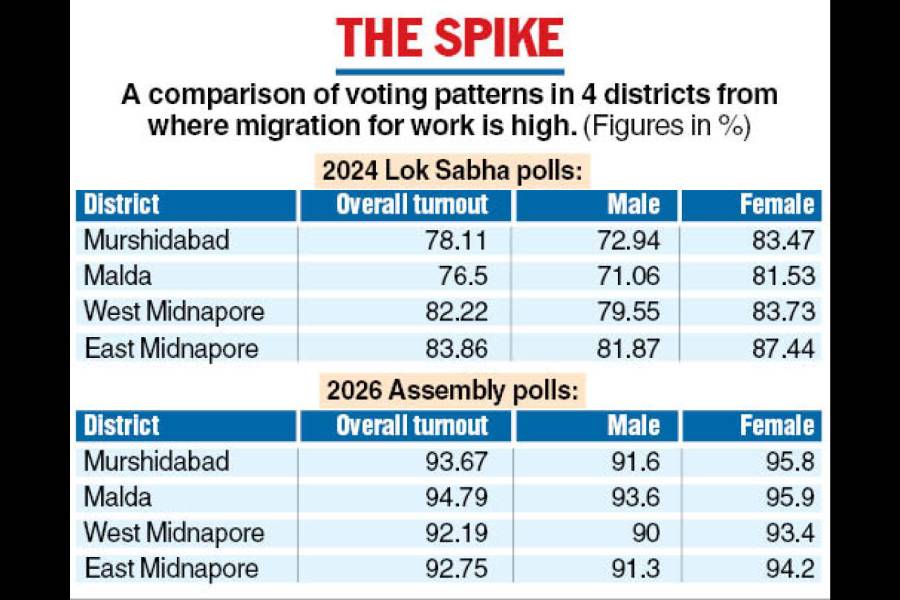
In Malda, the male and female vote rose 22.54 per cent and 14.37 per cent, respectively.
The second phase of voting on April 29 is expected to see a similar trend in districts with sizeable migrant populations, such as Hooghly, North 24-Parganas and South 24-Parganas.
Sabir Ahamed, a Sabar Institute researcher, said the sharper rise in the male voter turnout suggested that migrant workers — who are mostly men — had returned and voted in larger numbers compared with past elections.
“In our surveys, we have always noticed a significant gap between the male and female voter turnouts in districts from where large numbers of workers are employed in other states,” Ahamed said.
“This time, the rise in the male voter turnout establishes a huge inflow of migrant workers. Their vote will certainly have a significant impact on the outcome.”
The West Bengal Migrant Workers’ Welfare Board has a database of around 31 lakh migrant workers from the state, although multiple sources said the actual number would be higher. During the Covid lockdown, the state government had said that around 40 lakh migrant workers had returned to Bengal.
A source in the board estimated that more than 29 lakh migrant workers had returned to Bengal to vote in the two phases.
“According to information with me, over 29 lakh migrant workers have returned to vote in these elections,” board chairperson and Trinamool Rajya Sabha member Samirul Islam said.
“We believe that most of them have come back to protest against the SIR process that created panic among them.”
Some 27 lakh voters cannot vote in this election because the SIR deleted their names from the rolls and the Supreme Court-appointed tribunals have been unable to decide their appeals in time. Large sections of these voters are Muslims, most of them believed to be Trinamool supporters.
“If the SIR crisis has prevented these 27 lakh people from voting, the return of 30 lakh migrant workers will certainly compensate us for it,” Islam said.
Many of the migrant workers have said they have returned home to vote fearing their names might be deleted from the rolls if they didn’t.
The BJP claimed the migrants would help its cause, highlighting its efforts to ferry these workers — especially the Hindus among them — to Bengal to vote.
A BJP source said the party’s units in states such as Gujarat, Maharashtra, Haryana and Punjab had reserved 73 trains for the migrants’ return to Bengal, the majority of them for the first phase of voting.
Apart from this, more than 500 reserved buses had brought Bengal’s migrant workers home from states such as Odisha, Uttar Pradesh and Jharkhand, he said.
“The migrant workers know why they have to go outside Bengal to find work. It is because the Mamata Banerjee government has failed to create jobs in the state,” state BJP chief Samik Bhattacharya said.
“So, the majority among the migrant workers will vote against joblessness in Bengal. We know their contribution will play a significant role in the BJP forming the new government.”
Mostafizur Rahaman, CPM candidate from Domkal, Murshidabad, had travelled to Kerala to meet migrant Bengali workers and persuade them to return home to vote. When they arrived, he was at the railway station to welcome them.