
Maasai Mara, August 2017: In the southern reaches of Kenya lies the Maasai Mara National Park.
Over the past three years I have had quite a few opportunities to travel to this beautiful place. During my stays there, I have observed (and photographed) some of the most breathtaking wildlife spectacles I have ever come across in the two major seasons — dry and wet — this place is known to have. One of the most spectacular is the Great African Migration. Each moment spent in the wilderness will forever be a part of me... the roars, the smells… the ultimate thrills. A lifetime’s experience indeed!
LANDING IN HEAVEN
As we flew in our chartered flight from Wilson Airport in Nairobi to Maasai Mara, each moment was more exciting than the previous one. Surprisingly, deep inside the Mara there are small airstrips, unlike the national parks in India. In fact, when the pilot wanted to land, he was asked to wait for a while by the rangers, since there were cheetahs sitting on the airstrip! As the aircraft landed, I could not hold my excitement and stood in wonder for 10 minutes. I was beyond everyone’s reach. I was in heaven.
TAKE THE PLUNGE
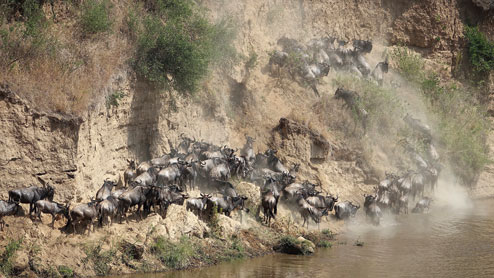
Every year, Maasai Mara in Kenya plays host to the world’s greatest natural spectacle, the Great Wildebeest Migration from Serengeti in Tanzania to the Mara. This August, I spent a fortnight here. From July to October, the promise of rain and fresh life pastures in the north brings more than 1.3 million wildebeest here. They pour in from across the border into the Mara, making a spectacular entrance; a surging column of life that stretches from horizon to horizon. To reach the grasslands of Maasai Mara, the herds cross the Mara river. The wildebeest have the ability to sense whether the river crossing is dangerous; and when they deem it to be so, they mull around at first and, after a long wait, the first few take a tentative plunge into the raging waters and soon after the herd follows blindly. At times, all you can see are thousands of horns and dust which would remind us of the rallies by politicians in the Indian heartland.
Thousands of wildebeest jump into the swift currents with a single thought in mind — The Grass is Greener On The Other Side. The careful start soon turns into chaos, bustling with animals, amid the sand and water. In their haste, wildebeest often jump off high cliffs to their death or injury. They face the greatest danger from the scores of hungry crocodiles, waiting in the tumultuous waters. And hippos — though not predators — are unpredictable and react violently when disturbed.

TWO TO TANGO
Stopping for lunch one day at Governors’ Camp, Maasai Mara, I spotted a pair of ostriches just opposite the gate of the camp. We got up close to watch. This was Maasai Mara, the heart of the best wildlife country in the world. As I tried to capture them through my lens, the pair started moving. I tried to identify their genders as the males have bold black feathers to attract the females, which, on the other hand, have light brown feathers. It was not far from the airstrip and at the sound of a plane, the couple quickly looked towards it.
Ostriches are bigger than any other bird in the world and can grow up to 9ft tall, and weigh up to 145kg.

YAWNING TYKE
A juvenile lion, about two-and-half years old, tried to shake off the flies pestering him as he posed tirelessly for us. It was early in the morning when we spotted it a little away from its pride and as I was watching it closely for almost an hour I found that, just like humans, the yawning of this young lion set off a chain of yawns among other members of the pride!

VIEW TO A KILL
Leopards at the Mara spend most of the day hiding in trees or caves and come out to hunt only at night; they are the hardest to spot and photograph. So, when we heard that a leopard had been sighted some distance away, we set off immediately. As we reached, we found two other jeeps at the site. The leopard had gone, but the kill — a gazelle — was still lying in the thick bushes. Surely, the leopard would return for its meal. It did so, within half an hour. It moved into the open, picked up its kill and started dragging it towards the bushes, keeping a watchful eye on us the whole time.

WANNA PLAY PATIENCE?
Tired after being on their feet the entire afternoon, a pride of lionesses and their cubs took a break for a few moments. The pride, camouflaged in the blowing Savannah grass, was stalking a herd of zebra at a distance for a long time, but could not get closer as the herd was on high alert and constantly made eye contact with the pride. Finally, we left.

CROUCHING LIONESS, BITTEN WARTHOG
As a wildlife lover, I have always waited for this moment and I had to rub my eyes to believe it. The most astounding sighting of our entire trip. As our jeep crossed the side of the Mara river mid-afternoon, we heard Dominique, our guide, get as excited as a kid on Christmas Eve. He slammed the brakes suddenly as our eyes turned to a lioness stalking a baby warthog. Within a fraction of a second she pounced on her prey and started staring at us. Mara is the ideal site for watching predator and prey — at conquest, at play, at rest. No photographer could ever capture all of the Mara in one lifetime.
WILD RUN
A wildebeest, who perhaps didn’t want to get captured in the frame, tried to run away.
BABY MAKES A TRUNK CALL
I am awed by the sight of African elephants; they are huge yet so peaceful, inspiring the highest degree of respect. It is always a photographer’s delight to watch a big herd walking towards the Mara river... that too at dusk when the colour of the sky changes like a painting. As I was watching this herd move in a straight line, this calf suddenly started trotting towards us and stopped right in front of our Jeep.

A WARM WELCOME
During my trip we visited the Maasai village where we were greeted by a group of Maasai women. For a moment I got the feeling that they had just finished the rehearsal for a ramp show and wanted to showcase the bright colours they were wearing.
A BEAST OF A FEAST
Back in Nairobi we stayed overnight and being a restaurateur and a foodie to the core, each trip to Kenya is always supplemented by a visit to the Carnivore restaurant. As the name suggests, the restaurant has always been a popular destination for exotic meat lovers because this is one of the few restaurants in the world serving exotic game meat. Various meats skewered on Maasai swords and roasting over a ginormous charcoal pit greeted us at the entrance. I had the rare opportunity to try zebra, venison, kudu and crocodile among other game meats on and earlier visit to their branch in South Africa. However, a recent ban on the sale of game meat by the Kenyan government made them showcase only conventional meats like beef, pork, lamb and corn-fed chicken with choices of farmed ostrich, ox testicles and crocodile as part of their exotic meat gallery. (They do not display the crocodile meat on the grill.)
The grilled meats served on metal plates are definitely worth trying. The meal here is an all-you-can-eat course of gourmet grills, served on the table which mostly resembles Brazilian Churrasco that’s now popular in the West. Crocodile meat in its whiteness looked closer to fish, but tasted like chicken. The ox testicles were exotic and left a distinctive taste of a typical “brain masala”, which we have introduced at our restaurant Oudh 1590 in south Calcutta. Carnivore’s Rump Steak, Leg of Pork and Barbequed Beef Ribs arrived in quick succession and were an instant hit with my taste buds.