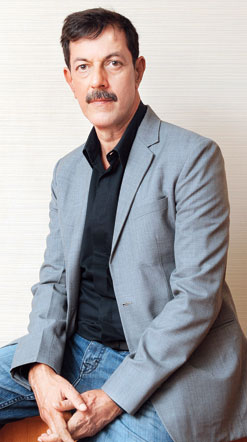

For a man who is picky about his roles, Rajat Kapoor is astonishingly run off his feet. He has just finished a movie and has turned his attention back to theatre. His latest offering, a brand new version of Shakespeare’s As You Like It, has just been a sellout in Delhi.
And Kapoor has decided that it isn’t enough to do one Shakespearean play in a season. The actor, director, theatre-person and scriptwriter is busy preparing for his next production What’s Done, Is Done — his take on Macbeth, one of the Bard’s most famous tragedies. The play will open in Mumbai on June 5 and then head south to Bangalore before hitting four cities in the US.
All this comes soon after shooting for independent filmmaker Nicholas Kharkongor’s Mantra, a movie revolving around a family in the post-liberalisation era. Besides that, he recently walked away with rave reviews for playing a despondent father and unfaithful husband in Dharma Productions’ Kapoor & Sons.
What are his key rules for any project that he undertakes? “The role must be meaty, the script good and, above all, the director mustn’t be an idiot,” he guffaws.
But ask Kapoor to choose between theatre and movies and he says: “Theatre is satisfying but it dies every day. But cinema will outlive me — which though a horribly narcissist idea — is oddly satisfying too.”
As director, Kapoor has earned accolades for his plays, while his skilful use of clowns as characters has almost become a signature. Clowns are omnipresent in his Shakespearean ventures and besides his two new plays,
they appeared earlier in Hamlet (staged as The Clown King) and King Lear (called Nothing Like Lear).
Kapoor uses clowns as metaphors, he explains. He says: “Clowns are free of social baggage and have no nationality, caste or religion. Because they’re clowns — much like ‘the fool’ in Shakespeare’s plays, they take liberties,” he says.
While Kapoor loves acting, direction is his first calling. “I grew up with a film buff father and by the time I was 14 I only wanted to direct movies,” he says.
The theatre bug bit him — quite accidentally — when he was just 19. He’d joined Alliance française in Delhi which had its own theatre group. “I was hooked,” says the 55-year-old actor. He joined the Film and Television Institute of India (FTII), Pune, in 1985, to hone his skills.

After his FTII stint, Kapoor assisted directors Mani Kaul and Kumar Shahani in Mumbai before he made Tarana that was released in 1995. This 26-minute, non-feature documentary won the Golden Lotus Award in the short film category.
Subsequently, several of his low-key films were surprise hits. In 2003, his Raghu Romeo won The National Film Award for Best Feature Film in Hindi. He acted in and directed his next movie Mixed Doubles, which too got good reviews.
Acting, which brought him recognition, too, was accidental, he says. It all began with him being roped in to appear in an advertisement for Double Diamond tea in 1999 by a friend who dropped out of it suddenly. “I filled his place and that was it!” he remembers.
Other advertisements came his way till director-actor Farhan Akhtar’s team auditioned him for Dil Chahta Hai in 1999. Around this time seasoned actor Naseeruddin Shah, who saw him on stage in his own play, Waiting for Godot, recommended him to Mira Nair for her film, Monsoon Wedding.

Monsoon Wedding released four months after Dil Chahta Hai and Kapoor was a hit. “I started my acting career playing uncles — the bad uncle in Monsoon Wedding and the good one in Dil Chahta Hai,” he smiles. Since then he’s left his mark in movies like Mixed Doubles, Bheja Fry, Iti Mrinalini and more.
Kapoor’s stamp is very distinct. He casts for his films carefully and takes actors who fit the roles and devote time to his productions. Stars don’t enamour him. He says: “Vinay Pathak and Ranvir Shorey are my friends but that’s not the reason that I cast them. They bring energy and incredible talent to the table.”
Pathak and Kapoor have been friends for 20 years. Pathak says: “Kapoor’s the most open director I’ve worked with. He welcomes ideas from anyone, anywhere, and uses them to expand his vision.”
Despite his diverse interests, it’s his ability to give the job at hand his undivided attention that defines Kapoor. “Multi-tasking is an overrated idea. You do nothing as your attention is grabbed by many things,” says the actor-director who emphasises that he does just one thing at a time — even when he’s being interviewed. So his mobile phone is out of sight and he doesn’t pull it out of his pocket to compulsively check it as he fields questions.
Clearly, while dabbling in many different things, Kapoor’s single-minded focus has helped him make a mark.