 |
| MEXICO CITY |
Imagine a holiday surfing the waves, scrambling over Mayan ruins or simply tossing back margaritas in a bar overlooking a quaint cobblestone street. At Mexico, you can do all this... and then some more. For the New World is the ultimate traveller?s Mecca, crammed with a multitude of opposing identities: desert landscapes, ancient ruins, towering volcanoes, bustling cities, colonial towns, deserted beaches and a huge diversity of flora and fauna.
Despite rampant modernisation, this erstwhile Spanish colony manages to hold on to the past and it?s this mix of the modern and traditional that is the key to Mexico?s charm. Sombreros, tequilas and tacos ? you?ll find it all here.
So if you?re all set to find out more about what this fascinating land has in store, here?s a ready reckoner of all the places that you just can?t give a miss.
Mexico City
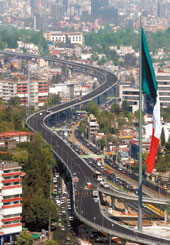
The world?s third-largest metropolis (Tokyo and New York City take the top two spots) is a heady combination of the best of Mexico and its worst. Mexico City has its share of green parks but it?s almost always enveloped in smog. Colonial palaces struggle for street space with skyscrapers and world-famous museums look down loftily over ever-spreading slums. Caught between the glory of its past and its all-encompassing present, Mexico City is certainly a place where travellers could never be bored.
What are the main areas of interest here? The heart of the city, El Z?calo, and its surrounding neighbourhoods are known as the Centro Hist?rico (Historic Centre) and are full of notable old buildings and museums. Avenida Madero and Avenida Cinco de Mayo link the Z?calo, or town square, with Alameda Central Park. The Palacio de Bellas Artes that dominates the east of the park is a must-see as it throws up some of the world?s finest murals. West of the Alameda is the Plaza de la Republica, a mostly residential area with budget and mid-range hotels. Mexico City?s grandest boulevard is Paseo de la Reforma that connects the Alameda to the Zona Rosa and the Bosque de Chapultepec. The Zona Rosa (or Pink Zone) throbs with swanky stores, hotels and nightclubs.
Though the city will sweep you up at any time of the year, the holiday periods of Semana Santa and Christmas to New Year are the peak seasons. The best way to get a feel of Mexico City: drinks or dinner at Bellini on the 45th floor of the World Trade Center. Bellini is a revolving restaurant that offers stunning views of the whole city.
 |
| AVENUE OF THE DEAD |
Guanajuato
From the fast-paced life of Mexico City, experience laid-back leisure at its best at Guanajuato in the mountains of the Sierra de Guanajuato. Its name originates from the word ?quanax-juato?, meaning ?place of frogs? ? the indigenous tribes thought the place was fit only for frogs! Little could they have known that later in the 18th century, Guanajuato would become the world?s leading silver extraction centre.
A city that still manages to retain the essence of its colonial past, Guanajuato?s charm lies in the amazing web of streets and alleys called Los Callejones. The most famous ? Callej?del Beso ? is an alley so narrow that two ill-fated lovers, kept apart by their families, were still able to kiss each other while sitting at windows on opposite sides of the street.
Explore Guanajuato by strolling through the 15 main plazas and visit the cathedrals like the Basilica of Our Lady of Guanajuato.
If you?re planning a visit in October or November, book a hotel room well in advance for this is when the city hosts Festival Cervantino, Mexico?s biggest cultural event of the year that honours Miguel de Cervantes, author of Don Quixote.
Morelia
Built in the 16th century, Morelia, the capital of Michoac?, is an outstanding example of urban planning which combines the ideas of the Spanish Renaissance with the Mesoamerican experience. More than 200 historic buildings, all in the region?s characteristic pink stone, reflect the town?s architectural history, an eclectic blend of Renaissance, Baroque and neo-classical elements. This apart, there are gardens and graceful arcades and colonnades that front the main square, Plaza de los M? rtires.
The city?s heritage actually goes back far beyond the days of Spanish Conquest, for the region has long been the ancestral home of the Tarascan Indians. A trip to nearby P?tzcuaro (meaning ?place of delights?) is a good idea.
Merida
Once referred to as the Paris of the West, Merida, the capital of the state of Yucatan, is home to one of Mexico?s renowned Mardi Gras celebrations. Its tree-shaded boulevards and majestic French-windowed mansions impart a distinctly European air to the city while the horse-drawn carriages that still roll along the streets take one back to the days when adventurers from France and Spain came here to set up vast haciendas for growing cotton, sisal and sugar cane.
The Yucatan is known as the realm of the Mayas and naturally visitors throng the Mayan ruins here. If fact, two of the most legendary of all Mayan cities ? Chichen Itza and Uxmal ? are only a few hours drive away.
 |
| A MARIACHI BAND |
Acapulco
This is Mexico?s first and foremost resort town complete with golden beaches, tropical jungles and lagoons, plush hotels and a pulsating nightlife. A known getaway for the rich and famous, Acapulco?s beaches are its biggest draw. But other attractions like museums, aquariums and the famous divers of La Quebrada, who plunge into the ocean swell from giddy heights, are other popular attractions here.
Baja California
Another beach paradise, the Baja peninsula is renowned for its long coastline of fine white beaches, peaceful bays and steep cliffs, sharply contrasting with the harsh, undeveloped interior.
Baja was once a hideout for revolutionaries, mercenaries, drinkers and gamblers, but these days visitors are attracted by more healthy pursuits like horse-riding, surfing and whale-watching. Highlights here include Loreto, with its Spanish mission history and off-shore national park; the extraordinary pre-Columbian rock-art sites of Sierra de San Francisco, near San Ignacio; La Paz, the laid-back capital of Baja California Sur; and the hiking paradise of Sierra de la Laguna, a botanical wonderland.
Guadalajara
Many of the traditions considered characteristically ?Mexican? were created in Guadalajara, the country?s second-largest city. Guadalajara can be held responsible for the mixed blessings of mariachi music, tequila, the Mexican Hat Dance, broad-brimmed sombrero hats and the Mexican rodeo.
Part of Guadalajara?s appeal is that it has many of Mexico City?s attractions ? a vibrant culture, fine museums, historic buildings, an exciting nightlife and good hotels ? but few of the capital?s problems.
It?s a bright, modern and well-organised place, with enough to please even the most discerning visitor. Highlights include the twin-towered cathedral and the lovely plazas that surround it, the Instituto Cultural de Caba?as and its frescoes by Jos? Clemente Orozco, and the twin handicraft hubs of Tlaquepaque and Tonal.
 |
| MEXICAN DANCERS |
Puebla
Though Puebla is now a modern and fast-growing city, it is a major Catholic centre with over 60 churches ? many of them hundreds of years old. The most imposing of these is the Cathedral of the Immaculate Conception, a tile-domed church.
Legend has it that Puebla?s founder ? the Bishop of Tlaxcala ? saw the city?s site revealed to him in a dream. And as you gaze out over the glittering tile rooftops, you can?t help but be awed by the sight of the snowy 17,900-ft Popocatepetl volcano in the distance.
A culinary treat not to be passed up here is mole poblano (chilli sauce mixed with chocolate, sesame seeds, ground almonds and spices, and served over chicken or turkey) first concocted in Puebla by nuns at the Convent of Santa Rosa.
Oaxaca
As any true Oaxaque? will tell you, this is a city no traveller should miss. Oaxaca (pronounced wo-hak-a) has a lovely valley setting and has been the home of the Zapotec and Mixtec cultures for over 2,000 years.
One of the most famous archaeological sites in Mexico, the ruins of Monte Alb?, is perched high on a hilltop and commands the best view of Oaxaca. From here you can see the tiled, domed spires of the city?s 27 churches, including the fabled Church of Santo Domingo.
Oaxaca?s main square, the Plaza de Armas is one of the liveliest in all of Mexico, often being the scene of celebrations, musical performances and cultural events.
Palenque
All those images of romantic Mayan ruins shimmering in the morning mist come true at Palenque. Surrounded by emerald jungle, Palenque?s setting is superb and its Mayan architecture is exquisite.
The best time to visit is early morning when a humid haze wraps the ancient temples in a mysterious mist. Only a handful of the almost 500 existing buildings have been excavated.
The instantly forgettable new town, where most hotels and restaurants are clustered, is about 7km from the archaeological zone.
Teotihuac?
Teotihuac?lies in a mountain-ringed off-shoot of the Valle de Mexico. The famous Avenue of the Dead is a monumental 2km thoroughfare lined with the former palaces of Teotihuac??s elite. To its south is the pyramid-bedecked La Ciudadela. To the north, is the world?s third-largest pyramid: the 230ft Pyramid of the Sun.
The avenue ends at the Pyramid of the Moon, flanked by the 12 temple platforms of the Plaza de la Luna. Teotihuac??s most famous mural, Paradise of Tl?loc, is in the Tepantitla Palace.
Travel tips
• Mexico is enjoyable year-round, but October to May is generally the best time to visit.
• The climate has something for everyone: it?s hot and humid along the coastal plains, but drier and more temperate at elevated areas inland.
• Around 30 Mexican cities receive direct flights from North America and Canada, and there are relatively cheap connections to the Caribbean and the rest of Latin America.
• From Europe you can fly to Mexico City and Cancun. Aeromexico and Mexicana are Mexico?s largest airlines.
• Crime in Mexico continues to plague travellers, particularly in Mexico City. Travellers should also be aware of the potential for political unrest in southern Mexico. The southern states of Oaxaca and Chiapas are political hotbeds where travellers should take extra security measures.