 |
 |
 |
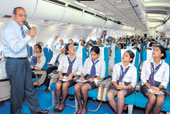
| (From top): Faculty member Evaristo Mendes conducts a training session with Frankfinn students inside the institute’s airbus; Puja Rasne in the midst of a class with students at AHTI; Neetu Manikataliya, a Flying Cats trainee and faculty member, Malaika Arora Khan |
It’s the last thing you’d expect behind a grey office block in Dwarka, a far-flung Delhi suburb. There, standing behind a wall far from any airfield, is an Airbus A 300 that once criss-crossed the world ? or most of it, minus a small portion of the tail. Rickety wooden steps lead to the aeroplane’s door and it obviously won’t be flying anywhere in the near future.
But this isn’t an aeroplane graveyard and this Airbus 300 gets its regular quota of ‘passengers’. Young girls in short skirts and earnest young men in ties and impeccably creased trousers troop up its steps for regular journeys into the world of aviation. Here, they’re coached on the finer points of how to pamper passengers, what to do in a mid-air emergency and all that goes into being cabin crew in the fast-growing world of international aviation.
The Airbus belongs to the Frankfinn Institute of Air Hostess Training which flies in students from its institutes around the country for five-day crammer on-board training courses. The 13-year-old institute says it’s the only air hostess training institute in the world that has its own plane ? even if it’s grounded.
Welcome to the brutally competitive world of aviation training. It’s a dogfight for the skies fought before anyone leaves terra firma. The protagonists are companies like Frankfinn and the Air Hostess Academy (AHA). Other players include the Air Hostess Training Institute (AHTI) and the Indian Aviation Academy. The newest entrant to the battle is Delhi’s Flying Cats, an institute that according to its director Neetu Manikataliya is a “cosmo air hostess training school”.
The two giants of the training industry for the skies are AHA and Frankfinn, which are both spreading their wings and expanding at supersonic speed. AHA, the older of the two has 18 branches across the country and is looking at ways to expand outside India. Similarly, Frankfinn has been stepping on the aviation turbine fuel even more and now has 60 centres in India.
The battle for students is fierce. But there’s room for everyone. These institutes train students primarily for a job in the airlines and also service industries like hotels ? and both industries are booming. “The domestic airline business is growing between 25 per cent and 30 per cent at the moment,” says Kapil Kaul, CEO, Centre for Asia Pacific Aviation. Also, India is fast becoming a grooming centre hub for wannabe flight stewards and stewardesses from places like Nepal, Nigeria and Mauritius.
Sapna Gupta, the founder and chief consultant of the Air Hostess Academy (AHA), reminisces how she started the institute with three students from Delhi University in 1997. They wanted proper grooming and training before embarking on a career in the skies. Today AHA says it’s placed 3,000 students in airlines, hotels and other related service industries.
“The times have changed as has the mindset. Classes are full with 25-30 students in each batch. And parents are no longer hesitant about their children opting for such a career,” says Gupta.
Each institute has its forte. The Air Hostess Academy has got an accreditation from Cambridge University, UK. Meanwhile, Frankfinn has a tie-up with Edexcel, a British organisation that rates courses and also with the BBC for language training. So, at the end of the one-year course, students get a co-branded certificate from the BBC.
Flying Cats, the newcomer in the highflying game, is looking for ways to carve out its own USP and says it provides education on a ‘different pattern’. The institute has virtual classrooms where each student works on a laptop. The academy has also tied up with the Singapore Tourism Board. “During the course, students will be flown to Singapore and given hospitality training for an international perspective on board Singapore Airlines,” says Manikataliya.
In addition, Flying Cats is also putting together a panel of celebrities who, it says, will conduct courses. Sabira Merchant is designing the syllabus for speech, diction and personal finesse. Other subjects such as personality grooming, presentation, body language and personal fitness are being taken care of by make-up whiz Cory Walia, fashionista Malaika Arora Khan, models Zulfi Sayed, Amrita Thapar and Aditi Govitrikar, fashion designer Ashley Rebello and psychotherapist P Khuraana.
And while the content varies at each, what remains common are topics like customer service, airport handling, serving techniques for different menus. Then there are the procedural parts of the job like what to do during an emergency landing, first aid, and how to handle tough situations. At a another level, there’s personality development, weight management and learning a foreign language.
Some like the AHA take them into the skies. “We have in-flight training on Jet Airways for students. Once in the airport and aboard the plane, they get a feel of what it is like to actually be cabin crew,” says Sweta Bhardwaj, senior training manager at AHA.
The courses have been adjusted for all needs. There are specialised diplomas for cabin crew and in-flight services and others for hospitality and travel management.
What does this all cost? The four-month course at Indian Aviation Academy is Rs 35,000, a six-month course at Flying Cats, Rs 60,000. The longer, one-year courses at Frankfinn and AHA are around Rs 90,000 to Rs 95,000.
The timetables are also pretty flexible so that people with jobs or ones studying other courses can sign on.
 |
 |
| (From top) A view of the Airbus A300 used by Frankfinn to train students; AHA trainees learn the ropes |
Working people can also apply. You can switch batches to your convenience,” says AHA’s Gupta. Similarly, at Frankfinn which has students like Dinesh Sachdev, a Mumbai-based BPO executive, who takes two-hour classes, five days a week. AHTI, meanwhile, offers only full-time courses.
The institutes all insist they screen potential students carefully. “There are personal interviews when we check basic conversational skills and see if there’s room for improvement. That’s how the candidate becomes eligible for the course,” says Puja Rasne, who’s on the AHTI faculty.
And what do the airlines look for? The qualifications have changed a bit from the early days of aviation. “It’s no longer essential to be a looker. You can be pleasant looking but an overall good personality scores high,” says Rupali Mathia, a former Lufthansa air hostess who teaches at Frankfinn.
What’s the track record of these institutes? AHA says it has a strong one. Frankfinn says it’s earned a place in the Limca Book of Records for the number of students it’s placed.
Also, the airlines are doing on-campus recruitments. “There are campus placements so that students do not have to apply directly to the different airlines. We also let them know where there are vacancies. Around four or five students from a batch of 25 students make it to international carriers while quite a few fly with domestic airlines,” says Rizwan Kadri, founder and chairman, Indian Aviation Academy.
At AHA, they have an academy alumni card, using which the students can get help with placements even after they leave the academy, and Frankfinn promises to help students get jobs for upto 18 months after completing the course.
Why do the airlines come to these academies. Says Mathia, “In an academy, the students get a basic training. So they’re preferred by airlines as they know how things work on board.”
That, says Mathia, makes it easier when the airlines do their in-house training. “It’s easier for students to grasp what is being taught during in-house training.”
The best part for all these youngsters is that the airline industry is looking poised for a vertical take off ? so there’ll be lots of jobs in the future. Says Kaul, “Airline operators have aggressive expansion plans. There will be some 5,000-6,000 cabin crew jobs up for grabs in the next five years.” So it may be time to become a highflyer.
Photographs by Rupinder Sharma and Jagan Negi