 |
 |
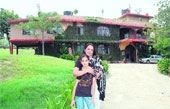
| Naina Balsavar and her daughter Aleah (top) at their nine-acre farmhouse in Sainik Farm; Prekash and Shanta Ramsingh at their two-acre spread in Chhattarpur |
Naina Balsavar and her politician husband Akbar ‘Dumpy’ Ahmed love going for long morning walks — and it’s even more fun because they never leave their own property. They march briskly along a walking path that zigzags around their sprawling nine-acre spread in Sainik Farm, Delhi. “It’s rejuvenating to live in the midst of greenery,” says Balsavar, a former model turned jewellery designer.
Even by Sainik Farm’s sprawling standards, Balsavar and Ahmed have a huge spread. They own the largest plot in and it oozes luxury. The stylish home has huge windows and creepers abound. There’s a swimming pool in the backyard and the walking path has red slabs that snake all over the property.
Drive a few more miles to Ghitorni-Mehrauli on the very outskirts of Delhi. Anuradha Sagar is enjoying a lazy breakfast with her in-laws sitting in a gazebo in the middle of the manicured lawns. Reclining in her chair, the 22-year-old loves to explain what living in a secluded farmhouse has meant to her. “It’s healing,” she says.
Step back a decade or so to the time when the ultra-rich bought huge farmhouses set in an acre or two of land. In those days the far-from-the madding-crowd spreads were reserved only for splendid parties or used as weekend getaways. “It was like a second home where people would retreat,” says real estate agent, Sameer Varma.
As the city spreads its tentacles in all directions, the weekend resorts have turned into palatial homes with space for a joint family and a few friends thrown in. What’s more, farmhouse living has become a different way of life for those who can afford it.
One lucky person who smartly bought his property in the days when it was all a barren landscape as far as the eye could see, is Subhash C. Kashyap, the former secretary-general of the Lok Sabha and a constitutional expert.
Kashyap says he got accustomed to living on a large spread after years in a gigantic government bungalow. And he wanted something similar after retirement.
“My wife Savita and I just got used to living in a spacious campus,” says Kashyap who came to Sainik Farm after he retired in 1990.
Others too are adding up the pros and cons and coming up with the same answers. They figure that the Big City is cramped and hopelessly polluted and there’s nothing like getting away from it — if, of course, you can afford it.
Take for instance the Sagar family which upped sticks and left their home in Greater Kailash I where they lived for 20 years. Nina Sagar, Anuradha’s mother-in-law, says, “It was pollution and lack of space that drove us to shift. I’d have even preferred to be on the farm when my kids were younger.”
Certainly, the Sagars have turned their farmhouse into a home that’s a blissful getaway from the city. They’ve planted an assortment of trees on the three-acre plot. The kitchen garden has a variety of herbs that Nina carefully tends herself. In the front yard there are two lotus ponds. And a bridge over the pond is surrounded by creepers.
 |
 |
 |
| (From top): Anjum and Neha Sehgal at their farmhouse in Mehrauli; Nina and Anuradha Sagar at their estate in Ghitorni-Mehrauli; Subhash and Savita Kashyap at their Sainik Farm spread |
Even senior executives whose Blackberrys are crammed with appointments and meetings have decided that a little extra commuting is worth the trouble if it means a more luxurious home life. Immediately after being posted to India a year ago, Prekash Ramsingh, CEO of Bang & Olufsen, and his wife Shanta began to look around for a home like the one they’d had in The Hague, the Netherlands.
The couple first rented one flat and then another before finally moving into a two-acre farmhouse in Chhattarpur. “It was like this farmhouse was waiting for us. In Delhi, it’s impossible to have a pool, a spacious lawn and the quietness,” says Shanta. Ramsingh says he doesn’t even mind the traffic and the crowd of devotees thronging Chhattarpur temple on his way to work. “As long as it’s relaxing to be home, I don’t mind the traffic,” says Ramsingh.
From a swimming pool to hi-tech gyms to kitchen gardens, most residents have built a world of their own. Anuradha, for instance seldom steps out except to attend classes everyday. She has an outdoor gym that is strategically designed to be amidst the greenery.
For those who almost don’t feel like leaving their beautiful homes, there’s the perfect answer when they want to socialise. Even when they have to organise a get together, they don’t need to look beyond their manicured lawns. Balsavar says, “We’ve had great parties here.”
Balsavar’s farm is dotted with trees and there are permanent fire torches erected in neat rows from the entrance all the way to the pool. If that’s not enough, there are bridges constructed over a manmade waterfall. Inside, from the windows guests can gaze at the greenery of the Asola Bird Sanctuary.
Ramsingh too is thinking about serious partying. In fact, he reckons that his spacious lawns would be ideal for new Bang & Olufsen product launches. “It will be a different affair,” he says.
Living far from friends and family can, of course, be both a blessing and a nuisance. But businessman Anjum Sehgal and wife Neha who live in Mehrauli reckon that being hard to get is often a blessing. So they don’t even mind the fact that the approach to their farmhouse is through cornfields and stretches of dusty road.
They’ve no immediate neighbours but they aren’t complaining. “It may seem lonely, but the quietness is bliss,” says Neha who’s seven months into her pregnancy and opted to have her baby here instead of joining her husband’s family in the US. “I could have had my baby in the US, but I think it will be more healthy for the baby here,” she says.
The young couple moved in two years ago and is still working at landscaping their two-acre farm. Anjum even works from home and rarely steps out except in an emergency. It’s not just a status symbol though as Neha says, “People do look at you differently if they know that you’re in one of the farmhouses. Although I feel, the one edge we have over those living in the city is the space and the fresh air.”
Kashyap too, insists that the sense of space and tranquility has helped him to finish all his books. “I wrote about 20 original works here and edited about 20 books,” he says.
Obviously, living in a farmhouse isn’t for anyone except those who don’t blanch when they get big bills. After you’ve spent a pile of money on buying the place, there’s also the question of maintaining it. “It requires big maintenance,” says Balsavar who has three full-time maids for her six-bedroom house and more than two workers round the clock apart from daily wagers who look after the garden. And of course, there’s an extra hand to look after the cows — yes, the family has its own supply of fresh milk.
Kashyap likes to point out that entire districts on the outskirts of Delhi have altered beyond recognition from when he and four friends bought land in the ‘70s. At that time it was all rock and nothing else. “We all got an acre each and grew wheat and other greenery. It was literally barren land.”
Today, sitting outside his bungalow, it’s tough to imagine that time. There are more than 200 fruit trees planted on the property and the family hardly ever buys fruit.
Balsavar too, had a hard time turning the property into her haven. “We had to level the ground,” she says.
Security is obviously a big issue when your nearest neighbours are a few acres away. But the security problem seems to have got better because so many people have moved here. “Now, with new colonies being developed beyond Chhattarpur, Mehrauli and even beyond Faridabad, security is less of a concern compared to few years ago,” says Varma.
Nevertheless, older residents remember how tough the early days were. Balsavar has never forgotten how deserted the area was when they constructed the house in 1989. “It was like the Chambal, deserted and wild,” she says.
It’s not surprising perhaps, that most farmhouse residents have dogs — usually large and ferocious. Balsavar for instance has four dogs. “They’re part of the family,” she says. But she adds, “Dogs are good security as they are very sensitive.”
Similarly, there are three German Shepherds at the Sagar’s farm. Says Anuradha, “Two of them are let loose every day after 11pm. And they’re trained in such a way that they recognise only the two people who feed them. Which means that even if we go out, the dogs are sure to pounce on us.”
The downside of being less isolated is, of course, that the crowds are growing even in these far-off places. Today, there are more than a hundred houses in Sainik Farm. And the residents’ big cars have outgrown the colony’s narrow roads.
In fact, Kashyap, who also lives in another block of Sainik Farm laments the growing noise pollution from the generators (the colony doesn’t have power from the municipal corporation). “As original settlers, we miss the quietness,” he says.
What’s the price tag on having your own spread? If you had the smarts to buy early when all these regions were semi-wilderness, the prices were actually reasonable. “We zeroed in on this place as it was secluded and reasonably priced. Now, prices has shot up,” says Balsavar.
Prices vary depending on location, but what used to be available 10 years ago for Rs 4,000 to Rs 6,000 per sq yard could now cost anywhere between Rs 10,000 and Rs 35,000 per sq. yard.
In fact, real estate developers are now heading even further into the countryside to previously untouched zones like Faridabad and asking for amazing prices. “In Gualpahari, a village on the Gurgaon-Faridabad border, for instance, a one-acre farmhouse could cost anywhere between Rs 50 lakh and a crore,” says Sameer Varma. Ten years ago, he reckons, it would have been possible to buy the same piece of land for anywhere between Rs 8 lakh and Rs 10 lakh.
Some owners are still deterred by the distance and loneliness from shifting in permanently. But even people who’re using their farmhouse as a weekend haunt have plans to live there. Ace lensman Raghu Rai can’t wait to go and live in his six-acre farm on the Delhi-Haryana border.
What’s stopping him at the moment is a security issue. “There aren’t too many houses around there except for three or four,” he says.
The charm of living in a farm, says Rai is different. Rai and his wife Gurmeet who is a restoration expert, have jointly done up the farm. “I did the landscape while she did the interiors. Together we’ve created our own space and will be moving there sooner or later,” he says.
Is it all about the social pleasure of saying you live in a farmhouse. Certainly not, says Sanjay Varma, joint managing director, Cushman and Wakefield, “It’s more of a lifestyle choice than status symbol.”
Photographs by Rupinder Sharma