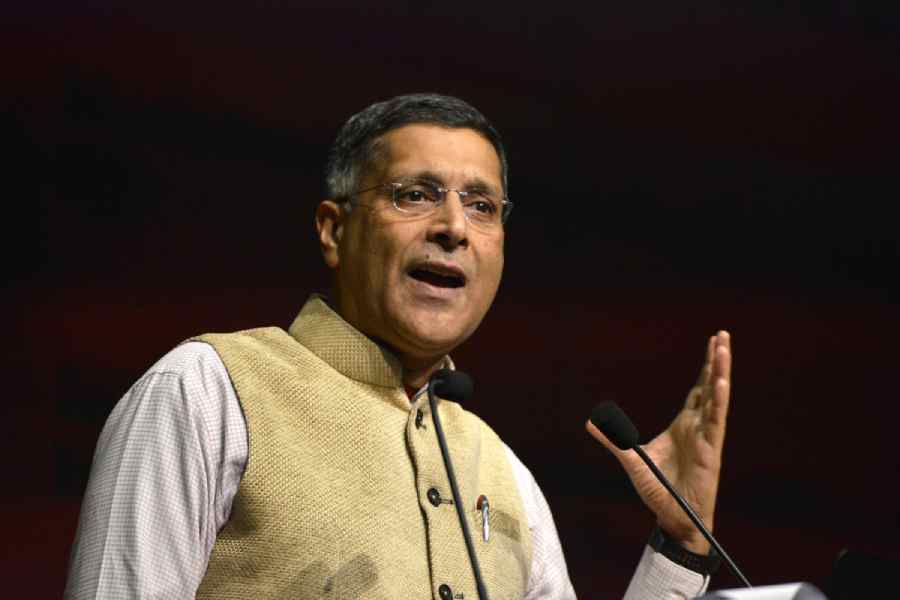
India’s economy is not showing signs of a robust recovery and the risk of higher US tariffs as well as increased dumping of low-cost Chinese goods could weaken the outlook, former chief economic adviser Arvind Subramanian said in an interview with Bloomberg.
Data released this week as part of government’s advance estimates show the economy expanding 7.4 per cent in the year ending in March, extending India’s world-beating growth streak.
“We should read that figure cautiously,” Subramanian said in an interview on Friday with Bloomberg Television’s Menaka Doshi. He said the estimate may suffer from the “age-old problem” of whether it is well measured, given an unusually low deflator, which is used to strip out inflation from the gross domestic product calculation.
“Even directionally, it is not obvious that the economy is recovering,” said Subramanian, a senior fellow at the Peterson Institute for International Economics. He pointed to decelerating nominal indicators and slowing high-frequency data as reasons for caution about both the level and direction of growth.
“I would not put a precise number on growth, but if growth next year ends up similar to this year, India should consider itself fortunate and view that as a job well done, given the heightened uncertainty,” he told Bloomberg.
Risks from US trade policy also remain high. President Donald Trump’s punitive 50 per cent tariffs on Indian goods, partly linked to New Delhi’s purchases of Russian oil, added to the uncertainty. “It is now looking less likely that there will be a trade deal,” Subramanian said, adding that “tariff rates may even move higher”.
India also faces pressure from what Subramanian described as “Chinese mercantilism”, as it rapidly exports and diverts goods to developing countries, including India, weighing on the domestic economy.
He also flagged concerns around public finances. “While the macro position is reasonably strong, the fiscal situation, partly because of Goods and Services Tax cuts, is not as strong as it should be,” he said. Subramanian sought greater flexibility in currency policy, arguing that exporters need support amid external shocks. With limited fiscal space, he said, currency depreciation may be the only effective channel.