 |
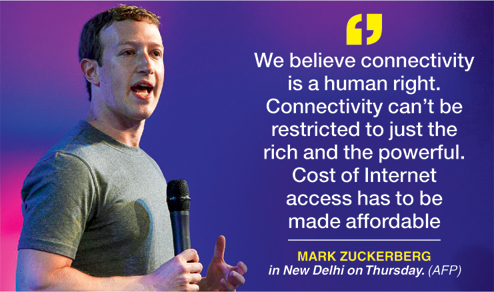
New Delhi, Oct. 9: Facebook’s co-founder and chief executive Mark Zuckerberg today said basic Internet connectivity should be considered a human right, drawing attention to the fact that almost a billion Indians are not connected to the Net.
“We believe connectivity is a human right. Connectivity can’t be restricted to just the rich and the powerful. Cost of Internet access has to be made affordable.
“About 243 million people in India are on the Net but a huge area is unconnected. India has embraced the Internet, but has a long way to go,” he said.
Counted among the youngest tech billionaires globally, Zuckerberg, who began his two-day visit to India today, said he was excited to help the Indian government in its ambitious Digital India programme.
“India is an amazing country with unlimited potential. It is a place of big ambitions and Facebook is deeply committed to the country. We see a lot of growth for us here. Tomorrow I am meeting the Prime Minister. He is committed to connecting villages online and we are excited to see how Facebook can help,” he said at the Internet.org summit here.
“One of the things I am really excited about is that the PM has this whole Digital India initiative. We can’t create connectivity around the world just by ourselves, we are trying to work with operators, governments.”
To help the Internet reach the common man, especially in large swathes of rural India where connectivity is absent, Zuckerberg advocated building Internet.org as a “911 for the Internet”.
Internet.org is a project that aims to bring connectivity to two-thirds of the global population who do not have access to the Net. The founding members of Internet.org include Facebook, Ericsson, MediaTek, Nokia, Opera, Qualcomm and Samsung.
The partners are collaborating to develop cheap smartphones, which will give Internet access to poor communities.
“In the US, you can always dial 911 (emergency telephone number) even if you don’t have a phone plan, the way you dial 100 here (in India),” he said.
“There needs to be a 911 for the Internet. We’ve been working with operators to offer free basic Internet for everyone, to break down social barriers. With this model, we’ve helped to connect 3 million people.”
He announced that Facebook was creating a $1-million fund to help develop apps for farmers, migrants and women. This will be a contest to drive new apps and services in local languages.
“Since 2007, Facebook has been working on new apps and services in local languages. About 65 per cent use Facebook in a language other than English, including 10 Indian languages,” he said.
Lack of local language content was the main reason for more than 4 billion people in the world not accessing the Internet.
To reach areas where mobile or cable infrastructure is limited, Facebook has advocated building solar-powered drone-like satellites to deliver connectivity, similar in concept to Google’s plan to use balloons to provide the Internet.
In India, access to the Internet is very limited; a majority use mobile phones for access.
A recent survey, Zuckerberg said, showed that 69 per cent of people in India said they didn’t know why the Internet would be useful for them.
However, the country is adept at assimilating technological changes. “India has really been good in the ability to make these leaps,” Zuckerberg said. “The Green Revolution helped hundreds and millions out of poverty, and the computer revolution made India one of the few countries in the world to send an orbiter mission to Mars.”
Zuckerberg joins a long list of US-based CEOs who have either visited India or met Narendra Modi in the US, which include the CEOs of Boeing, GE, Amazon and Microsoft.
With China shielding its market from competition by building home-grown social media entities such Sina Weibo, Internet companies such as Facebook and Twitter have been targeting India.