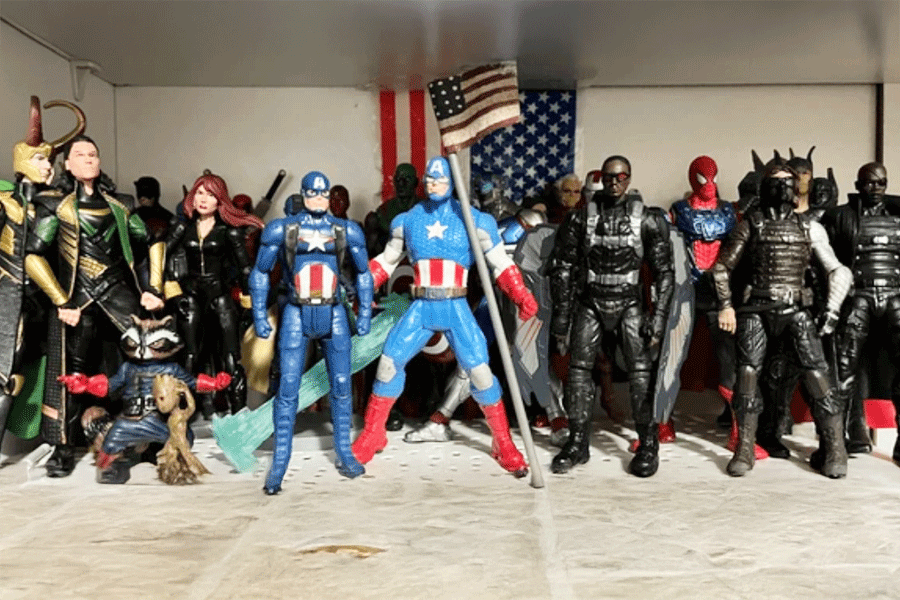
India’s fast-growing toy manufacturing sector has been jolted by steep US tariffs leaving factories idle, expansion plans frozen and millions of dollars’ worth of goods stranded in warehouses, a report has highlighted.
Near Bengaluru, Vijendra Babu’s Micro Plastics Pvt Ltd, once a symbol of India’s ambition to become a global toy hub, is reeling from Donald Trump’s tariffs, according to the Bloomberg report.
The company had invested $30 million (over Rs 200 crore) to build what was then India’s largest toy factory, offering production for global brands like Hasbro, Mattel and Spin Master.
With business nearly doubling every two years, expansion plans were already under way.
That momentum has stalled after Washington imposed 50 per cent tariffs on Indian goods in August, purportedly to penalise New Delhi for buying Russian oil.
The duties, higher than those levied on China, have forced Micro Plastics to halt shipments and pull unfinished toys off assembly lines.
Babu estimates the company is sitting on nearly $20 million worth of unsent inventory, while fresh orders worth another $15 million are on hold.
“We had plans to expand,” he told Bloomberg. “Now we will have to see how this affects all that.”
Warehouses are filled with half-finished dollhouses, toy vehicles and water pistols, packed and waiting for a tariff rollback.
A newly completed 250,000-square-foot facility next to the existing plant remains empty. Instead of the 40 percent growth Babu had projected this year, he now expects a decline and is making products at cost for some clients to keep his 2,000 workers employed.
The Bloomberg report noted that the impact of the tariffs goes beyond one company. Across India, erratic trade policy has caused overseas buyers to delay or cancel orders, raising doubts about the country’s ability to capitalise on supply chains shifting away from China.
Outside New Delhi, Sunlord factory owner Amitabh Kharbanda highlighted why parts of toy manufacturing cannot realistically move to the US.
At his plant, skilled workers spend hours handcrafting fabric Elsa dolls from Disney’s Frozen, sewing hair, clothing and facial features entirely by hand. “You couldn’t move that to America at a commercially viable price,” he told Bloomberg.
Kharbanda also pointed to decades of skill-building, noting that 70 per cent of his workforce has more than 25 years of experience. “This has to be done by hand,” he said. “It’s impossible to do it by any kind of automation.”
India’s toy industry has only recently revived after decades of protectionism and import dominance by China.
In 2020, Prime Minister Narendra Modi’s government launched a National Action Plan for Toys, raising import tariffs, tightening quality norms and encouraging domestic manufacturing.
Since then, toy and sporting goods exports have risen 42 percent to $571 million, with a target of $3 billion by 2030.
However, India’s exports to the US remain modest at about $100 million last year, compared with China’s $11 billion and Vietnam’s $3 billion.
Bloomberg reported that weak supply chains remain a major hurdle, with key components such as plush fabrics, electronics and even doll eyes still largely imported, often from China.
Political tensions with Beijing have also limited Chinese investment and technology transfer.
To cope, Indian manufacturers are increasingly collaborating. Kharbanda has partnered with rivals to build shared laser-cutting facilities and is planning joint ventures in poorer states such as Bihar to expand domestic production capacity.
Despite the uncertainty, both Kharbanda and Babu remain cautiously optimistic. If access to the US market remains constrained, they plan to focus more on India’s vast domestic demand, driven by over 350 million children.
“Plan A, tariffs are going to go away. Plan B, we need to start expanding the markets. Plan C, focus on the Indian market,” Kharbanda told Bloomberg. “We hope for the best, but we prepare for the worst.”