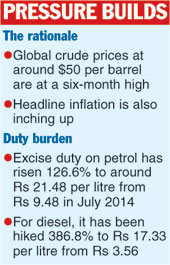

New Delhi, Aug. 9: Global crude prices are expected to slump to $40 per barrel, which will have a significant impact on the oil import bill.
According to analysts, the prices may slip because of a supply glut, weakening of growth in China and the return of Iran in the oil market after the lifting of sanctions.
The Indian basket of crude has already fallen below the psychological level of $50 per barrel. The basket represents the average price of Oman and Dubai sour grade crude and the sweet Brent crude processed in the Indian refineries in the ratio of 72:28.
Goldman Sachs, which has forecast prices to slump to $40 per barrel, in a report said the global oversupply was running at two million barrels a day against 1.8 million barrels during the first six months of the year.
"The rebalancing of supply and demand will likely prove to be far more difficult than what was previously priced into the market. The risks remain substantially skewed to the downside," it said.
The possibility of higher supply from Iran has put pressure on prices. According to the International Energy Agency, Tehran is in a poistion to ship as many as 17 million barrels.
"The potential return of up to 0.7 million barrels per day in Iranian production over the next 12 months could add downside pressure on forward oil prices of $5-10 per barrel," Bank of America Merrill Lynch said in a research report.
The fall in prices will have a significant impact on India's oil bill as it imports 80 per cent of its requirements.
"The government had budgeted for an average crude price of $70 per barrel for this financial year. If the average price of $60 per barrel in the first four months (April-July) is sustained, we are looking at Rs 65,000 crore savings in the import bill for companies, and around Rs 9,000 crore savings in the subsidy bill for the government," K. Ravichandran, senior vice-president at ratings agency ICRA, said.
A decrease of $1 in crude prices pulls down the import bill by Rs 6,500 crore and the subsidy burden by Rs 900 crore.
However, the benefit will be limited by the depreciation in the rupee value. At present, every Re 1 increase in the exchange rate of dollar raises the oil import bill by Rs 7,455 crore, according to the Petroleum Planning and Analysis Cell, an arm of the oil ministry.
India imported 189 million tonnes (mt) of crude for $112 billion in 2014-15. The lower crude rates are expected to create Rs 65,000-crore cushion for importers. State-owned refiners can pass on the benefit to consumers by reducing the retail prices of petrol and diesel.