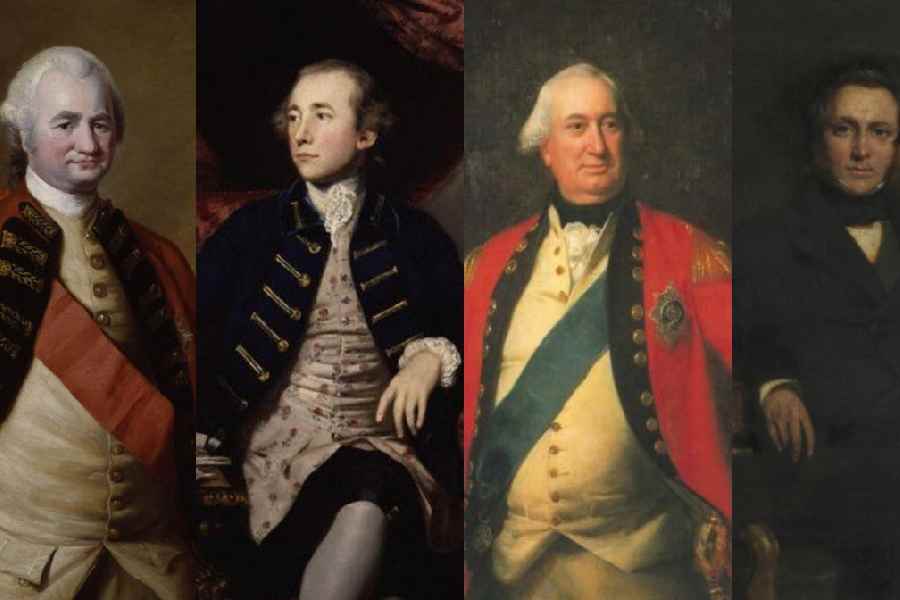
Book: GOVERNORS OF EMPIRE: THE EAST INDIA COMPANY’S CHIEF FUNCTIONARIES IN INDIA
Author: Amar Farooqui
Published by: Aleph
Price: Rs 999
This work, as the title suggests, is about British Empire’s governors who came and left a mark of some kind before leaving India. In its organisation, it follows the basic logic of older series that featured rulers and princes of India, sponsored largely by the Oxford University Press. The idea behind the series was to adopt a prosopographical approach to narrate the story and the growth of British power in India and to highlight achievements that came to stand for a particular vision of modernisation and progress. To that extent, the series was mildly propagandist — a feature that the present work eschews. It self-consciously critiques some of the implicit assumptions behind a biographical treatment of British governors in India and offers a more balanced understanding of individual trajectories of the governors in power as well as thereafter
when they had to struggle to remain relevant.
Assuming the lead in the story is Robert Clive, the governor most of us love to hate, given the sheer audacity of his ambitions and the ruthlessness of his actions. Amar Farooqi adopts a very reasoned tone in his description of Clive’s genealogy and his childhood, when he prepared for his writership that brought him to India as a clerk in the English East India Company. The descriptions of Madras in the 1740s when Clive arrived and of the outbreak of Anglo-French hostilities are evocative. Farooqi deftly tracks the stages in the development of Clive’s commercial interests, especially after he opted for a civilian position in 1749, just as he reflects on his ability to take command as soon as the Second Carnatic war resumed, exposing the English to the aggression of the French. By the early 1750s, when the French had surrendered, Clive had accumulated a substantial volume of capital — about 40,000 pounds — at his disposal when he left for England to try and make a foray into politics. This did not go well; circumstances forced him to rejoin Company service on a five-year contract as deputy governor of Madras and governor of Fort St. George. The timing of his arrival coincided with a political crisis in Bengal and the rest, as one would say, was history. Farooqi does not labour with the details of the political revolution that Clive staged in Bengal in 1757; rather, he focuses on Clive’s untiring efforts to secure peerage and political office in Britain. These were compromised by news of his misdeeds in Bengal. However, by the 1760s, the anti-Clive faction in Parliament and the East India Company was defeated. Once more, it was the Bengal factor that enabled Clive to stave off the challenges and his ability to turn around events in favour of the Company allowed him to assume a second governorship of Bengal but not the kind of political influence in England that he desired. Following a persistent affliction and depression, Clive committed suicide and was buried without ceremony. His interment in an unmarked grave stood in sharp contrast to the swashbuckling and audacious life that he had led. In many ways, Clive’s rule set the stage for both the political expansion of the East India Company as well as for the stormy relations between the Company and the British Crown in the years to come.
What is impressive about Farooqi’s treatment of individual governors is the continuous referencing of their backgrounds and family connections that informed their choices of a career with the East India Company. In the case of Warren Hastings, we come to know how the family had connections to prestigious institutions of learning and how family circumstances led Hastings to opt for a course in merchant accounting and writing. Farooqi traces the principal achievements of Hastings during his tenure in Bengal, emphasising the charges that were levelled against him for excesses, especially by his adversaries. Unlike Clive, however, Hastings was able to fight the charges, undergo trial proceedings and, at the same time, consolidate his estate to lead a comfortable life but not enough to stake a claim in British politics.
Governors who followed Hastings operated in a different context, one that was informed by both imperialist tendencies as well as by greater regulation of the affairs of the Company that was by the 1790s a territorial power rather than a mercantile body. At the same time, governors like Cornwallis, Shore and Wellesley came from more influential backgrounds and were able to leverage greater influence. The accounts of their rule remain fairly standard: we are reminded of the well-known facts associated with these men — the Permanent Settlement, the Subsidiary Alliance and the abolition of the sati — and as such do not nuance the narrative of Company rule. The last governor to be described is Lord Dalhousie, under whom the final conquest of territories happened, leading to the great Revolt of 1857.
Where the book makes a mark is in the integration of domestic politics in England with that of the affairs of the East India Company in India and the personal aspirations of individual governors. The role of family status in the making of individual careers and the aspirations for social influence through the acquisition of peerage in England make for fascinating reading and suggest the enduring distance and social disconnect between the rulers and the ruled.