

The path to the NGO offices in south Calcutta is shaded from the scorching mid-day sun and strewn with, well, not flowers but plants. It is very different from the one those three girls, whom I am about to meet, have travelled to get here.
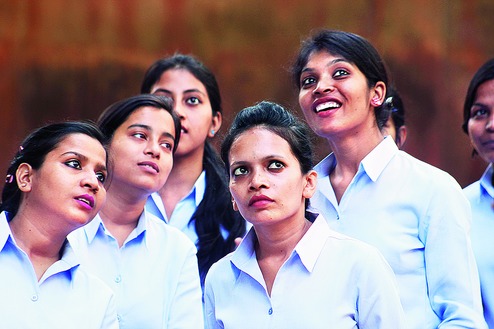
Shabnam, Asha and Sangita, along with 16 other trafficking victims are preparing to be lawyers with some help from this NGO - Sanlaap - and its Dutch counterpart, an initiative called Free A Girl International.
Shabnam, sitting front and centre, is dressed in bright yellow. Her feet are planted wide apart, the posture of a fighter. Last year, she landed a job to train girl students under the Kolkata Police's Sukanya scheme. She gave it up this March to pursue her newest passion - law.
Fifteen years ago, Shabnam was rescued from a kotha in Sonagachi along with two other girls. She was nine. She was under the impression that the kotha owner was her grandmother. It turned out she had bought Shabnam from her parents.
The police lodged a case of trafficking against six people. The case is still in court. In the meantime, the "grandmother" who is the prime accused has died. But Shabnam awaits justice and says she will fight her own case if necessary. That is why she wants to study law and become a public prosecutor.
Tapati Bhowmick has been working with trafficked children ever since Sanlaap was founded in the 1990s. She is currently involved with setting up the School of Justice, a joint initiative of the two NGOS, meant to help trafficked girls wanting or willing to become lawyers.
Why law? Bhowmick seems to believe that only when the "victims" cross over to the other side, the legal side, will the number of convictions increase.
This afternoon, Bhowmick is resplendent in a white south cotton with a golden blouse. She walks in, looks at Asha and asks, "All right?" It seems Asha is the in-house stylist. She was sold in Mumbai's oldest red light area - Kamathipura -when she was 11. A group of Bengali sex workers took her under their wings. That is how the girl from Nagpur speaks such idiomatic Bengali with a completely non-Bengali lilt. " Pankeo padma phote (The lotus also blooms in mud)," she says of the Mumbai sex workers.
Asha, in fact, became so attached to them that when she was rescued she pretended to be Bengali. That is how she ended up in Calcutta. She has lost touch with most of those " padmas", but she has found other people to love.
And, of course, she misses her brother, the elder one who used to shield her from their stepmother's wrath. One day, they decided to run away, but the railway station was too crowded and Asha's hand slipped out of his grasp. She never saw him again. A "helpful" woman promised to take her to her aunt's house - and sold her instead. It turns out most of these girls were trafficked by women whom they approached for help.
"I want to go back to Nagpur once I become a lawyer," says Asha wistfully. "I want to see my brother again... he doesn't have to accept me but I'm sure he will be proud of me."
None of these girls has any illusions about how their families will react to them. Bhowmick talks about a trafficked girl whose mother promised to take her back. The girl waited from 8am to 8pm but nobody came. Another girl who was rescued from Mumbai used to send money home. One day she got a phone call at the shelter. She rushed, all excited, but came out sobbing. Her parents could take her money but they could never take her back because she was considered unclean, impure. "The money isn't dirty?" asks Sangita once she has narrated the story.
Sangita has very clear ideas about everything - what the government should do to stop trafficking (use parent-teacher meetings to spread awareness), where she sees herself 10 years from now (in a lawyer's gown). Ever since she was enrolled in a school - she was rescued at 13 and lived in a shelter at Jhargram in West Bengal - she has enjoyed studies immensely.
She has a BA in Political Science and is now solving model question papers for law entrance tests. She says she likes the School of Justice in south Calcutta's Behala because here she is allowed to sleep. It is a luxury she has never had, not at the shelter homes, not at that place in Park Circus where she worked as a domestic help, not even at home with her mother who would wake her up early to go to school.
Back then she hated school. And now all she dreams of is becoming this " dapute" or influential lawyer. The kind that makes criminals tremble in their boots. "I want people to be worried when they hear I'm the prosecuting lawyer," she says quietly.
It's the quiet ones you should watch out for.