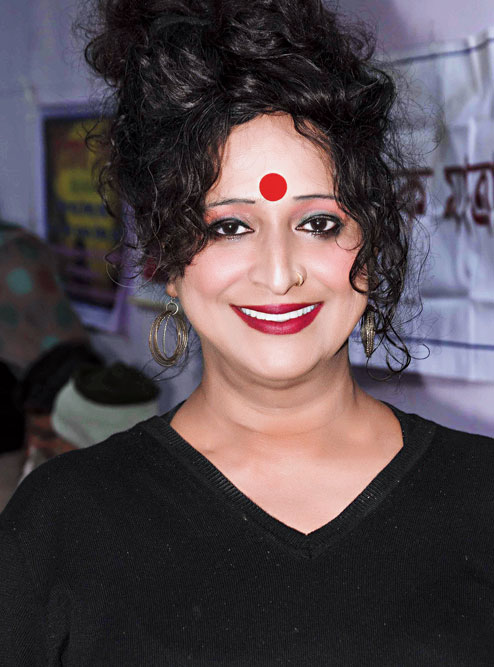

In the 25 years that she has spent in classrooms teaching thousands - five years in a school and then the next 20 in a college - she has never looked at her students in the eye.
"The glance of a eunuch is supposed to be evil and brings bad luck. I could never bring myself to look anybody in the eye lest they make obscene gestures!" says Manabi Banerjee.
Banerjee admits that her achievement - she is set to take over charge of a college in Bengal as the first transgender principal in the country and probably, in the world too - has been dwarfed by the constant compromises she has had to make in her routine work.
"My achievement hasn't earned me respect from my colleagues yet. The days of humiliation are not over. It's just a small step. Dignity for the third gender is still elusive in Third World countries," she says, arranging her dupatta over her bosom.
As I settle down on the cool marble floor of her 600 sqft empty flat in Santoshpur on a sultry afternoon, I observe how beautiful she looks with her chiselled nose, thin lips and slender fingers. Wearing a yellow kurta over a pair of yellow track pants coupled with a red dupatta, and a big red bindi, she looks the colourful personality that she is. Her flat seems to be an extension of herself with five different colours in shades of red, yellow, blue and orange adorning the walls and ceiling of the living room.
But life hasn't been so colourful for this feisty woman. "Even 12 years after I underwent vaginoplasty, people question my femininity," rues Banerjee. Snide remarks, teasing, harassment and physical abuse were an integral part of Banerjee's life till recently. The groves of academia proved to be no more sympathetic, with even colleagues allegedly attacking and heckling her. Banerjee has been associate professor of Bengali at Vivekananda Satavarshiki Mahavidyalaya in Jhargram for the past 20 years.
"At one point I wasn't even allowed to use the college toilet and this continued for over a month, affecting my health," says Banerjee, her eyes turning moist.
Significantly, none of her colleagues sent her a single congratulatory message after it was announced that she would become the principal of Krishnagar Women's College.
Banerjee's childhood too had its share of trauma. She was abused by a cousin at the age of four. Then known as Somnath, she used to wrap her private parts tightly in clothes for fear of being abused.
But those abuses had nothing to do with Banerjee's sexual orientation. "There is a misconception that childhood abuse twists a person's sexual orientation. That's not correct. I used to feel like a woman anyway," she reiterates.
Hailing from a conservative family in a remote village of Naihati in North 24-Parganas district, she was the youngest with two sisters. The two things that saw her through her difficult early years were mother and her passion for education. "I was a bright student and I think that helped me come out with dignity. Otherwise I would have to go around begging like many transgenders are forced to," she says.
After she did her postgraduate and MPhil degrees from Jadavpur University, her examiner Nabanita Dev Sen encouraged Banerjee to do a PhD on transgenders. "None could imagine such a work can be done on them. It was a big challenge," says the author of several books on the third gender.
As she moves seamlessly between the past and the present, she reminisces how, despite becoming a complete woman, her womanhood was questioned again and again, both on professional and personal fronts. The deepest blow to her came from none other than her husband of two years, who went to court claiming that she falsely claimed to be his wife when she was not a woman at all. "I have filed a case against him. The matter is sub judice. I have no faith in men now," she says with disgust.
So is she frightened of falling in love again? "I often dream of a family, but in reality I shudder. Sometimes, I feel I should give it another try later, for my son," she says.
Banerjee informally adopted Debashis, a 23-year-old youth from a poor family in Midnapore, shortly after her mother died in 2011. "He has filled a big void in my life. I have someone to talk to. He calls me Ma, the sweetest word in the universe," she says, her eyes glistening with pride.
What does she plan to do after taking charge as the principal on June 9? "I want be make the service training centre of our college active, so that girls become employable. Also, I will try to address the problem of students bunking classes. As a principal, my sole task is to ensure quality education in a college, even if it is in a remote district," says Banerjee.
Her grit is also reflected in her resolve to do something for the transgender community. She is grieved when accused that she doesn't support the causes of transgenders. "I have been recognised as a woman after my surgeries. Still, to make things easier for my community I opted to tick on the third gender box of the form before the final interview for the post of the principal. Isn't that a bigger protest," she asks.
Besides taking phone calls from any transgender in distress, Banerjee publishes Abamanab, the only Bengali magazine for the third gender. She recently formed a theatre group comprising 10-11 transgenders and staged two shows of the play Dehantar Manantar, in collaboration with theatre director Debesh Chatterjee.
With so many crusades won, is there anything else she wants to achieve? "I want society to treat us as equals. My identity doesn't lie between my legs. All I want is to look you in the eye without fear of being insulted," she says.
As principal of a college, Manabi Banerjee may have come a lot closer to doing just that.